
PUBLISHED: August 11, 2026

New Research: Loss of 111,000 International Students Could Cost U.S. Economy $3.4 Billion and Nearly 40,000 Jobs
Overview
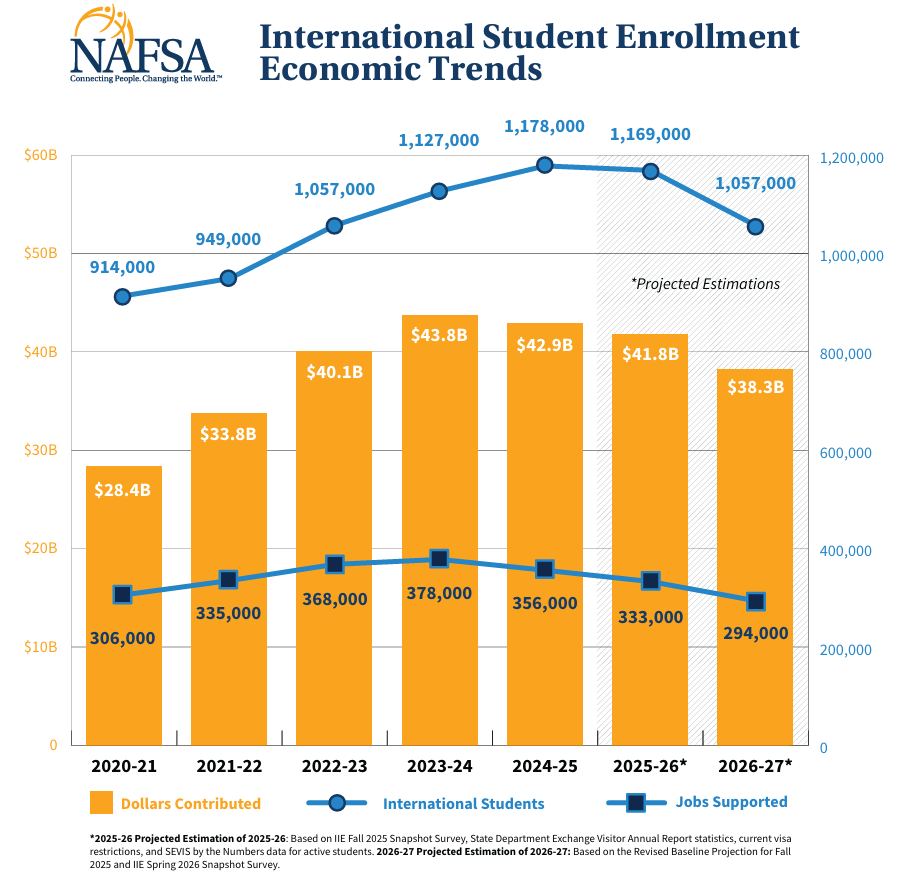
Preliminary analysis by NAFSA: Association of International Educators and JB International indicates a projected decline in international student enrollment for Fall 2026, with cascading effects on U.S. economic contribution and jobs supported. This downturn reflects the convergence of several headwinds: declining application volumes, persistent visa appointment bottlenecks, and newly restrictive immigration policy changes. Our analysis, based on U.S. institution of higher education responses to Institute of International Education’s (IIE) Spring 2026 Snapshot on International Educational Exchange, estimates as many as 111,000 fewer international students at U.S. colleges and universities will result in up to $3.4 billion in lost revenue and nearly 40,000 fewer jobs.
Estimated Losses by State, 2026-27
| State | Losses in US Dollars | State | Losses in US Dollars | State | Losses in US Dollars |
|---|---|---|---|---|---|
| Alabama | $27.1 million | Kentucky | $23.6 million | North Dakota | $4.5 million |
| Alaska | $798,478 | Louisiana | $23.6 million | Ohio | $102.3 million |
| Arizona | $80.8 million | Maine | $7.0 million | Oklahoma | $18.0 million |
| Arkansas | $12.3 million | Maryland | $83.6 million | Oregon | $21.1 million |
| California | $499.6 million | Massachusetts | $284.0 million | Pennsylvania | $164.2 million |
| Colorado | $32.8 million | Michigan | $284.0 million | Rhode Island | $21.8 million |
| Connecticut | $59.7 million | Minnesota | $41.4 million | South Carolina | $16.6 million |
| Delaware | $8.7 million | Mississippi | $7.4 million | South Dakota | $5.4 million |
| District of Columbia | $42.5 million | Missouri | $81.5 million | Tennessee | $30.7 million |
| Florida | $118.9 million | Montana | $2.5 million | Texas | $199.1 million |
| Georgia | $84.2 million | Nebraska | $9.7 million | Utah | $25.3 million |
| Hawaii | $9.9 million | Nevada | $5.4 million | Vermont | $4.6 million |
| Idaho | $6.8 million | New Hampshire | $12.8 million | Virginia | $71.4 million |
| Illinois | $191.6 million | New Jersey | $75.9 million | Washington | $75.9 million |
| Indiana | $79.7 million | New Mexico | $6.8 million | West Virginia | $6.5 million |
| Iowa | $21.3 million | New York | $470.3 million | Wisconsin | $45.7 million |
| Kansas | $18.4 million | North Carolina | $70.8 million | Wyoming | $2.0 million |
| Total Loss | $3.4 billion |
Mid- and Upper-Range Projections
| Scenario | International Students | Dollars Contributed | Jobs supported |
|---|---|---|---|
| Fall 2024-25 Actuals | 1,177,766 | $42.90 Billion | 355,736 |
| Fall 2025-26 Projection | 1,168,602 | $41.77 Billion | 332,939 |
| Fall 2026-27 Mid-Projection | 1,104,912 | $39.62 Billion | 303,514 |
| Fall 2026-27 Upper-Projection | 1,056,884 | $38.37 Billion | 293,743 |
Economic Impacts at a Glance
- The U.S. economy stands to lose up to $3.4 billion in direct economic contributions from international students in Fall 2026.
- Up to 40,000 U.S. jobs are at risk - a roughly 9 percent reduction from the Fall 2025 baseline.
- Graduate-level enrollment declines are the primary driver of economic losses, particularly among institutions with the largest international student populations.
- Inflation was factored into the analysis, which increases dollar figures but also requires more economic output per job supported. These projections reflect direct economic contributions from enrolled students (does not include students on Optional Practical Training).
What's Driving the Decline?
International Student Application and Enrollment Numbers Declined
Early indicators confirm reduced demand across multiple channels:
- According to recent data collected by the Association of American Universities Data Exchange, international applications to U.S. doctoral programs for this fall declined by 21 percent, fueling a 17 percent drop in international admissions, and contributing to a 15 percent drop in overall doctoral program admissions due to federal research funding uncertainty;
- According to the Common App, international submissions fell 9 percent for the 2026-27 cycle, with submissions from India down 14 percent, Ghana down 34 percent, and Nigeria down 17 percent (note: Nigeria is covered by the current Travel Ban);
- Nearly two-thirds of institutions responding to IIE’s Spring 2026 Snapshot survey expect further declines in 2026–27, with some projecting graduate enrollment drops as high as 40 percent.
These application and enrollment trends align with JBI's projection ranges and suggest actual Fall 2026 outcomes may approach or exceed this analysis.
Travel Ban, Visa Appointment and Processing Bottlenecks
Expanded visa ban, and visa appointment wait times and processing continue to prevent admitted students from arriving on time:
- Visa Bans: A December 16, 2025, executive order established restrictions targeting 39 countries with no exceptions for F student or J exchange visitor applicants. Countries covered by the ban include Iran and Nigeria, which send large numbers of students to study in the United States.
- FIFA World Cup 2026: The State Department publicly announced priority visa processing for FIFA World Cup ticket holders traveling to the United States. The final game occurred on July 19, well into the traditional “peak” season (May through August) for student and exchange visitor visas. Historically, the Department has prioritized student and scholar visa applications during this peak season, helping ensure timely campus arrivals.
- Limited Appointment Availability: There are reports of limited or delayed appointments for international students at consulates in India, China, and across Europe, with many requests for expedited appointments denied. India and China are the top two international student sending countries to the United States.
Duration of Status (D/S) Rule, Possible Changes to OPT Creates Further Uncertainty
In August 2025, the Department of Homeland Security (DHS) proposed eliminating the longstanding "duration of status" framework for F students and J exchange visitors. On July 17, 2026, DHS published the final rule that replaces D/S with a fixed Admit-Until-Date (AUD), creating significant planning uncertainty for prospective students, particularly those considering longer-degree programs or uncertain career trajectories. [NOTE: A court ruling has since blocked the implementation of this rule while the lawsuit filed by NAFSA and others proceeds]. This compounds the uncertainty caused by the current administration’s continued warnings that it intends to reform the Optional Practical Training program, which is an essential tool to meeting the U.S. labor shortage in key fields, especially STEM.
Policy Solutions
To address this decline, NAFSA urges the administration to:
- prioritize visa interview availability and processing for all F and M students and J exchange visitors;
- exempt F and M students as well as J exchange visitors from the current travel ban affecting nationals from 39 countries while maintaining background checks and vetting required for visa issuance; and
- preserve Optional Practical Training for all F-1 students.
Congress also should pass legislation to restore the D/S policy, the Keep STEM Talent Act, the Keep Innovators in America Act, and provisions that extend dual intent and create a path to green card for F-1 students included in the Dignity Act.
Media Inquiries
Members of the media are encouraged to contact NAFSA's media relations team with additional questions or to request an interview.