
2009 Spotlight Berklee College of Music
Berklee College of Music is teeming with aspiring rock, jazz, R&B, and hip-hop musicians as well as songwriters, sound engineers, and others determined to make careers in contemporary music. They come not only from across the country, but around the world: almost a quarter of Berklee’s 4,000 students are international. Berklee sends faculty out to hold auditions on six continents. Working in pairs, they hit 45 cities in 21 countries on Berklee’s “World Scholarship Tour.”
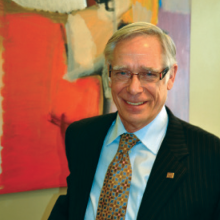
Why go to such lengths? “We think there is great talent out in the world and it’s our job to find them, not wait for them to find us,” said Berklee President Roger Brown. And when they bring their musical traditions and materials into Berklee’s classrooms, all benefit. “If I’m in class with a young man from Ghana and someone from Indonesia and someone from Finland, I’m learning a lot more than if I were just with people who had the same background that I had,” said Brown.
In just the past two years Michael Shaver, assistant director of admissions, has been to “every continent except for Antarctica. I’ve been to Australia, Malaysia, Japan, Italy, Thailand, Finland, Ghana, South Africa, France, Brazil, Ecuador, and Canada.” Berklee conducted 1,250 live auditions overseas in 2008–09. Half the 6,400 auditions were held in Boston, and the rest in locations across the United States.
Alto saxophonist Jim Ogdren, academic assistant to the dean of the performing division, gave clinics and conducted auditions in Panama City during the Panama Jazz Festival, the brainchild of Panamanian jazz pianist and Berklee alumnus Danilo Perez. “We try to get them to play the style and music they know best,” said Ogdren. “They often try to play what they think (we) want to hear and stop being themselves. They think we want to hear jazz. We’ll see a great shredder guitarist or a drummer come in and they’re trying to play swing.”
A Strong Draw From Asia
Almost half of Berklee’s 1,000 international students come from Japan, South Korea, and other countries in Asia. Sung Ho Cho, 29, from Seoul already holds a bachelor’s degree in physics but is retooling himself as a jazz guitarist. How did he hear about Berklee?
“Actually in Korea, Berklee is famous among the music students,” he said. “When they think about going abroad and studying, the first choice is Berklee. Lots of students want to come here.” His idols include Pat Metheny and Berklee’s own Mick Goodrick, a faculty member the students admiringly call Mr. Goodchord.
Classmate Seung Hun Lee, 28, also from Seoul, earned a classical music degree back home, playing saxophone in a symphony orchestra. Now he hopes to chart a new path as an alto saxophonist. “I never played jazz before. I really wanted to learn,” said Lee, whose favorite player, Walter Beasley, graduated from Berklee.

Berklee was founded as a jazz school called Schillinger House of Music in 1945. Founder Lawrence Berk later combined his name and his son’s first name to come up with Berklee. It has had an international cast for decades. The first international student was Toshiko Akiyoshi, who arrived from Tokyo in 1956 after Berk sent her a plane ticket and offered a full scholarship. “She went on to become one of Japan’s most preeminent big band leaders and really helped create the tradition of jazz in Japan,” said Brown. “The school has a long and great tradition of finding talent all over the world and giving those young people opportunities they wouldn’t have had otherwise.”
Arif Mardin, the legendary music producer from Turkey who produced hits for Aretha Franklin, the Bee Gees, and Norah Jones, attended Berklee on a scholarship paid for by Quincy Jones, who spent a year at Berklee before heading off to make his name in the music world. Canadian jazz great Diana Krall won a scholarship at the Vancouver International Jazz Festival that paid her way to Berklee.
Teaching Master Classes Around the World
The institution’s own international musical journey began in earnest in 1985 when faculty members traveled to Japan to give clinics. Now faculty musicians regularly head out to perform and give master classes at 14 schools in the Berklee International Network in Nancy, France; São Paulo, Brazil; Barcelona, Spain; Quito, Ecuador; Kuala Lumpur, Malaysia; Freiburg, Germany; Tokyo and Kobe, Japan; Helsinki, Finland; Dublin, Ireland; Athens, Greece; Ramat HaSharon, Israel; and Seoul, South Korea. The college also mounts jazz festivals in Perugia, Italy, and San Juan, Puerto Rico.
Berklee’s tuition and fees top $15,000 per semester. Four of the nine full-ride scholarships the college offers are reserved for international students, including ones reserved for African and Canadian musicians. In 2008 Berklee launched an Africa Scholars Program with auditions in Accra, Ghana, and Durban, South Africa, where it offered $1.4 million in scholarships to 25 musicians. Brown, the president, once taught school in Kenya before getting an M.B.A. and founding a successful child-care company, Bright Horizons.
“The school has a long and great tradition of finding talent all over the world and giving those young people opportunities they wouldn’t have had otherwise.”
“Obviously, we could give a thousand of those scholarships to gifted African musicians, so it will not make a dent in allowing the talent of Africa to come to Berklee. But it will certainly deepen our connection to the continent,” the president said. “We also find that a lot of students who come to the auditions and get to know the college find a way here through other scholarships they are able to get.”
An ‘Outlier’ Among Music Schools and Conservatories
Jay Kennedy, associate vice president for academic affairs, said that among U.S. music schools and conservatories, “Berklee is essentially an outlier. There are aspects (of the curriculum) that are similar in other schools, but not in the concentration that we have them…. We are the most progressive in terms of how we align with what the music business and industry is doing today.”
A decade ago, many international students would come for just two to four semesters, said Jason Camelio, director of international education operations. Now “more are wanting to stay and complete that degree because they see value to it.” Berklee offers diplomas and certificates as well as bachelor degrees.
Berklee will raise its international profile even higher in 2011 when it opens a satellite campus in Valencia, Spain. Berklee Valencia will be a joint venture with Spain’s Sociedad General de Autores y Editores (SGAE) in a new arts complex called ARTeria Valencia. The Spanish campus will accommodate 1,000 students, including 200 that Berklee hopes to send from Boston each year, said Sharon Glennon, former director of international programs and now planning director for the Valencia branch. And that means Berklee students will be getting even broader exposure to the wide world of music.