Luther College
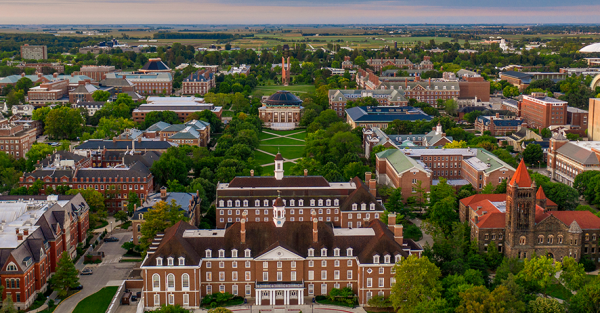
Founded in 1861 by Norwegian immigrants, Luther College is a private liberal arts institution in Decorah, Iowa, enrolling approximately 1,400 undergraduate students. International students from more than 70 countries make up roughly 15 percent of the student body. More than two-thirds of Luther students participate in off-campus study before graduation, and in any given January, the college’s Center for Global Learning sends approximately 300 students abroad through 15-20 faculty-led programs.
Religion Professor Guy Nave was supposed to spend January of his first year at Luther College finishing a book. But when a colleague needed to step away from a study abroad course, Nave was asked to cover it. Since then, Nave has taught abroad during 18 of the 25 years he’s been at Luther.
That global orientation is rooted in the college’s founding. Its ties to Norway remain active—the college houses the nation’s first fully endowed Nordic Studies Center, and the Crown Prince of Norway visited campus in 2025. Decorah is also home to Vesterheim, the largest Norwegian-American museum in the United States. For President Brad Chamberlain, the heritage and the global mission are connected. “We come to this little corner of Northeast Iowa to experience the world,” he says. “We’re a gateway.”
Nave’s journey is not unusual at Luther. Faculty across disciplines—from religion to chemistry to the arts— lead programs in other countries each year, and the college funds scouting trips to build new ones. Luther’s global engagement is embedded into the institution. The recently revised curriculum requires all students to complete three global engagement courses, allowing long-term partnerships with countries such as England; Germany; Roatan, Honduras; Malta; Nepal; Norway; and Tanzania to grow over generations of classes.
A Culture Built on Global Engagement
Luther’s mission calls on students to “courageously serve the common good,” language that President Brad Chamberlain says has always carried a global dimension. “In our vision statement, we talk about Luther being a catalyst for the creation of a more just and sustainable world,” he says. “Our focus as a community has always been on others—how do we use our education to the benefit of communities and society writ large?”
That ethos shapes everything from how courses are designed to how faculty spend their January terms. Nave, who has led capstone courses in Costa Rica, Ghana, South Africa, and the United Kingdom, says teaching abroad has reshaped his approach to his courses, considering their content and impact on an international level. “My travel experience has made me acutely aware of thinking more globally,” he says.
“That has impacted my resources, my syllabi, my reading assignments—exposing students to perspectives outside of the United States.”
Victoria Christman, a historian who has been at Luther for 21 years and now directs the Center for Global Learning, says the college has long been conscious of what it means to send students into communities abroad. Luther refers to all its study abroad programs, as well as programs held elsewhere in the United States, under the umbrella of “study away.”
“We’re really trying to foster a kind of community engagement model of study away,” she says. “It’s not just us being us in a different place—we’re trying to learn from the communities that host us, and find ways to benefit them.” This philosophy is built into Luther’s long-term semester programs in England, Germany, and Malta— partnerships spanning 35 to 55 years— where students enroll in local universities, live with host families, and are embedded in community life.
“Our focus as a community has always been on others—how do we use our education to the benefit of communities and society writ large?”
—President Brad Chamberlain
Global Learning for All
Each January, 15 to 20 faculty-led programs take place in a wide range of disciplines in locations around the world. During this time, all faculty with long-term contracts are encouraged to develop programs, and the college funds scouting trips to all new locations. Programs operate at cost; students pay direct expenses but no additional tuition, and any surplus is returned to participants.
The culture is self-reinforcing. Jermaine Dizon, a 2026 graduate who majored in global health, chose Luther specifically for its study abroad opportunities and spent January terms in Nepal and Tanzania. His Nepal program, centered on the social determinants of public health, introduced him to a Luther alumnus now running the largest private public health institution in the country—an encounter that shaped his decision to pursue a master’s in public health and, after graduation, take courses with the World Health Organization in Switzerland.
Peacebuilding is a particular focal point in Luther’s global programs. Through its partnership with the Davis Foundation, students have competed for Projects for Peace grants, which are $10,000 awards for student-led peacebuilding initiatives. Luther students have completed 36 projects to date in a range of countries, including Bangladesh, Democratic Republic of the Congo, Nigeria, and Timor-Leste. Two students are also selected each year as Peace Scholars, participating in a seven-week summer program in Oslo focused on peace, justice, and human rights.
To support student access to programs abroad, Luther provides approximately $250,000 annually in need-based scholarship support, drawn from 37 endowed funds available to both domestic and international students.
A recently implemented core curriculum that was spearheaded by faculty also formalizes global learning as a foundational requirement. All students must complete three global engagement courses—at least one taught in a language other than English—as well as a course in social and environmental justice. The global engagement category is the largest in the general education curriculum and spans all disciplines across the entire college. “Even in chemistry you can have a global experience,” Chamberlain notes.
The curriculum also includes a capstone course, “Paideia 450,” that is required of all Luther students and is taught both on campus and abroad. A key component of the course is ethical reflection. “Part of that course is actually engaging and serving the place that you’re experiencing,” Chamberlain says. Recent “Paideia 450” education abroad offerings have included courses on national identity and memory in Greece and Turkey, pastoralism and conservation in Tanzania, and peacebuilding in Northern Ireland.
Welcoming International Students
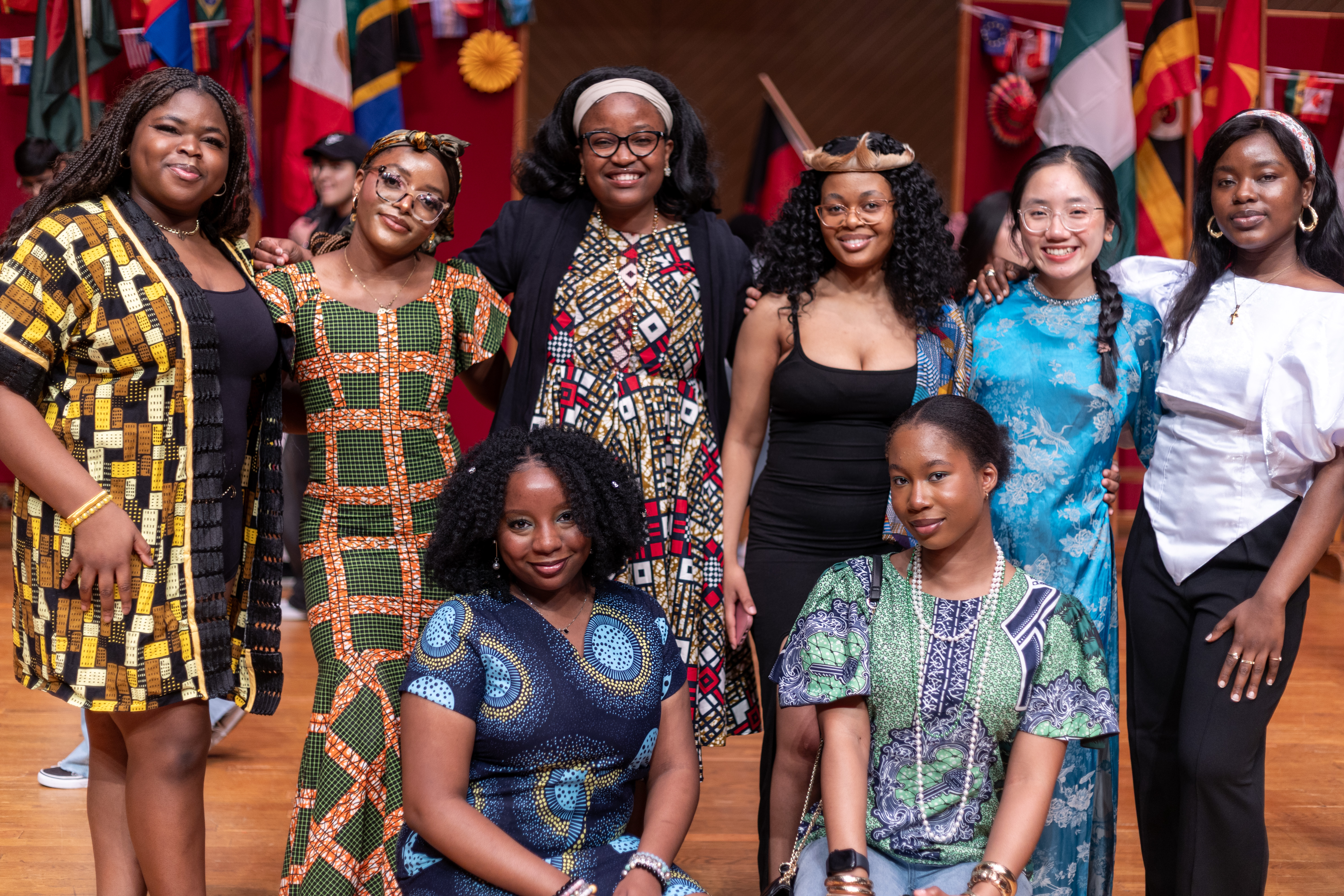
International students from more than 70 countries make up approximately 15 percent of the student body—a significant presence in a town of 8,000. Since 2020, international enrollment has grown by 17 percent. Luther’s admissions office maintains three dedicated international positions and recruits globally. Roughly half of Luther’s international students arrive through the Davis United World Colleges (UWC) Scholars program, a partnership Luther joined in the early 2000s. The program supports students who have graduated from one of 18 UWC schools around the world with scholarship funding to study at partner institutions in the United States. Luther currently enrolls 59 Davis Scholars from 36 countries.
Sabina Doycharoen, a graduating senior from Thailand who came to Luther after attending UWC Thailand, received a full scholarship through the Davis program. She also used Davis funding to spend a semester abroad in Malta, studying Mediterranean history and enrolling in courses at the University of Malta. For Doycharoen, it was another chapter in an education that had already taken her from Thailand to Iowa—and now to the Mediterranean.
Korpo Selay, also a graduating senior—a biology and global health double major from Liberia who attended UWC in the Netherlands—describes the support she received as central to her transition to the United States. “There’s a difference between a school saying we accept international students and making the extra effort to make sure that you are there,” she says.
Stacy Soderstrom, director of international and transfer admissions, says that commitment to international students is financial, programmatic, and relational. “An ethos of Luther is having students here [who bring] that global perspective into the residence halls, into classrooms, into student clubs—while also ensuring that students can go out and seek it,” she says.
What's Next
Looking ahead, the college is focused on expanding exchange opportunities with longtime partners like Norway and continuing to integrate domestic and international students on campus, while also reviewing its systems to better support international students. As Luther navigates the uncertainty facing higher education, it has embedded endowment support for its signature international programs into the first phase of its current capital campaign. For Chamberlain, the investment reflects something deeper than financial planning. “Welcoming is being friendly,” he says. “Belonging says we’re happy to have you here, and we’re willing to let you change us. We’ve long had this identity—and let’s not take it for granted.”
Lessons Learned
Build Community Before Students Arrive on Campus
Rather than bringing newly arrived international students directly to Decorah, Luther buses them to Minneapolis, where local alumni and friends of the college host them for a weekend—feeding them, taking them shopping, and easing the transition to American daily life before campus life begins. “We’re intentionally, from the very beginning, trying to build out their community on arrival,” says Stacy Soderstrom, director of international and transfer admissions.
Take Campus Cultural Programming into the Community
Luther’s Center for Intercultural Engagement and Student Success partners with The Landing, a community food hall owned by a Luther alumnus within walking distance of campus, to host six themed community meals per year. The events are organized around cultural celebrations like Lunar New Year and co-led by student organizations and the admissions office. Hosting events off campus draws in Decorah residents alongside students, faculty, and staff. “It’s an intentional partnership off campus,” says Soderstrom.
Make Global Learning Part of Staff Recognition
Luther’s annual Staff Excellence Award gives two staff members—one exempt, one nonexempt—the option to accompany a January-term program abroad in lieu of a $4,000 cash award. Most choose to travel. Recent recipients have included the director of financial aid, an academic administrative assistant, and a custodial staff lead. “It enriches their experience,” says President Brad Chamberlain, “which enriches the student experience.”
More 2026 Comprehensive Award Winners
Lone Star College System
Saint Louis University
Washington University in St. Louis