University Of Illinois Urbana-Champaign
The University of Illinois Urbana-Champaign is a public, land-grant research university enrolling more than 60,000 students, including more than 13,000 international students and scholars from over 120 countries—one of the largest international populations at any U.S. public university. That long-standing commitment to global engagement stretches back decades and today finds its fullest expression in strategic frameworks that positions internationalization as central to teaching, research, and service across all disciplines.
Every August, staff at the University of Illinois Urbana-Champaign set up shop at terminal five of O’Hare International Airport, right outside baggage claim, and wait. For five days, they greet thousands of incoming international students fresh off flights from Beijing, Mumbai, Seoul, and beyond, guiding them onto chartered buses bound for Champaign. Volunteers from many university departments are stationed at drop-off points around campus—sometimes until 1:00 a.m.—to walk students to their residence halls. “From the moment you get out of baggage claim . . . you can have somebody from the University of Illinois with you until the moment you get to your dorm room,” says Martin McFarlane, assistant provost for international student and scholar services (ISSS).
The commitment to welcoming international students, among other aspects of internationalization, has deep roots. When Earl Kellogg came to the University of Illinois in the mid-1990s to become its first associate provost for international affairs, he found a major research university with no coordinating center for its global activity, just scattered programs across a sprawling campus. What followed was decades of deliberate institution-building: international faculty lines seeded across every college, new study abroad programs targeting underrepresented students, and the International Achievement Awards, an annual banquet that continues to recognize Illinois’s international alumni, including presidents of nations, heads of central banks, and Nobel Prize winners. The university received its first Senator Paul Simon Award for Comprehensive Internationalization in 2008, and its IGlobal program was recognized with a Paul Simon Spotlight Award in 2025.
Today, that institutional foundation underpins a broader global engagement strategy with several key players. Illinois International, the university’s central hub for global engagement, coordinates international student and scholar services, study abroad, global relations, safety and security, and global communications across a campus of more than 60,000 students. The Illinois Global Institute (IGI), which coordinates 11 centers of area and global studies, offers 21 degree and certificate programs, 13 minors, and instruction in 31 languages, including less commonly taught languages.
Most colleges also maintain their own international offices focused on either study abroad, college-based international engagement and research, or a combination of both areas. Illinois International also provides embedded services for those colleges or units too small to operate certain aspects independently but have a deep desire for greater global engagement. Illinois International sought to capture that desire through a coordinated global strategy known as Vision 2030, which articulated and reflected what has been true at Illinois throughout its history: Global engagement is central to the university’s academic mission.
“From the moment you get out of baggage claim . . . you can have somebody from the University of Illinois with you until the moment you get to your dorm room.”
— Martin McFarlane, assistant provost for international student and scholar services
A Framework for Global Engagement
The global strategy “transformed the way we operate, the way we were engaging globally,” says Luis Canales, associate provost for Illinois International. Launched in late 2022, Illinois International’s Vision 2030 Global Strategy organized internationalization around five priorities: education for global citizenship, engagement for impact in the Global South, leadership for innovative partnership and development, education for inclusive excellence, and global excellence for the state of Illinois. Governance is anchored at the provost level, with Illinois International serving as the coordinating hub—shifting global engagement from personally-driven activity to institutionally structured work.
Central to Vision 2030 was a competitive grants program through which the Office of the Provost invested $500,000 over three years to advance faculty-, staff-, and student-led proposals. Colleges receiving grants were required to co-invest at a rate of 20 to 30 percent, ensuring that participating units have genuine buy-in. Priority was given to proposals that span multiple colleges and engage with Global South partners—a design intended to draw faculty whose disciplines had not previously been framed as global into international work. The grants program also funded the Staff Global Exchange Program, which provides international experiences to administrative staff across the university, with priority given to those with limited international experience whose roles are not typically framed as global.
Two funded courses illustrate the model. “Chemistry, Coffee, and Community,” developed through collaboration among the colleges of Liberal Arts and Sciences, Agriculture, and Medicine as well as Student Affairs and La Casa Cultural Latina, is an eight-week credit-bearing course developed with Panamanian coffee producers that examines the social, economic, and environmental dimensions of coffee production. “Place Making and Rural Tourism in China” brought together faculty across architecture; art and design; and recreation, sport, and tourism. In a sustained collaboration with residents of China's Xihu village in Jiangxi province, they co-developed architectural plans, tourism strategies, and place-making activities. Both courses have since been integrated into departmental curricula as permanent offerings.
Vision 2030 grants have supported initiatives involving seven colleges, one research institute, and three administrative units. The grants program was designed in part to address a common pitfall in international partnership development—programs that extract value from local communities abroad without providing any lasting benefit.
Supporting International Students and Scholars
The welcoming crew greeting international student and scholars at O’Hare is just the beginning of the support they receive at the university. Illinois built the infrastructure to support international students well before orientation day and throughout their time at Illinois. “Illinois has a long-standing history and . . . commitment to being a campus that welcomes international students and provides structures of support for them to thrive during their time here,” says Colleen Murphy, vice provost for global engagement.
The pre-arrival orientation program, developed in collaboration with offices across campus, provides incoming international students and their families with practical guidance on immigration, academics, housing, health insurance, and life in Champaign-Urbana— delivered both online and through in-country sessions in China, India, South Korea, Taiwan, and Turkey. In 2025, more than 2,000 incoming students participated across 96 countries. On campus, staff promote global learning opportunities such as study abroad and intercultural programming at the university-wide New Student Registration, connecting incoming domestic and international students alike with global engagement opportunities before their studies begin.
Once on campus, Illinois International’s global and intercultural staff provides year-round programming organized around three themes—sharing intercultural experiences, strengthening social and cultural well-being, and the new international student experience—designed to build sustained relationships between international and domestic students. In 2024–25, for example, 64 programs, three overnight trips, and two day-long trips engaged more than 3,000 students and scholars.
Support extends well beyond programming. When Joanna Adewunmi, a doctoral student in information science from Nigeria, received her teaching assistant appointment letter, it included a list of campus resources specifically for parent-students—among them the Child Care Resource Service, which helped offset daycare costs. “It’s not just international student and scholar services,” she says, “it’s ISSS in collaboration with other departments—the Women’s Resource Center, the counseling center—all of those different resources have helped me.” Adewunmi has since paid that support forward, volunteering with the O’Hare shuttle operation and with the Global Educators program, which positions international students as co-educators across campus through cultural programming and intercultural events. In 2024, she traveled with a university delegation to the African Women Transformative Summit in Kenya, where she presented alongside another student about her experience at Illinois.
Professional development for faculty and staff focused on supporting international students is addressed through 34 intercultural training programs, including targeted sessions such as Brazilian, Indian, Mandarin, Pakistani, and Turkish names training. Nearly 900 staff and faculty participated in 2024–25 and 680 in 2025–26.
Expanding Global Learning
Illinois has a diversified approach to global learning that includes study abroad, Collaborative Online International Learning (COIL), internationalizing the curriculum, and area studies and language learning. The university offers hundreds of study abroad programs in more than 60 countries, with approximately 2,000 students participating in credit-bearing education abroad in 2024–25. To increase access for underrepresented students, the university distributes approximately $380,000 annually in study abroad scholarships. A newer initiative, Bridging Sustainable and Personal Development Goals in Panama, provides about 20 first-generation and Illinois Promise scholars a semester-long course aligned with the United Nations Sustainable Development Goals, culminating in a fully funded short-term experience abroad. All study abroad participants are required to complete “Global Perspectives,” a three-credit, three-phase course that prepares students before departure, supports active learning while abroad, and facilitates reflection after they return.
The Global Classrooms Initiative—Illinois’s implementation of COIL—extends global engagement to students unable to travel due to financial, curricular, health, or visa barriers. Recent course offerings have spanned a wide range of disciplines and partner institutions, including an anthropology course on policing with Zhejiang University of Finance and Economics in China, a storytelling course with Universidad Jesuita de Guadalajara in Mexico, and a Quechua language course partnered with Universidad Nacional José María Arguedas in Peru.
For Luis Jaimes-Illanes, an international student from Bolivia who completed a master’s degree in management at Illinois in 2023, the international dimension of his program went beyond the classroom. Faculty intentionally included case studies, tailoring course content to reflect where students were from and what they wanted to accomplish. “They tried to narrow down where we are from, what are our interests,” he says. That experience informed the social impact work he has since built in Bolivia, leading a volunteer-based mentoring network that connects young Bolivians with professionals abroad. Illinois faculty now volunteer with the program as well.
Anchoring the university’s global learning infrastructure are the 11 centers of area and global studies centers of the IGI. The IGI’s New Approaches to International Area and Global Studies grants provide up to $30,000 for faculty projects that develop multidisciplinary approaches to teaching, research, and public engagement.
Strategic Partnerships
Illinois has built a portfolio of international partnerships designed to be reciprocal, sustainable, and focused on global challenges. The most developed of these is the BRIDGE Partnership with the University of Birmingham in the United Kingdom, which connects more than 120 faculty across disciplines, has generated more than $10 million in jointly secured external funding. It was recognized in 2025 with the Institute of International Education’s (IIE) Andrew Heiskell Award for Innovation in International Education in the sustainability category. The partnership has produced joint research projects, professional exchanges, and fellowship opportunities for students and scholars.
In 2024, Illinois joined a trilateral alliance—UNIQ— with Kyushu University in Japan and National Taiwan University, creating a platform for interdisciplinary research and academic exchange across three institutions. Illinois also joined Universitas 21, a network of research universities providing access to cooperative research, learning, and development opportunities across institutions worldwide.
The IGlobal program provides online global fieldwork for preservice teachers in the College of Education and professional development for in-service teachers internationally. The program also connects Illinois international students with their home cultures and creates opportunities for local and international middle school students to collaborate across languages on real world challenges. Participation spans 1,100 middle school students, 20 countries, 55 undergraduate preservice teachers, and 10 international students.
Illinois also partners with Scholars at Risk and IIE’s Scholar Rescue Fund to host displaced scholars through the Illinois Scholars at Risk Program (ISAR), underscoring its commitment to academic freedom. These partnerships reflect a broader ambition: to build relationships that generate impact not only for Illinois and its students, but for the communities and institutions it works with abroad.
Looking Ahead
Among the priorities on the horizon is a deliberate diversification of Illinois’s global engagement toward underrepresented regions, particularly in the Global South—through research partnerships, community-based learning, and faculty collaboration. The university’s ongoing work with institutions in Colombia, Sierra Leone, and South Africa, supported through Vision 2030 grants, reflects that mission. As the university looks head to its next strategic plan, internationalization remains a central characteristic of its approach to learning, discovery, and engagement.
Kellogg, who planted many of the seeds that have grown into Illinois’s current internationalization infrastructure, sees the stakes clearly. The students sitting in Illinois classrooms today will be leaders in the global arena in the 2040s, 2050s, and beyond. “If we don’t teach our students to value the international dimension of their subject matters,” he says, “we’re not doing our job.”
Lessons Learned
Build Global Competency Development into Staff Roles, Not Just Faculty and Student
Illinois International’s Staff Global Exchange Program pairs administrative staff with counterparts at partner institutions abroad whose jobs mirror their own. Priority is given to applicants with limited international experience and roles not typically framed as global—precisely the population most often overlooked in internationalization efforts. Katie Shumway, senior director of community engagement in the School of Social Work, was the program’s first recipient, traveling to the University of Johannesburg where she connected with researchers at the Center for Social Development in Africa. A shared interest in global mental health that emerged from those conversations led her to secure funding to bring two Johannesburg researchers to present at an Illinois conference on the topic. Partner institutions can also send a counterpart to Illinois in return. “Being removed from the United States and seeing that there are so many different ways of being and thinking in the world,” Shumway says, “I just think that has an effect on people’s entire approach to life.
Establish Direct Line Between International Student Services and Senior Leadership for Responding to Federal Policy Changes
As immigration policy has grown more volatile, Illinois has formalized a structure for responding quickly and consistently. Martin McFarlane, assistant provost for international student and scholar services, chairs an immigration subcommittee of a campuswide federal updates steering committee. The group meets weekly to assess new executive actions and make recommendations to senior leadership—including, when warranted, mass communications from the chancellor’s office. His team also conducts regular outreach to academic advisors across campus, ensuring international students receive accurate immigration guidance from every corner of the university. “From the moment there are restrictions announced on a Friday, we are getting information out on the Saturday,” McFarlane says.
2026 Comprehensive Award
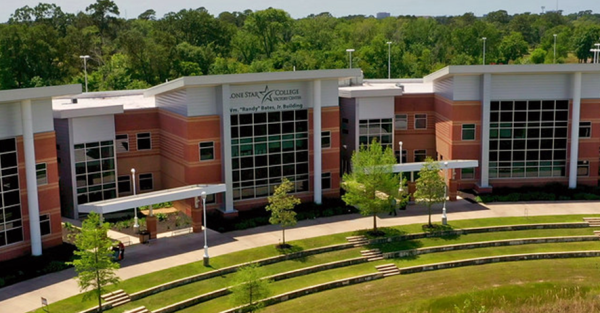
Lone Star College System
Luther College
Saint Louis University