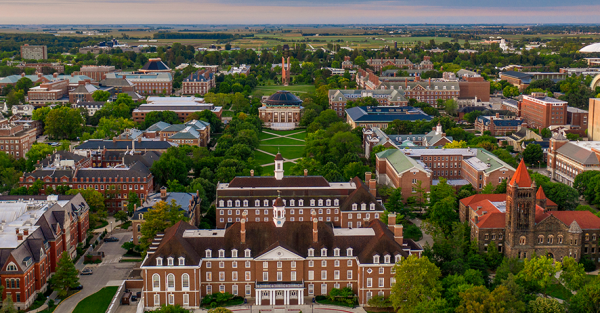
Washington University in St. Louis
Washington University in St. Louis, a private research university enrolling about 16,000 students in St. Louis, Missouri, has built a comprehensive approach to internationalization that spans its research enterprise, undergraduate curriculum, and support for its community of more than 5,500 international students and scholars from 120 countries. About half of the university s undergraduate students nowʼ participate in some form of global experience before graduation, and that global character is woven into the fabric of campus life.
Washington University in St. Louis (WashU) has long drawn scholars and students from around the world. About one in three faculty members was born or trained outside the United States; among the university’s postdoctoral scholars, that figure rises to about 70 percent. That depth of international experience shapes everything from the research questions faculty pursue to the partnerships they build and the global perspectives they bring into the classroom.
WashU Global, housed in the Office of the Provost and led by Senior Vice Provost Vijay Ramani, serves as the coordinating hub for internationalization efforts across the university. It works in close collaboration with various departments across campus, each handling distinct aspects of the university’s global mission. WashU Global facilitates international strategy and partnerships, seeds research collaborations, manages the university’s global agreements, and connects faculty and programs across the institution. Global engagement is integrated in all three pillars of WashU’s 2022 strategic plan—research, community, and people.
Building Global Research Partnerships
At a university where research is central to the institutional mission—WashU receives more than $1 billion in external funds annually for research—international partnerships are treated as drivers of scholarly impact rather than simply diplomatic. Ramani’s approach to building those partnerships is deliberately bottom up. “Anything that is solely driven from the top is not sufficient,” he says. “If the faculty and students aren’t engaged, it dies away, because leaders change.”
The university’s partnership with the University of Warwick in the United Kingdom illustrates this philosophy working in practice. What began as a connection between two senior leaders in 2024 evolved into something more durable: WashU cofunded joint workshops in both the humanities and life sciences, established a bilateral seed grant program open to faculty from both institutions, and created a student exchange agreement for undergraduates. “The roots of this partnership are very deep now,” Ramani says.
The primary mechanism for starting these relationships is the Global Incubator Seed Grants program, which provides early-stage funding for faculty pursuing research with an international facet and partner. Over the past six years, WashU has invested close to $2 million in the program, generating $21.3 million in external awards—with an additional $11.5 million in external grant applications pending. The program has helped launch more than 100 new global projects, engaging researchers from every WashU school and from 75 institutions in 35 countries. Complementing the seed grants, WashU Global’s International Distinguished Visiting Scholars program brings leading academics from across the world to campus for week-long residencies that lay the groundwork for future collaboration.
Global Learning for All
Global learning at WashU is embedded systematically across the undergraduate curriculum. Within the School of Arts and Sciences’ Integrated Inquiry curriculum, now in its fourth year, all courses identify one or more competencies from a shared framework of eleven literacies—one of which is intercultural and global fluency. “It’s not an add-on,” says Erin McGlothlin, vice dean of undergraduate affairs in the School of Arts and Sciences. “It’s built into how faculty think about what they’re teaching and what students are supposed to be getting out of it.”
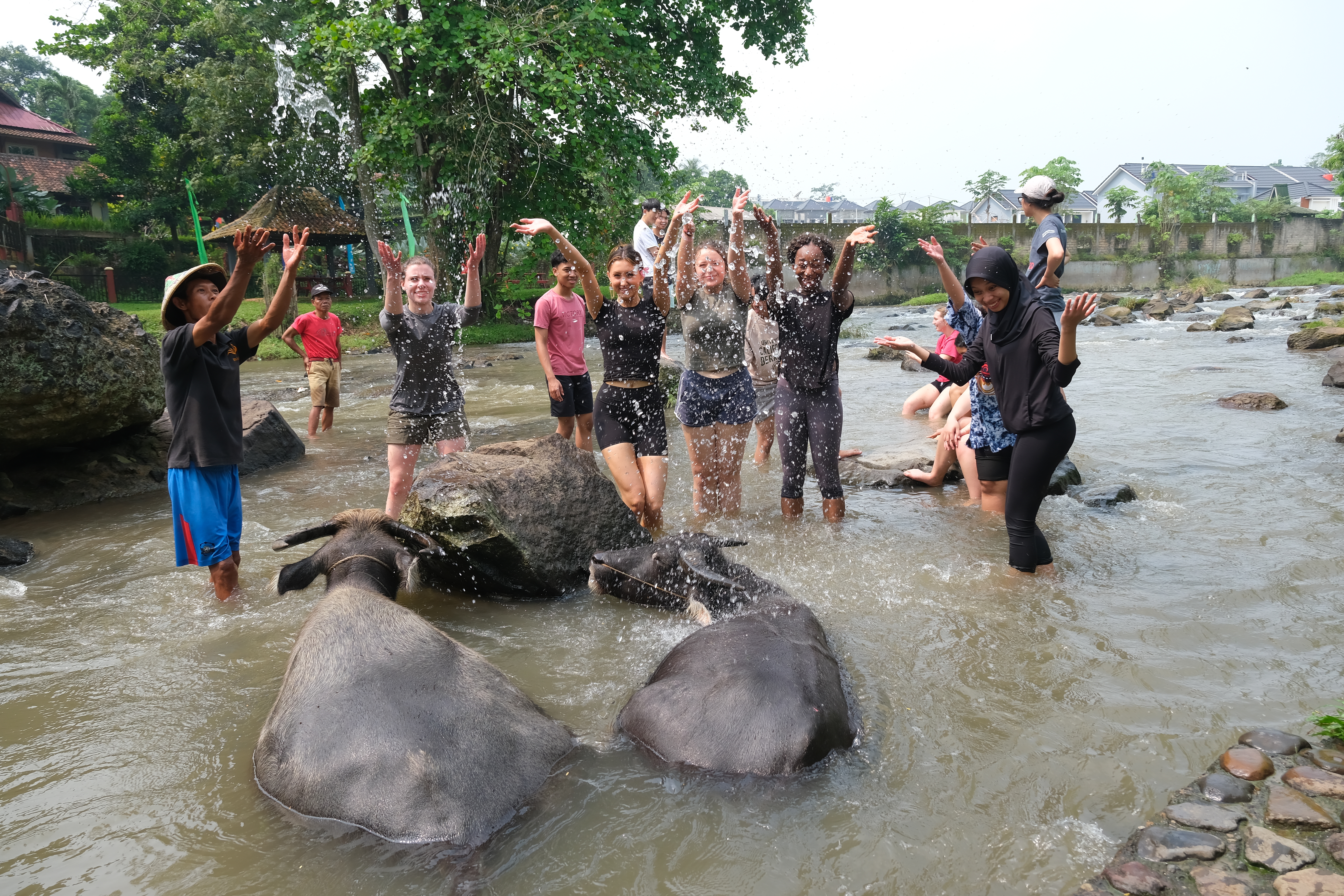
Many students encounter global learning early through Ampersand Programs—small, multisemester courses designed for first year students that integrate global themes and, in some cases, short-term international travel. Recent programs have taken students to China, Costa Rica, Greece, Italy, Morocco, and Poland, with approximately 40 percent of participating students receiving need-based funding to support travel.
About half of WashU undergraduate students now participate in some form of global experience before graduation. To expand access, WashU has significantly increased financial aid for study abroad, growing from approximately 19 percent of tuition costs in 2022 to 37 percent in 2025. A recent realignment of the university’s study abroad partnerships has focused on building geographic hubs and prioritizing depth and quality over the breadth of options. “We want experiences that are integrated into what students are actually studying,” says William Acree, vice dean for interdisciplinary initiatives and innovation in the School of Arts and Sciences.
For students unable to travel internationally, WashU is in the early stages of expanding virtual exchange opportunities. The university sees these exchanges as mechanisms to provide students with international learning experiences. In the School o Public Health, a professor cocreated a new course on public health and the built environment, engaging several partners in Brazil.
Supporting International Students and Scholars
With more than 5,500 international students and scholars on campus, WashU has invested significantly in the infrastructure to support them. The Office for International Students and Scholars (OISS), an integral part of WashU Global, handles immigration compliance and advising. With significant support from the Office of the Provost, OISS has overhauled its data systems, added a dedicated Optional Practical Training (OPT) adviser, and runs bi-weekly sessions to keep students and faculty informed about immigration developments. “WashU has made a meaningful investment in building a strong OISS, one that manages immigration compliance with care and provides international students and scholars with the stability and support they need to pursue their academic dreams,” says Geet Vanaik, executive director of OISS.
Alongside OISS, the Office for International Student Engagement (OISE), established in 2023, handles the cultural and programmatic aspects of international student life. OISE runs weekly community gatherings, cultural programming including an international fashion show and food festival, regional day trips, and recently launched WashU’s first international student graduation celebration.
The McDonnell International Scholars Academy, now in its 20th year, provides an additional layer of community for international graduate and professional students. This endowed fellowship program supports about 85 scholars per year with tuition, a competitive stipend, and leadership development programming that extends well beyond the lab or classroom. Puneet Dhatt—a McDonnell scholar originally from Canada who recently completed a PhD in chemical engineering—connected with a fellow scholar from Africa, and their conversations helped orient Dhatt’s thinking about a biodegradable plastics project connected to a clinical trial in Malawi. These exchanges prompted Dhatt to consider how communities that receive new materials experience them and build trust in the process.
“WashU has extremely generous support across all of their schools,” Dhatt says. “That is really important— not only for international students, but for everybody—to make sure that you can focus on what you’re studying and really try to make an impact.”
Jessica Cissell, director of the McDonnell International Scholars Academy, says that the academy’s goal is to help scholars from around the world build connections across disciplines and cultures. “International students and scholars are woven throughout the life of WashU, enriching our community in ways that strengthen the classroom, the lab, and the university’s truly global reach,” she says.
“We try to look at it as an entire life cycle. Not just recruitment, or just their experience on campus, but the
outcomes.” — Senior Vice Provost Vijay Ramani
Looking Ahead
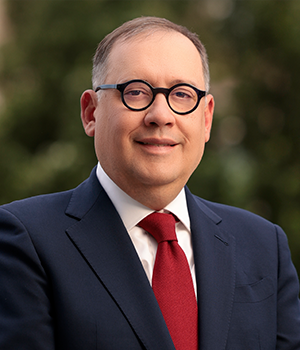
As WashU looks to the future, Ramani has identified alumni engagement as one strategic priority. With roughly 18,000 alumni living overseas, he sees an opportunity to build a global network that connects former students to current ones—supporting recruitment, job placement, and philanthropic investment in international programs. “We try to look at it as an entire life cycle,” Ramani says, “not just recruitment, or just their experience on campus, but the outcomes.” The recently established Global Advisory Council, charged by Chancellor Andrew Martin and comprising senior leadership, faculty, and a board of trustees representative, is tasked with synthesizing trends in higher education and aligning WashU’s global efforts across the institution. “At WashU, internationalization is not something we add on; it is woven into the fabric of who we are,” says Provost Mark West.
Lessons Learned
Build an in-House Global Engagement Dashboard
Tracking international partnerships, research collaborations, faculty with international backgrounds, and student mobility across a large, complex university is a persistent challenge. WashU Global developed its own solution: a global engagement dashboard built using Tableau. The dashboard pulls data from across the institution—including the registrar, research office, human resources, and the Office for International Students and Scholars—giving leadership a unified view of the university’s global footprint. According to Roumy Theunissen, director of global communications and outreach, the question of how to effectively track partnerships and global activity comes up regularly among international educators at peer institutions. Building the tool in-house rather than relying on off-the-shelf software allowed WashU to customize it to its own data structures and institutional needs.
Close the Gap between Admission and Arrival
At an institution like WashU, individual schools locally manage their own admissions processes—which meant that for years, the level of contact with admitted international students between when they received their offer letter and their first day on campus was sparce. When Ramani convened admissions directors from across the university’s schools—some of whom had worked at WashU for two decades without ever meeting their counterparts in other schools— the gaps became clear. WashU has since established a coordinating committee that shares best practices across schools and ensures consistent outreach to admitted international students before they arrive. “You don’t need to look too far for an answer,” Ramani says. “I think you just look at your own backyard.”

2026 Comprensive
Lone Star College System
Luther College
Saint Louis University