Saint Louis University
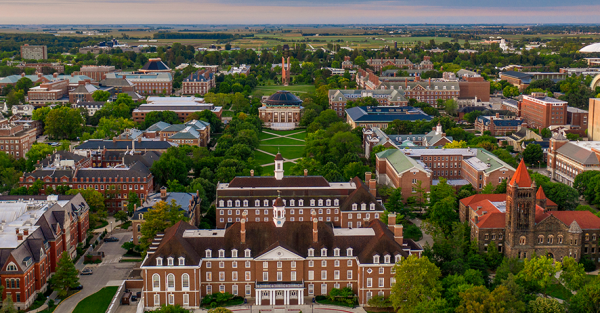
Saint Louis University is a private Jesuit research university founded in 1818 in St. Louis, Missouri—the first university established west of the Mississippi River. The university enrolled approximately 15,000 students in the 2025-26 academic year, including roughly 1,900 at its campus in Madrid, Spain. The university hosts around 2,000 international students from more than 90 countries on its main campus. Through its core curriculum, all undergraduate students are required to engage with coursework on global interdependence and cross-cultural identity.
Shortly after arriving on campus each fall, new international students at Saint Louis University (SLU) board a tram to the top of the Gateway Arch, the 630-foot monument that has defined the St. Louis skyline since 1965. There, a historian explains what the arch has meant to the city and the country. Students are then invited to reflect on their own gateway—the beginning of their academic careers.
SLU has spent years building out the infrastructure behind moments like this. The university’s Academic Strategic Plan, adopted in 2023, made internationalization a consistent theme across the university’s priorities, according to Luchen Li, SLU’s former associate vice president for global engagement and international enrollment who left the institution in August 2026. These efforts range from diversifying SLU’s student body and faculty to expanding global learning opportunities and deepening ties with the St. Louis community.
“When we build relationships and seek knowledge across borders, we contribute to a better and more peaceful world,” says President Edward J. Feser.
That work is coordinated centrally through the Office of International Services (OIS), which oversees international student services and education abroad. The office works in close partnership with academic advisors, career services, and student development. They have also been building out college-level representation, Li said, working with individual schools and colleges to identify associate deans or faculty champions who can coordinate internationalization efforts with the central office.
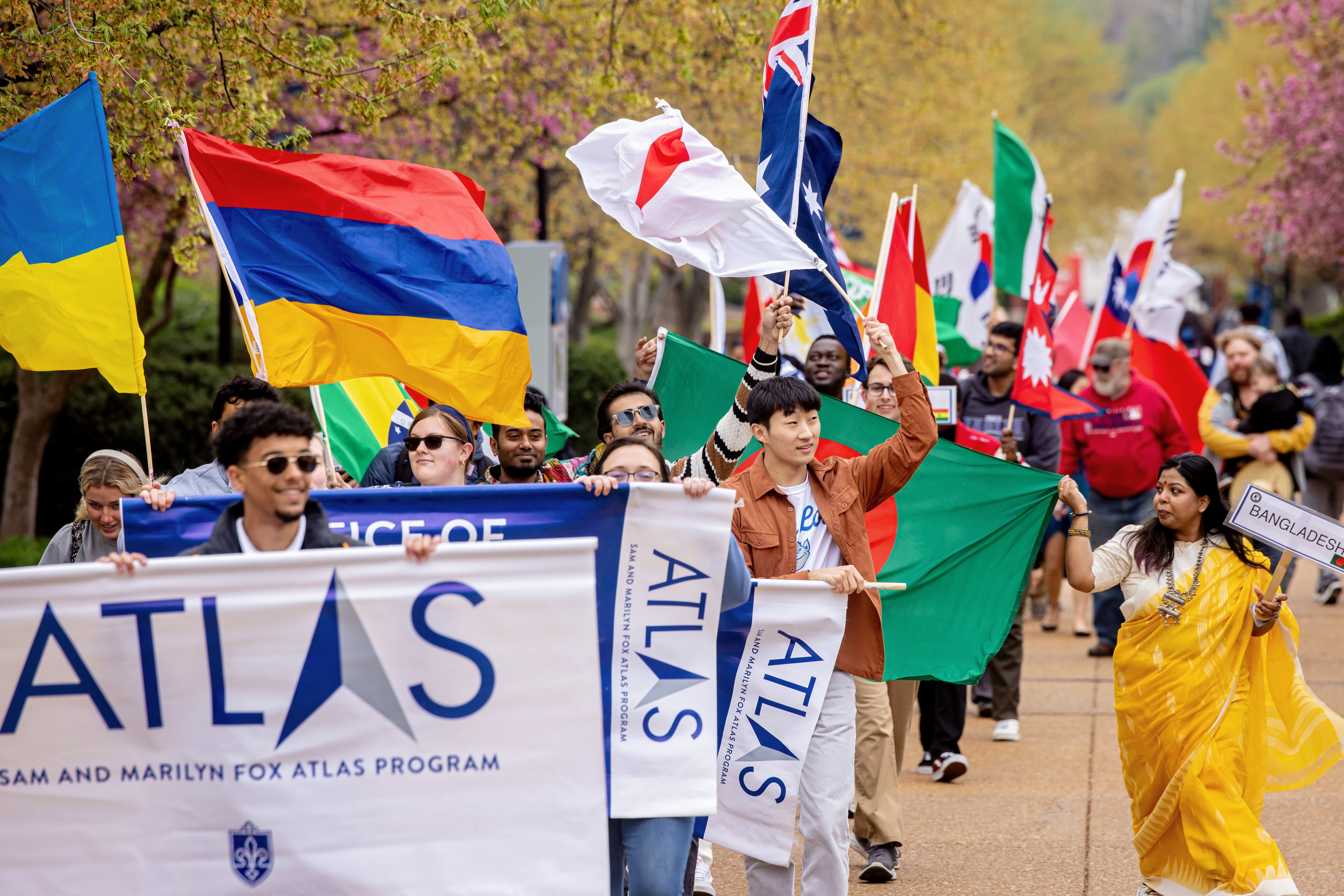
The results have been significant. Between 2020 and 2024, international enrollment at SLU’s main campus grew from around 6 percent to roughly 22 percent of the student body, driven in part by the Global Graduate Initiative, which launched 18 new STEM master’s programs designed to attract international graduate students. The university currently enrolls about 2,000 international students, and more than 600 students study abroad each year. In 2025, SLU received the Simon Spotlight Award for its partnership with Jesuit Worldwide Learning, which provides a fully accredited bachelor’s degree program—at no cost—to students living in refugee camps in Kenya and Malawi.
“When we build relationships and seek knowledge across borders, we contribute to a better and more peaceful world.”
— President Edward J. Feser.
A Campus Abroad
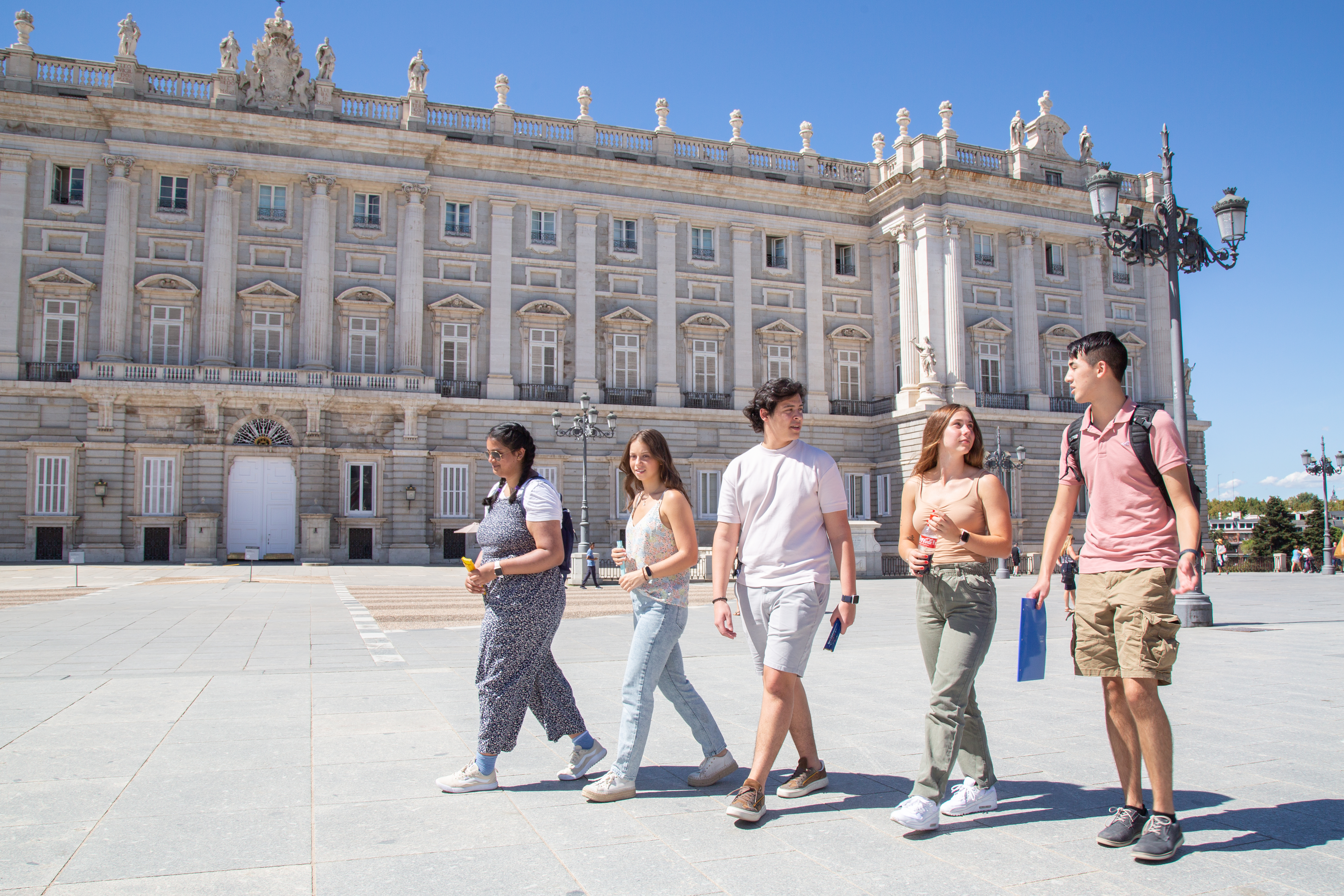
SLU’s Madrid campus traces its origins to 1967, when Fr. Raymond Sullivant started a study abroad program there —one chapter, as Feser describes it, in a centuries-long Jesuit tradition of meeting students where they are. In the 2025–26 academic year, SLU-Madrid enrolled approximately 1,973 students from more than 80 countries in U.S.- accredited degree programs, and in fall 2025 hosted more than 700 students from 33 other U.S. colleges and universities for short-term study.
The two campuses function as a single academic institution. All degrees from SLU-Madrid are awarded through the campus in Missouri under the same Higher Learning Commission accreditation. Students can begin a degree on one campus and complete it on the other, and many do—including Madrid-based students who spend a semester in St. Louis. Academic leadership in Madrid participates in key institutional committees, and Madrid staff alsotravel to St. Louis for major institutional events such as presidential and provost searches. The connection isreflected even in how academic departments list their faculty—Madrid-based colleagues appear alongside their St.Louis counterparts, identified by campus.Between 400 and 500 SLU students study at the SLU-Madrid campus each academic year on a semester or year-long basis, with additional students participating through short-term faculty-led programs. When SLU studentshead to Spain, OIS manages their visa applications from St. Louis, at times transporting hundreds of passports tothe consulate in Chicago to have them stamped. To make a semester in Madrid more financially accessible, SLU’sBilliken Promise offers all undergraduates the option to spend at least one term at the Madrid campus.in St. Louis. Academic leadership in Madrid participates in key institutional committees, and Madrid staff also travel to St. Louis for major institutional events such as presidential and provost searches. The connection is reflected even in how academic departments list their faculty—Madrid-based colleagues appear alongside their St. Louis counterparts, identified by campus.
Between 400 and 500 SLU students study at the SLU-Madrid campus each academic year on a semester or year-long basis, with additional students participating through short-term faculty-led programs. When SLU students head to Spain, OIS manages their visa applications from St. Louis, at times transporting hundreds of passports to the consulate in Chicago to have them stamped. To make a semester in Madrid more financially accessible, SLU’s Billiken Promise offers all undergraduates the option to spend at least one term at the Madrid campus.
Expanding Education Abroad
Beyond its Madrid campus, SLU offers a portfolio of nearly 50 study abroad programs at more than 50 sites worldwide. Faculty-led programs have expanded significantly since the pandemic: SLU offered seven in academic year 2021–22, grew to 12 in 2022–23, and reached 21 in 2023–24, with destinations including Belize, Brazil, Germany, Hungary, Italy, and the United Arab Emirates. In the 2024–25 academic year, 120 students participated in faculty-led programs. Nine of SLU’s study abroad programs also include international internship components, offering students three or six credit hours for work placements abroad.
To expand access for students from high-need backgrounds, SLU applies federal and institutional financial aid to approved global programs and does not charge additional tuition for study abroad, instead paying tuition directly to partner institutions and providers. “There’s support and encouragement to have all of our undergraduate students have some type of international experience,” says Rebecca Bahan, director of OIS, noting growing interest among faculty in short-term programs.
SLU has also added new exchange partnerships over the past two years, including with Ming Chuan University and Fu Jen Catholic University in Taiwan, and the University of Notre Dame in Australia.
Supporting International Students on Campus
OIS provides comprehensive support for more than 3,500 international students and scholars currently enrolled at SLU or who are on Optional Practical Training (OPT), from pre-arrival orientation webinars through immigration advising and career readiness programming. One distinctive feature of the office’s approach is active outreach across campus, instead of waiting for students or colleagues to come to them.
Bahan describes a regular practice of going directly to individual academic departments and meeting with students and advisers together: “If we have students working in our school of nursing, we want to talk with not only their advisers but their students together, so that when we engage with them, the questions the advisors might have, the questions the students might have—everybody’s hearing what the answer is, and we’re all working together.” The office has also created a dedicated training course for academic advisers on best practices in working with international students, covering topics from Curricular Practical Training (CPT) regulations to what happens if a student needs a leave of absence.
Central to the office’s programming is the International Student Ambassador program, a peer cohort of graduate and undergraduate students—both international and domestic—who help welcome new students, plan events, and participate in yield webinars for admitted international students. Eduardo De Franceschi Brasil, an MBA student from Brazil finishing his first year at SLU, joined the program after experiencing the orientation process firsthand. He now helps coordinate events for incoming students, including the office’s Holi celebration, which drew more than 200 students.
Yeeon Ryu, a junior from South Korea studying computer science and data science, describes the orientation experience as one that signaled SLU’s priorities from the start—the games, the programming, the airport pickup that greeted her when she landed. “Getting to know that SLU really cares about international student diversity within the campus really helped,” she recalls. Monthly OIS Essentials workshops on practical topics—filing taxes, buying a car—extend that welcome into the academic year.
Global Perspectives in the Core Curriculum
Ensuring that students who never leave the St. Louis campus also develop global competencies has shaped SLU’s approach to curriculum design. The SLU core, a 32-credit integrated general education program required of all baccalaureate students on both campuses, was revised to embed global perspectives across every undergraduate’s experience. Among its requirements are courses in global interdependence— which ask students to explore the transnational impact of local actions—and identities in context, which examines how intersecting identities shape experience across social structures.
“Saint Louis University’s core gives all undergraduate students, regardless of college, school, major, or program, the intellectual tools to understand and participate in our globally connected world,” says Liz Burke, assistant director of the university core. “Through one or more global learning courses, the core enables students to identify the transnational impact of local actions in order to be engaged and responsible global citizens.”
The core’s global requirements extend to SLU-Madrid, where faculty from both campuses sit on the same subcommittees and participate in the same professional development workshops—held virtually and scheduled for mornings in St. Louis so they don’t fall too late in the evening for Madrid colleagues. Uraizee has also visited the Madrid campus in person as part of the core assessment cycle, leading workshops and reviewing course materials with faculty there.
Assessment of the global interdependence requirement is built into the core’s accreditation framework, with two components assessed each year through a structured process that includes developing a rubric, collecting student work artifacts in collaboration with the assessment office, and holding a two-day faculty workshop to examine the findings. The Reinert Center for Transformative Teaching and Learning holds twice-per-semester workshops where faculty work to align their assignment prompts more explicitly with the core’s learning objectives—for example, designing assignments that ask students to identify connections between parallel processes, such as healthcare or political systems, across two different countries. Uraizee says the goal is to make the global connections in the core objectives more explicit.
What's Next
Looking ahead, SLU is deepening the connection between its two campuses through its “One SLU” approach—building stronger programmatic ties between St. Louis and Madrid to create more seamless cross-continental experiences for students on both sides of the Atlantic, Li said. At the same time, the university is expanding local employer partnerships that connect international students and graduates in Missouri with St. Louis organizations for CPT or OPT opportunities, translating global education into professional experience in the region SLU calls home.
For Feser, both efforts reflect the same underlying conviction. “Internationalization is not a passing trend or a catch phrase for us,” he says. “We believe that community and relationships are essential to learning and human thriving, and when our students deeply understand that all people are connected, we educate better and more ethical leaders."
Lessons Learned
Fully Integrate Branch Campuses into Institutional Governance–Not Just Academic Programming
SLU-Madrid’s participation in university-wide shared governance—including presidential and provost search committees, key academic affairs committees, and weekly leadership meetings via videoconference—means the campus functions as a part of the institution rather than a remote outpost. When Madrid staff are in the room for major decisions, the entire university benefits from a more international perspective, and the campus itself has a real stake in institutional direction, said Luchin Li, SLU’s former associate vice president for global engagement and international enrollment.
Close the Loop Between Global Learning Assessment and Faculty Practice
When SLU’s initial assessment of its Global Interdependence core requirement revealed that students were reaching basic competency but struggling with more sophisticated engagement, the university used those findings to design targeted faculty workshops in partnership with the Reinert Center for Transformative Teaching and Learning. Twice each semester, faculty teaching globally designated courses work to align their assignment prompts more explicitly with the core’s learning objectives.
Use Places to Orient International Students—Not to Campus, But to the Community
The Gateway Arch Project connects new international students to the history and identity of St. Louis before the semester begins in earnest, grounding their arrival in something larger than orientation paperwork. Institutions looking to strengthen international student belonging might consider what landmark, story, or community connection in their own city could serve a similar purpose—offering students a way into the place, not just the campus, Li said.
2026 Comprehensive Award
Lone Star College System
Luther College
Washington University in St. Louis