Teaching, Learning, and Facilitation

2010 Comprehensive Carnegie Mellon University

ITC 2010 Carnegie Mellon President
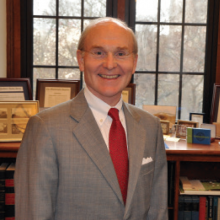
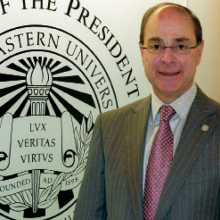
President Jared Cohon

When Jared Cohon received the Carnegie Corporation of New York’s Academic Leadership Award in 2005, there was no shortage of worthy academic pursuits on which the Carnegie Mellon University (CMU) president could spend the accompanying $500,000 prize. He chose to direct a large sum to a Global Awareness Across the Curriculum initiative, in which faculty from the institution’s six undergraduate colleges vied for grants to create new courses exploring international topics and themes. It achieved the desired results. An engineering professor won a national award for a project management course in which students in Pittsburgh collaborate with counterparts in Brazil, Israel, and Turkey. Information technology students teamed up with classmates in Qatar and students in Singapore to design Web sites for NGOs. In classes held synchronously and linked by video in Pittsburgh and Qatar, an architecture professor explored the challenges posed by the construction boom in cities in the Middle East. 

A n international bent comes naturally to Carnegie Mellon, a private university founded in 1900 by the Scots-born steelmaker and philanthropist Andrew Carnegie to teach “practical arts and sciences.” CMU is a bastion for computer science and for engineering and technology, but is also home to a celebrated fine arts program. It boasts not only of Nobel Laureates (16), but also of winners of Academy Awards (56) and numerous Tonys and Emmys. Both mathematician John Nash of A Beautiful Mind and artist Andy Warhol are alumni. Its labs have done pioneering work in artificial intelligence, robotics, and biometrics. Those breakthroughs occurred on the home campus in Pittsburgh, three miles from where the Allegheny and Monongahela meet to form the Ohio River. But today CMU has a wider footprint, with graduate programs in more than a dozen countries and a full-fledged undergraduate branch in Qatar.

One of Six U.S. Universities in Qatar

Carnegie Mellon Qatar is one of the six U.S. universities—the others are Weill Cornell Medical Center, Texas A&M, Northwestern, Virginia Commonwealth, and the Georgetown School of Foreign Service—offering degrees in the oilrich emirate’s Education City in Doha. Carnegie Mellon Qatar occupies a striking new building with golden interior walls on which are etched the words of Andrew Carnegie that serve as the university’s motto: “My heart is in the work.” A bagpiper in full Scots regalia played at the February 2009 ceremony where Sheikha Mozah Bint Nasser Al Missned, wife of the Emir and chair of the Qatar Foundation, and Cohon shared ribboncutting duties. The student body, half Qatari and half international students, is small (300) but growing, with roughly 35 graduates each year. It offers bachelor of science degrees in business administration, computer science, and information systems.

“If you spent enough time here in Pittsburgh to get the essence of Carnegie Mellon and then went to observe our ­program in Doha, you would say, ‘Gee, this really is Carnegie Mellon.’”

Carnegie Mellon, with unstinting support from the Qatar Foundation, has striven to replicate in Doha the educational offerings and the cocurricular experience afforded in Pittsburgh. Some faculty are hired from the region, but others such as Kelly Hutzell and Rami el Samahy from the School of Architecture alternate semesters’ teaching in Pittsburgh and Doha. Hutzell calls it “a joy” to be teaching her “Mapping Urbanism” course in a city undergoing dizzying changes. Carnegie Mellon deans and department heads visit Doha regularly and there is a brisk, two-way traffic of students on breaks, over summer and for full semester stays. Secretary of State Hillary Rodham Clinton and Bill Gates have spoken at events hosted by Carnegie Mellon Qatar.

“If you spent enough time here in Pittsburgh to get the essence of Carnegie Mellon and then went to observe our program in Doha, you would say, ‘Gee, this really is Carnegie Mellon,’” said Cohon, a civil engineer who has piloted Carnegie Mellon since 1997.

Surging International Enrollment

The number of international students has doubled over the past decade, from 1,747 in fall 1999 to 3,518 in fall 2009. They constitute almost half the graduate student population and are strongly represented in engineering, management and information systems, computer sciences, and business.

Carnegie Mellon prepares undergraduates for careers in engineering, arts, humanities, and sciences. Many of these professionally oriented majors have requirements that can make it difficult for students to fit education abroad into their schedules. Some 400 now take some of their coursework overseas, and that number has been rising. “Study abroad in the usual semester abroad sense is sometimes a hard sell,” said Linda Gentile, director of the Office of International Education. This reality has strengthened the determination of faculty and administrators such as Vice Provost for Education Indira Nair to find other ways for students to, in Nair’s words, “become aware, socially responsible global citizens.” This includes innovative uses of technology to expand the classroom well beyond the confines of Pittsburgh and arranging unusual summer internships in faraway places for CMU’s technologically adept students.

A Memorable Lesson in Concrete

ITC 2010 Carnegie Mellon Professor
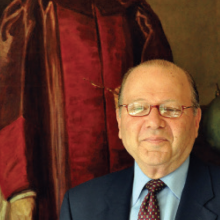
Professor of Civil and Environmental Engineering Lucio Soibelman won an award for his global project management course teaming students from Pittsburgh, Brazil, Israel, and Turkey.

Lucio Soibelman, professor of civil engineering, codesigned the award-winning construction project management class taught synchronously with engineering schools in Brazil, Israel, and Turkey. His share of the president’s Carnegie award paid for digital equipment that allows students in all four countries to see everything that Soibelman writes on a whiteboard in Porter Hall in Pittsburgh. Soibelman isn’t teaching basic engineering skills—these advanced students are well beyond that—but he is equipping them to overcome the cultural barriers that working engineers confront daily on international projects. “The main readings and discussions are related to globalization. They read books on working across cultures and on negotiation,” said Soibelman, a native of Brazil.

His students once got into a friendly quarrel with their Turkish counterparts over how quickly concrete could be poured. “The Turkish students kept saying they could build one floor per week. The American students kept pushing back, saying, ‘No, you can’t,’” recalled Soibelman. One floor a month is the U.S. norm. But when the Americans flew to Turkey on spring break, the Turkish students immediately brought them to a construction site where concrete was being poured. A week later, before the return flight, they returned to see the next floor going up. “When I asked my students how the trip was and what sights they had seen, they just looked at me and said, ‘They can do it,’” recalled the professor, who explained that lower labor costs, greater use of concrete, and major investment in concrete forms allow the Turks to build more rapidly.

“We want every student to have a global perspective and be able to use their expertise to solve real world problems (across) disciplinary boundaries and national boundaries.”

Globe-Trotting Student Consultants

Joseph S. Mertz, Jr., who teaches in both the School of Computer Science and the graduate H. John Heinz School of Public Policy and Management, places students each summer on internships as technology consultants in Micronesia, the Cook Islands, Palau, India, and elsewhere. “I teach geeks the soft skills they need to put their technical skills to use in the service of humanity,” said Mertz. CMU undergraduates helped the Republic of Nauru issue national identification numbers to its 10,000 inhabitants. Two students helped the tiny island of Niue, the smallest selfgoverning country in the world (pop. 1,400), connect laptops to the internet for its 500 schoolchildren. At a Bangalore, India, orphanage for blind children, students wired a computer to a traditional Braille machine, sounding out the letters and words children wrote with a stylus and correcting their spelling.

In the Global Project Management course taught by Randy Weinberg, director of the Information Systems (IS) program, students in Pittsburgh and Doha collaborate with students at Singapore Management University. “They do video, they Skype, they e-mail. We have the same readings, assignments, and assessments,” said Weinberg. It is a taste of the life they will lead when they graduate “because unless you’re a small, boutique IS shop, your clients and partners are going to be in distant locations.”

The culture at Carnegie Mellon is highly interdisciplinary. Partnerships are encouraged with colleagues across campus and around the world. “We want every student to have a global perspective and be able to use their expertise to solve real world problems (across) disciplinary boundaries and national boundaries,” said Amy Burkert, an assistant science dean who designed and taught one of the global courses and recently succeeded the retiring Nair as vice provost for Education.

Branding Carnegie Mellon Overseas

Doing what Carnegie Mellon is doing in Qatar is daunting, but there has been widespread agreement that “getting the Carnegie Mellon brand out into the world was an adventure worth pursuing,” said Provost Mark Kamlet.

Students from Pittsburgh are encouraged to spend a semester in Doha, and 10 are sent over spring break on a trip paid for by the division of student affairs in Pittsburgh and Qatar Foundation. Fifty students vie for those slots, and those chosen are expected on their return to share the experience with peers.

Megan Larcom, 21, a senior from Middletown, Rhode Island, majoring in international relations and business administration, interned in the Doha student affairs office the summer after freshman year, then returned to Qatar for a full semester as both a student and teaching assistant in accounting classes. A varsity rower with a 4.0 GPA, she also played on a newly formed women’s basketball team in Doha. She twice won federal scholarships to spend summers studying Arabic in Tunisia and Morocco, then landed a Fulbright scholarship to Egypt, where she is teaching English and pursuing research at Suez Canal University.

Student Affairs in Qatar

ITC 2010 Carnegie Mellon Linguistics
Pooja Reddy linguistics doctoral candidate is researching how poor children in her native Bangalore, India, acquire second and third languages.

That student affairs office in Doha has a staff of ten, larger than any of the other U.S. universities in Education City, said Renee Camerlengo, assistant dean of student affairs and director of special projects in Pittsburgh. “From the very beginning we really believed in a very strong out-of-classroom experience” for the Doha students, most of whom commute to classes, said Camerlengo.

While Qatar is regarded as a progressive and tolerant place, Camerlengo asks the American students to dress conservatively and not drink alcohol while living in the Muslim country “as guests of the Emir and the Sheikha.” On their return, students are expected to share what they saw and learned. “We’ll never be able to send all 5800 (undergraduates) to Doha on this kind of trip, so the students fortunate enough to go have to bring a part of that experience back to their contemporaries,” Camerlengo said.

Opportunities and Pins on a Map

President Cohon said the expansion of Carnegie Mellon’s global footprint has not been “as strategic as we would like. If we took a map of the world and put pins on the countries we would like for Carnegie Mellon to be present in…. It would be China and India first, and then maybe other places after.”

But CMU planted its flag in the Middle East when the Qatar Foundation pledged to furnish the facility and cover most other costs. “Where we are is very much a product of our taking advantage of opportunities that have arisen and respecting the constraint we have self imposed, which is that we will not subsidize any international program from Pittsburgh. They have to pay for themselves,” said Cohon. “We are not a rich university.”

Cohon wants Carnegie Mellon to be recognized “as an important institution and indispensable institution in those new centers of wealth and power.” And he wants the university community to look back in 2050 and say, “Gee, it really was a great thing that we decided to become a global university 50 years ago.”

Read More

2011 Comprehensive Macalester College

Macalester College’s determined global outlook can be seen and heard on even a short stroll around the 53-acre campus in a leafy St. Paul, Minnesota, neighborhood not far from where F. Scott Fitzgerald grew up. The flag of the United Nations flies overhead as it has every day for 61 years. Dozens of other banners line the balcony above Café Mac, the college dining room, and flags from the home countries of Macalester students are rotated on four other flagpoles throughout the year. Sitting conspicuously in the foyer of the new athletic and fitness center is a ping pong table dedicated to and autographed by Nobel Peace laureate and former UN Secretary General Kofi Annan, a track star and champion ping pong player here half a century ago (he graduated in 1961). On warm spring afternoons, the rhythmic beat of drums reverberates across campus as the 40-member African Music Ensemble practices outdoors. 

ITC 2011 Macalester President
President Brian Rosenberg sees the Institute for Global Citizenship as “a clear embodiment of Macalester’s distinctive mission.”

These visible tokens all reflect what Macalester calls its “special emphasis on internationalism, multiculturalism, and service to society” and its determination, in the words of President Brian Rosenberg, to produce “socially responsible global citizens and leaders.” That commitment begins at home, where Macalester students are strongly encouraged to volunteer in the Twin Cities’ polyglot tapestry of immigrant communities—Hmong, Somali, and Hispanic among them—as well as to undertake service and learning abroad. Indeed, Rosenberg in 2006 combined the college’s three separate offices for community service, internships, and international education into a unified Institute for Global Citizenship (IGC) with the aim of making it “a catalyst for cutting-edge teaching, scholarship, and events fostering the education of citizen leaders for the interconnected world of the twenty-first century,” with Ahmed Samatar, professor of international studies and a leading scholar on the history and struggles of his native Somalia, at the helm as its first dean. Two of its conjoined parts, the International Center and the Civic Engagement Center, share quarters in the U.S. Green Building Council LEED platinum-certified  Markim Hall, where water circulating through radiant ceiling panels and flooring provides the “hydronic” heating and cooling. The internship office is next door in Kagin Commons along with the Office of International Student Programs.

Finding Stellar Students on a Fjord in Norway

Generous financial aid helps Macalester attract international students in large numbers. The private college actually provides aid to a higher percentage of international students (almost 90 percent) than the U.S. undergraduates (70 percent), and the average package covers two-thirds of the more than $50,000 annual cost of tuition, room, and board. Macalester has recruited top students from the United World Colleges (UWC) for years even before philanthropist Shelby Moore Cullom Davis gave it $13.5 million to provide $20,000-a-year scholarships for graduates of UWC, an international network of boarding schools offering international baccalaureate diplomas to students chosen for academic ability and leadership potential. Jimm Crowder, then-associate director of international admissions, made a dozen recruiting visits to the Red Cross Nordic UWC on a fjord in Norway, more than any other visitor, the headmaster told him, save Queen Sonja.

“Forty years ago, the religion department here would have been five Presbyterian clergymen teaching Bible. We’re still five, but three of us do Asian religions and Islam.”

The robust international studies (IS) program, founded in 1949, is the fifth most popular major, with four and one-half tenure-track positions of its own and allied faculty across the humanities, social studies, and even the sciences. Its chair, David Chioni Moore, calls it “the oldest, broadest, and deepest such program at any private liberal arts college.” Education abroad is mandatory in this program, as it is for language and anthropology majors and those from a handful of other disciplines. Macalester now offers interdisciplinary concentrations in global citizenship, community and global health, human rights, and humanitarianism. Overall, 60 percent of Macalester students study abroad, over half outside Western Europe.

Duties of World Citizenship

Macalester held its first classes in 1885, a nonsectarian institution affiliated with the Presbyterian Church. Classics scholar James Wallace saved it from bankruptcy as president at the turn of the twentieth century and was the lion of the faculty until the eve of World War II. His son, DeWitt Wallace, founder of Reader’s Digest, became a major benefactor. President Charles Turck raised the UN flag in 1950 and spoke of “the duties of world citizenship.” In recent decades Macalester has attracted a far more diverse and globally minded faculty to carry out that vision. “Forty years ago, the religion department here would have been five Presbyterian clergymen teaching Bible. We’re still five, but three of us do Asian religions and Islam,” said Professor of Religious Studies James Laine.

Classics Professor Andrew Overman takes 25 Macalester students each summer to work on the excavation of a Roman temple complex at a site called Omrit in northern Galilee, near Israel’s border with Lebanon. They live on a kibbutz, publish with Overman in scholarly journals, and uncover finds that are on permanent display at the New Israel Museum in Jerusalem. It is “an incredibly transforming experience for everybody,” said Overman, who previously brought students to a Black Sea dig in Sevastopol, Ukraine.

Most Macalester students study abroad not with their professors but at some 70 recommended programs overseas bearing the International Center’s stamp of approval. Macalester runs a handful of semester-long programs, including one in Maastricht, Netherlands, and classes taught in German at the Goethe Institute in Berlin and the University of Vienna in Austria. Since 2003 Macalester, in a consortium with Pomona and Swarthmore colleges, has offered a program on globalization and the environment at the University of Cape Town in South Africa.

A Preference for Foreign Programs and Local Faculty

ITC 2011 Macalester Seniors
Seniors Morgan Sleeper, linguistics and Asian studies major, and Needham Hurst, economics major, both speak fluent Mandarin.

Michael Monahan, former director of the International Center who recently became president of BCA Study Abroad, said Macalester approaches education abroad “in a very selective way. Our faculty primarily are in the classroom here. We like to see foreign faculty teaching our students abroad. So our motto has been to engage with foreign universities and program providers rather than running them ourselves.” Monahan said, “A distinctive feature of Macalester education abroad is it’s a match between each individual student and not just a program, but a course of study.” Even the education abroad brochures used to be grouped by major instead of by country or region. But that caused some confusion and was changed recently to make it easier for students to see all their options by country. 

Paul Nelson, an alumnus of the class of 1972, the new director of the International Center and former study abroad coordinator, and study abroad adviser Rachel Kamagne-Jones, a more recent alumna, class of 2007, structure their advising sessions around academic content, not location. They personally interview each applicant. “It’s rare to tell somebody no. Everything on campus is setup to make the answer yes,” said Nelson, an attorney and author who used to run a summer Spanish immersion program in Cuernavaca, Mexico. “It’s the ethos that students take it seriously.” 

“A distinctive feature of Macalester education abroad is it’s a match between each individual student and not just a program, but a course of study.”

ITC 2011 Macalester Freshman
Yulun Li, a freshman from Xi’an, China, was surprised to find how interested “American students are in events outside their country.”

An unusual spurt in enrollment with the class that entered in 2009 has produced a bumper crop of nearly 350 students studying abroad in 2011–12. Fourteen students were headed to China, a record, and 17 signed up for intensive Arabic programs in Morocco, Jordan, and England. Star quarterback Clark Bledsoe, a rising junior and anthropology major, will skip spring 2012 football practice to study in South Africa, one of eight football players’ bound for different parts of the world. “I savor the focus this school places on internationalism, as well as all the interesting people it attracts,” said the anthropology major.

Macalester’s geography department, with five professors, draws swarms of students to courses on geographic information systems (GIS), the environment, urban studies, and global issues. Senior Needham Hurst, an economics major, minored in geography and Chinese and applied his GIS skills while studying in China to research how people there were being evicted from ancestral homes for urban renewal. Hurst, who also spent a month studying in Bangladesh, said, “It was shocking how closely these patterns of land loss match those I mapped on American Indian reservations.”

Linguistics and Asian studies major Morgan Sleeper, 22, from Deland, Florida, studied Chinese in China, Maori in New Zealand, and Gaelic in Ireland during his four years at Macalester and won a $25,000 Watson Fellowship to travel the world for a year exploring how Celtic music is keeping Gaelic and other endangered languages alive.

Sarcasm 101 and Bus Tokens

For Macalester’s contingent of 227 international students (almost 12 percent of undergraduates), introduction to campus and U.S. life includes a course that International Student Programs Director Aaron Colhapp titled Sarcasm 101: An Introduction to Humor in America, which includes clips from a sardonic Saturday Night Live skit as well as other break-the-ice discussions and activities. Colhapp brings as guest lecturer an associate dean’s spouse who once taught improvisation at Second City. “Students love it,” he said.

The international office also sends U.S. and international students into Minneapolis and St. Paul with a bus token and instructions not to come back until they have found and interviewed several people with distinct characteristics, from eyeglasses to tattoos. “It’s a good way to get them out, learn the bus system, and get them used to not being afraid to talk to other people,” said Colhapp. 

Another program called Ametrica pairs students with mentors throughout the year for fortnightly discussions on politics, religion, social networking, and other topics. Marissa Leow, a biology major born in Singapore but raised in part in upstate New York, works in the international student office and signed on as a mentor. Her skepticism of the program shifted when she saw that new international students “value hearing each other’s perspectives and going through that [adjustment] process with each other.” 

Yulun Li, 18, a freshman from Chengdu, China, said, “There’s a lot of things to do here. I’m very busy, meeting new people, talking to new people. It’s kind of joyful.” Li was surprised to find how interested American students are in events outside their country. But first-year student Amy Janett from Vernon, New Jersey, who spent a year in Iceland as a high school exchange student and helps organize events for international students, was surprised to find that not everyone at Macalester was as internationally minded as she is.

President Rosenberg said, “Any time you get 2,000 students, you’re going to get different priorities and perspectives.” He believes student interest in global matters is greater at Macalester than at most schools, and he has even advised students’ who are weighing whether to accept the college’s offer of admission that if they aren’t seeking such an international emphasis, “this might not be the right college for you.”

International Journals and Its Own Student Council

The Institute for Global Citizenship, which has its own student council, brings scholars to campus each fall for a three-day International Roundtable devoted to globalization issues. Papers commissioned for the forum are published in the annual journal Macalester International.

ITC 2011 Macalester Dean
Ahmed Samatar, first dean of the Institute for Global Citizenship, said no other U.S. school “has put together this kind of an internationalist academic program so early.”

Samatar, who recently stepped down as IGC dean, is also founder and editor-in-chief of Bildhaan: An International Journal of Somali Studies. “Working here (at the IGC) has been challenging and delightful and exhilarating, but I need to get back to full-time scholarship,” said Samatar, who at age 17 was chosen to be a news reader on the national news broadcast in his homeland and was a broadcaster for the BBC Somali Service in London before coming to the United States for college. “Internationalism as a spirit has been a part of Macalester’s life for decades,” said Samatar. “No (other) college in the United States has put together this kind of an internationalist academic program so early.”

A national search is on for Samatar’s successor as dean. Asked what advice he would give that person, Samatar said, “Excellence is a moving thing. It is not something that you discover once, pitch your tent, and just (relax). Others are pushing, too. New questions arise and old questions refuse to go away and require new methodologies. So excellence is a journey. You never really rest.”

Read More

2011 Comprehensive Kennesaw State

Kennesaw State University’s transformation from junior college to Georgia’s third largest university took only a few decades. It is still growing, adding its first doctoral degrees and building dorms so more than just 4,000 of its 22,000 students can live on the metropolitan Atlanta campus. With help from legendary University of Georgia coach Vince Dooley, it is preparing to field its first football team in 2014. But its academic ambitions are even grander and—as suggested by the 22-foot-high sculpture by Eino, Spaceship Earth, in the heart of campus—more global. “That’s Kennesaw State straddling the globe,” Ikechkwu Ukeje, a Nigerian-born professor and chair of elementary and early childhood education, said in jest.

ITC 2011 Kennesaw Vice Provost
Barry Morris (front, right), vice provost for global engagement and strategic initiatives, with visiting Indian students and their professor.

But that artwork and a nearby colorful, 2.7-ton slab from the Berlin Wall both remind students and faculty every day of Kennesaw State’s international ambitions and achievements. One feather in its cap recently came in the form of a midterm report from its accreditor, the Southern Association of Schools and Colleges (SASC), which requires member institutions to single out an area for self-improvement when they seek reaccreditation. KSU intrepidly asked in 2007 to be held accountable for how much and how well it bolstered its international education programs.

SASC sent Susan Buck Sutton, then associate vice chancellor of Indiana University Purdue University Indianapolis (she is now at Bryn Mawr College), to take a look. “KSU is emerging as a national leader in international education,” Sutton wrote in evaluating the institution’s Quality Enhancement Plan (QEP). “It would be difficult to find another university where such a broad range of global learning initiatives, across all dimensions of the institution, is occurring.”

“We’ve made the Quality Enhancement Plan part of our DNA,” said Barry J. Morris, vice provost for global engagement and strategic initiatives and executive director of the Institute for Global Initiatives, who deflects credit to the faculty. Morris said KSU’s international thrust benefited from strong leadership from President Daniel Papp and his cabinet, but received legitimacy “because it was chosen from the bottom up. The faculty themselves raised the flag.” 

From Junior College to Comprehensive University

ITC 2011 Kennesaw President
President Daniel Papp, a Sovietologist and founder of the Sam Nunn School of International Affairs at Georgia Tech, picked up the international torch from his predecessor, Betty Siegel.

KSU opened in 1966 as Kennesaw Junior College, constructed on what once was farmland in Cobb County 20 miles northwest of Atlanta. It did not start offering bachelor’s and master’s degrees until the 1980s. Now it is preparing its first doctoral students. Today it has 20,000 undergraduates (average age 25) and 2,000 graduate students. Some 1,600 are international and nearly 900 students study abroad each year. Eighty-five percent live off campus or commute and half are nontraditional. KSU proudly describes itself as “a metropolitan university.” Former President Betty L. Siegel was a vigorous proponent of KSU’s international efforts during her quarter century at the helm, and KSU took part in the American Council on Education’s Global Learning for All project aimed at helping institutions expose adult, minority, and part-time students to international education. Daniel Papp, a Sovietologist and founder of the Sam Nunn School of International Affairs at Georgia Tech, picked up the international torch when he became president in 2006. 

The “Year Of” Program

A signature international activity is KSU’s “Year of Program” that spotlights a particular country, region, or international theme through a host of courses, lectures, exhibits, music, theater, and other activities that extend throughout an academic year. It started with Japan in 1984–85 and now has examined nearly two dozen countries as well as the Olympic movement and slave trade across the Atlantic. The Year of Romania was marked in 2010–11 with 33 lectures, a film festival, and other events that examined the treatment of the Roma (Gypsy) minority, persecution of Jews, post-communist religion and politics, and medieval painted monasteries. Some KSU students studied in Romania, and five faculty with Romanian roots made contributions as well. The Year of Program “is a lot of fun and a lot of work,” said Daniel Paracka, director of education abroad and manager of the Year of Program.

The 2006–07 Year of Kenya resonated with Atlanta’s sizeable Kenyan immigrant community. When the Kenyan ambassador spoke, he brought consular staff to process visas for Kenyan Americans to visit their homeland, and KSU has held follow-up conferences with support from Atlanta companies that do business in Africa. “We are still reaping the positive benefits. People now call us ‘Kenya-saw,’” said Vice Provost Morris, a Russian-speaking political scientist and former international banker.

[The Global Learning Coordination Council is] “the group that more than any other drives our internationalization efforts. This is the engine that ties the entire university together.”

Kennesaw State’s Coles College of Business recently became the new home of the India China America Institute, an economic think tank on economic and geopolitical issues involving the United States and the world’s largest emerging economies. The institute will help the business school and the university to “further engage in these countries while solidifying our position as a leader in global education,” said Ken Harmon, the business dean who is serving as interim provost and vice president for academic affairs. 

A New Institute for Global Initiatives

The Institute for Global Initiatives (IGI) was created under the provost’s office in 2003 to provide what history professor Akanmu G. Adebayo, the first executive director, describes as a “one stop shop” for faculty and student research and study. It replaced a smaller Office of International Programs housed in the College of Humanities and Social Sciences. Today a Global Learning Coordination Council (GLCC) of faculty, staff, and students oversees and coordinates KSU’s international activities (Professor Ukeje is a council member). The biweekly council developed a Global Engagement Certificate that students now can earn with their diplomas. Morris calls the council “the group that more than any other drives our internationalization efforts. This is the engine that ties the entire university together.”

Ed Rugg, retired vice president for academic affairs and former chief academic officer, said the transformation from junior college to university in the 1980s left “open fields for us to run in. The undergraduate curriculum hadn’t been fleshed out…. If we had better ideas for doing something, people were willing to entertain them. Nobody was saying no.” KSU was the first public institution in the state to offer an international affairs major, and its faculty have led internationalization initiatives for the entire University System of Georgia. “Our visibility and perception as an international campus was not just mythic, but real,” said Adebayo, who is editor-in-chief of KSU’s peer-reviewed, interdisciplinary Journal of Global Initiatives.

Financing Study Abroad With Student Fees

Kennesaw State provides $1 million a year in funding for the IGI and $940,000 more for other global learning activities, said Assistant Vice President for Financial Services Ashok Roy, who is also an associate professor of Asian studies. Students voted to impose an additional $14-per-semester fee on themselves to provide Global Learning Scholarships of at least $500 for everyone who studies abroad or takes part in university-sponsored service trips overseas. Students receive as much as $2,000 if they perform service and study abroad for longer periods. The fee generates $750,000 annually, said Dawyn Dumas, director of Global Engagement Programs.

“Our philosophy is that leadership is a lifestyle. Once they’ve gone on their first trip, they are hungry to go all around the world.”

KSU has dramatically increased education abroad opportunities for math and science majors. Professor of Mathematics Jun Ji, the College of Science and Mathematics representative on the GLCC, said, “Four years ago we had one (education abroad) program with 10 students. Now we have eight programs in science and math, and we got 98 students last year.” A large poster outside Ji’s office shouts in bold letters, “YOU CAN GO TO CHINA FOR $2,100.” This includes a $750 Global Learning Scholarship plus an additional $400 per student from KSU’s Confucius Institute, one of the 68 such centers in the United States and 300 worldwide that receive support from China to encourage study of Chinese language and culture. 

KSU sends students on 40 different education abroad programs, mostly for two to three weeks in the summer. With Georgia Southern and Georgia State, it offers full-semester Italian culture courses in the Tuscan town of Montepulciano. KSU ranked tenth in the 2010 Open Doors report among master’s level institutions in education abroad. The School of Nursing sends students on two-week service-learning trips to Oaxaca, Mexico. Sociologist Ardith Peters leads students to Uganda in summer to work with an NGO on adaptive sports for blind children. 

‘Emerging Global Scholars’

ITC 2011 Kennesaw English Major
Dhanashree Thorat, an English major, had help from the university to pay her way to give a paper at Oxford University in England.

KSU has added a President’s Emerging Global Scholars program to the mix of opportunities offered through its Center for Student Leadership (CSL). Fifty high achievers took 10-day service trips to Brazil or Mexico as freshmen and went to South Africa at the end of their sophomore year for further civic engagement activities. “Our philosophy is that leadership is a lifestyle,” said CSL Director Brian Wooten. “Once they’ve gone on their first trip, they are hungry to go all around the world.”

“Next year we’re going to India,” said sophomore Gina Perleoni. Classmate Zoe HoChoy, who grew up in Kennesaw, said never “in my wildest dreams” did she expect to have multiple education abroad experiences in college. Graduate student Punit Patel, born in Mumbai, India, but raised in the United States, said that “momentum is building year after year” on KSU’s international front. Patel, former student body president, and 21 classmates took part in the Asian International Model United Nations conference in Beijing, China, over spring break. All received Global Learning Scholarships to attend.

“One great thing about KSU is that international students are encouraged to become campus leaders,” said Dhanashree Thorat, 22, an English major from India. The university helped pay her way to give a paper at Oxford in England.

Moby-Dick in Morocco, Children’s Books in Benin

During the Year of Kenya, Karen Robinson, associate professor of theatre and performance studies, and lecturer Margaret Baldwin collected oral histories from Atlanta’s Kenyan community and mounted a play around them. Robinson, who visited Kenya with other faculty, later brought the Shangilia Youth Choir, a troupe of children rescued from the streets of Nairobi, to perform at KSU. Ten theater majors staged Melville’s Moby Dick at a collegiate festival in Casablanca, Morocco, in 2009, speaking their lines in English with selective narration in French and Arabic by students fluent in those languages.

While a graduate student, Assistant Professor of French Lucie Viakinnou-Brinson created a nonprofit called Seeds of Knowledge to provide textbooks for schools in her native Benin. Now she has students in her French classes, from beginners to advanced, write children’s books in French to donate to schools in Benin, and hopes to take students on her next trip there.

Recognition for Faculty, Student Global Engagement

Dawyn Dumas, the IGI’s director of Global Engagement Programs, spearheaded efforts to create a registry of KSU faculty and staff with international expertise. Scores of faculty have stepped forward to present credentials entitling them to be designated international education “specialists” or “contributors.” Dumas is also the point person for students seeking to earn the Global Engagement Certificate. They must have spent at least four weeks on education abroad, completed 12 credits in upper division global learning courses, and submitted a portfolio documenting service or activism on such issues as hunger or human rights. More than 100 students have earned the certificate since 2008.

Image
ITC 2011 Kennesaw Students
Students strike a pose in the Global Village, an office and gathering spot for KSU’s large contingent of international students.

Donald L. Amoroso, executive director of the new International Center for Innovation in Technologies and former chair of the Department of Computer Science and Information Systems, takes students with him twice a year to study and conduct research in Japan. “My heart is in it,” said Amoroso, an expert on advanced cell phone technology. The university spent more than $1 million converting a warehouse into high-tech classrooms and computer labs for Amoroso’s innovation center.

Though on the rise, an immediate goal for the university is to lift the graduation rate, which is still under 40 percent. Papp, Morris, and faculty leaders all believe KSU’s international thrust will help the institution keep more students on that path to a diploma. 

Read More

2011 Comprehensive Indiana University-Purdue University Indianapolis

The unwieldy name of Indiana University-Purdue University Indianapolis (IUPUI) recalls its 1969 birth as an institution combining the Indiana University School of Medicine and allied schools with the extension branch of the Purdue School of Engineering and Technology and sister components. There are twin faculties under a common dean, separate course numbering systems, and separate IU or Purdue diplomas depending on which school a student attends. Notwithstanding the vestiges of split identity, IUPUI has grown into an urban research university with 30,000 students and a distinctive emphasis on international education.

Susan Buck Sutton
Susan Buck Sutton, former associate vice chancellor for international affairs, looked for strategic partners for the urban university.

“Comprehensive programs of internationalization come neither easily nor naturally to institutions like IUPUI,” said former Associate Vice Chancellor for International Affairs Susan Buck Sutton. Its internationalization has “defied the odds not by replicating the historical modes of international education found elsewhere but by thinking through what new forms of internationalization might fit the new kind of institution.” For IUPUI, said William Plater, retired executive vice chancellor and dean, internationalization became “a way to unite the campus.”

After Sutton became the international affairs office first full-time director in 2003, she winnowed a bulging, cobwebbed pile of Memoranda of Understanding (MOU) that she inherited. “We had signed around 200 over the years, and with most, nothing (ever) happened,” said Sutton. “It seemed like a friendly thing to do but, after a nice dinner in Bangkok or in Paris or wherever, no one ever thought about what would be needed to sustain the MOU.” 

Strategic Partnerships: The International Fulcrum

IUPUI concentrated on developing close relationships with a limited number of universities. “Internationalization through institutional partnerships has become our defining feature,” said Sutton, an anthropologist who retired this past spring but is spending a year doing international work for Bryn Mawr College. “You collaborate not just in sending students back and forth but in curriculum development, teaching in each others’ classes, and joint research projects.” Such strategic partnerships draw in “faculty and students who previously would never have done anything international,” she added.

“Internationalization through institutional partnerships has become our defining feature....You collaborate not just in sending students back and forth but in curriculum development, teaching in each others’ classes, and joint research projects.”

After campus-wide discussions involving hundreds of faculty and administrators, IUPUI settled on Moi University in Eldoret, Kenya; Sun Yat-Sen University in Guangzhou, China; and the Autonomous University of the State of Hidalgo (AUEH) in Pachuca, Mexico, as its three closest partners. IUPUI already had a strong base upon which to build its Kenyan ties: the Indiana University School of Medicine helped Moi build its school of medicine in the late 1980s and ever since has been sending a faculty physician for a full year and residents and students on rotations.

Lawrence W. Inlow Hall
Lawrence W. Inlow Hall is home to the IU School of Law.

The IU-Kenya partnership took an extraordinary turn after Professor Joe Mamlin discovered in 2000 that a Moi medical student was among the AIDS patients dying with only palliative care in Moi’s hospital. Mamlin secured antiretroviral drugs for Daniel Ochieng, who recovered, and set about creating a community-based program called the Academic Model Providing Access to Healthcare (AMPATH), which today provides AIDS medicines and primary health care to 120,000 Kenyans in dozens of clinics across western Kenya. Seven other U.S. medical schools have joined the effort, which has grown thanks to $60 million in funding from the U.S. Agency for International Development. Fran Quigley, associate director of AMPATH and a clinical professor at the IUPUI School of Law, told the AMPATH story in a 2009 book, Walking Together, Walking Far.

Reaching Across the Curriculum

The IUPUI partnership with Moi now extends well beyond this celebrated medical collaboration. Chancellor Charles Bantz and Moi Chancellor Bethwel A. Ogot in 2006 signed an agreement forging a strategic alliance that has led to joint projects in education, social work, informatics, engineering, business, and other fields.

A campus-wide faculty committee spent two years developing a dozen international learning goals that apply equally to the professional schools as well as the liberal arts. “It’s relatively easy for liberal arts folks, but what is international learning for students in the school of engineering? What about the school of nursing? What about tourism management?” asked Sutton. Understanding societies and cultures became a main objective for student learning.

IUPUI’s Department of Tourism, Conventions, and Event Management twice has sent faculty and students to a town in the Rift Valley where Lornah Kiplagat, a four-time world champion runner, operates the High Altitude Training Centre. They helped the center revamp its Web site and improve marketing aimed at sports teams and tourists from Europe. Kiplagat aspires to open a boarding school for girls at the facility, which is 8,000 feet above sea level. The IUPUI visitors gave advice to women in nearby villages about how to draw more tourists with arts and crafts. They also shared information on health and fitness because obesity is a growing problem, even in a land famed for its fleet runners, according to Assistant Professor of Physical Education Brian Culp.

Ian McIntosh, director of international partnerships, helped organize two reconciliation conferences in Kenya following postelection violence. He also brought Rwandans from both sides of that country’s 1990s civil war and genocide together for a reconciliation conference in Indianapolis. “If you can find ways for students, staff, or faculty to be meaningfully engaged and doing something important in their life, they’ll jump at it,” said McIntosh, an Australian and veteran of work with indigenous peoples.

Impact Overseas and in Indianapolis

The close relationships with Sun Yat-Sen and AUEH have rippled through IUPUI’s hometown. The partnership with Sun Yat-Sen helped IUPUI land a Confucius Institute, not unusual by itself—there are 68 Confucius Institutes across the United States and more than 300 worldwide that promote study of Chinese language and culture—but this was the third institute for Indiana. Only five states have three or more.

It is also the only one headed by a cell biologist. The “day” job for professor-physician-scientist Zao C. “Joe” Xu is running a National Institutes of Health-funded research lab that studies strokes. Xu was skeptical when Guangmei Yan, vice president of Sun Yat-Sen and a former colleague in China, asked him to add leadership of the Confucius Institute to his duties. “I’m not a Chinese studies expert or a language expert. What do you want me for?” he asked.
Yan replied that having attained such professional stature at IUPUI, Xu should make time to contribute to strengthening “the most important bilateral relationship in the world.” Chancellor Bantz and civic leaders play active roles on the institute’s advisory board. It helped mount the first Indianapolis Chinese Festival, subsidizes study abroad in Guangzhou, and runs a language-and-culture day camp for youngsters. “Of course we teach Chinese, but we do more than that,” said Xu. “People are turning to China now. Business is one thing, but the cultural ties…and people-to-people (relationships) will last forever.”

IUPUI and Sun Yat-Sen soon will offer 2+2 bachelor degrees in a half dozen fields, where students earn degrees from both universities after spending two years at each. IUPUI had a 2+2 program for undergraduate engineers with the University of Tehran in Iran until 2009 when they were unable to win U.S. Treasury Department approval for joint master’s degrees.

The partnership with AUEH “is an organic outgrowth of the increasing migratory ties between this heartland area of Mexico and the heartland state of Indiana,” Sutton said. One fruit is a $1 million research collaboration called the Binational Cross-Cultural Health Enhancement Center (BiCCHEC) that engages faculty from many disciplines to work on solutions to problems with oral health, nutrition, and diabetes in distant Mexican towns and immigrant communities in Indiana. Hospitals at IUPUI and AUEH exchange pediatric resident doctors, and medical, nursing and dental students perform service in Jalisco and other Mexican towns.

“IUPUI has doubled its international student numbers to nearly 1,400 over a decade, and Bantz, the chancellor, is eager for more. ‘Great international students are going to raise everybody’s performance.’”

Associate Professor of Dentistry Angeles Martinez-Mier, an expert on fluoride and decay prevention, leads BiCCHEC, which was designated one of IUPUI’s first Signature Centers of Excellence in 2006. Martinez-Mier, herself from Mexico, said they brought IUPUI anthropologists, historians, engineers, educators, and other faculty into the mix because “we soon realized you cannot deal with these health issues if you don’t tackle the social determinants of health.” The learning goes both ways. IU’s James Whitcomb Riley Hospital for Children made adjustments to its bereavement program after a faculty member witnessed how in Hidalgo a hospital for children with serious disabilities helped the parents to grieve.

Michael Snodgrass, associate professor of Latin American history, has studied how immigrants from western Mexico have revitalized run-down Indianapolis neighborhoods. Snodgrass now chairs the fast-growing international studies program.

Making Service a Centerpiece of International Education

IUPUI students
IUPUI students (seated left to right) Cora Daniel of Fort Wayne, Indiana, and Pich Seekaew of Chiang Rai, Thailand; (standing left to right) Kawa Cheong of Macau, China, Assoumaou Mayaki of Niamey, Niger, and Wenting Jiang of Hangzhou, China.

IUPUI’s robust Center for Service and Learning has a 12-person staff headed by Bob Bringle, a psychology professor who consults with universities around the world on service learning. Bringle has hosted national workshops and coedited a book on international service learning. He argues that even short-term participation heightens students’ knowledge, ethical sensitivity, and interest in global issues. “A third of our study abroad courses have a service-learning component,” said Bringle, who once helped Sutton add a service component to the summer course on modern Greece she taught on the island of Paros. IUPUI Informatics students still perform service on Paros, such as producing videos at the mayor’s request to promote the island’s cultural heritage, said Stephanie Leslie, director of study abroad.

David Jan Cowan, director of the architectural technology program with the School of Engineering and Technology, has led IUPUI students to Thailand and Indonesia under the aegis of his Global Design Studio, a volunteer project that helps communities recovering from disasters or blight. Cowan, now an associate professor, said international activities “launched my career” at IUPUI. 

Backing International Ambitions With Resources

IUPUI’s global emphasis received a shot in the arm in 2005 when it joined the American Council on Education’s Internationalization Collaborative. The international affairs office, which Plater remembers as having a budget of $500 when it started in 1987, has matured into a $1.7 million operation with a staff of 30 and prime space in a heavily trafficked building in the heart of campus. 

IUPUI has doubled its international student numbers to nearly 1,400 over a decade, and Bantz, the chancellor, is eager for more. “Great international students are going to raise everybody’s performance,” he said. Among those students is Wenting Jiang, 24, a junior marketing major from Hangzhou, China. “We can say the entire downtown is our campus,” said Jiang. “Although we cannot work off campus, I personally get lots of chances to visit companies and do some networking.”
The emphasis at IUPUI on global health drew junior Pich Seekaew, 19, a premed biology major from Chang Rai, Thailand, who founded a chapter of the Timmy Foundation, which sends medical volunteers overseas. “We’re trying to increase the engagement between these amazing (health) schools on campus.”

Challenge of Internationalizing a Commuter Campus

Study abroad numbers at the predominantly commuter school are also up more than twofold to 410. More than 6,000 of the 22,000 undergraduates attend classes part-time. IUPUI was open admissions until a decade ago. The six-year graduation rate for freshmen who enrolled in fall 2004 was just 34 percent (This is an Indiana-wide problem; the manufacturing-heavy state ranks 42nd in percentage of adults with bachelor’s degrees). 

George Edwards
Indiana University School of Law-Indianapolis Professor George Edwards’ international human rights law program has received special consultative status from the UN.

The freshman retention rate has jumped from 64 to 73 percent over the past five years and Executive Vice Chancellor Uday Sukhatme is seeking to further enrich the student experience with his RISE to the IUPUI Challenge initiative, which encourages all undergraduates to engage in Research, International, Service, and Experiential learning or RISE (the name Uday means rise in Hindi). Students who complete at least two of these activities get a special notation on their transcripts. The first to do all four was senior Cora Daniel, 22, a nursing major from Fort Wayne, Indiana, who worked in a Kenyan orphanage, studied in Strasbourg, France, and was headed after graduation to Benin as a Peace Corps volunteer.

Recognizing that not everyone can fit education abroad into their schedule, global dialogue courses allow students to talk over videoconference links with counterparts in classrooms in Mexico, Russia, and elsewhere. “We’ve had nursing classes, education classes, and others,” said Dawn Whitehead, director of curriculum internationalization. Freshmen are targeted because “we want them to have this international perspective as early as possible.”

Read More

2011 Comprehensive Beloit College

Like a championship basketball team from the past, the first dozen Beloit College students who flew off to Europe in 1960 are still remembered and celebrated at the Wisconsin campus as “the Brussels Sprouts” who set the pace for study abroad. Beloit’s international roots extend to the nineteenth century when the first international students enrolled and alumni founded universities in Japan and Turkey. Campus museums display the artifacts that archeology and anthropology professors brought back from Africa and Asia. Between the two world wars, Dean George Collie made headlines with a proposal to turn Beloit into a “world college” for students from around the globe dedicated to pursuing peace and racial harmony.

Today this liberal arts campus by the scenic Rock River is renowned for its success in integrating education abroad into the curriculum. Working with colleagues from Kalamazoo College, International Education Director Elizabeth Brewer coedited and other Beloit faculty contributed to an entire book on the topic, Integrating Study Abroad Into the Curriculum: Theory and Practice Across the Disciplines, which lays out a blueprint for maximizing the benefits of education abroad. “We established a mission statement for international education and then invented learning goals for study abroad,” said Brewer. “We’ve focused on multiple things—communication skills, understanding oneself, learning from the host country, and not just about the host country but making discoveries about the subjects the students study here.” Beloit also is a sponsor of the journal, Frontiers: The Interdisciplinary Journal of Study Abroad. A signature Beloit approach is its Cities in Transition courses that use foreign cities as classrooms and send students off on explorations after teaching them how to map new places, conduct ethnographic studies, and interview strangers about their everyday lives. Brewer, an adjunct professor in German, has helped Beloit secure steady support from foundations for these efforts. Brewer, director of the international education office since 2002, is a former study abroad director who took three years off in mid-career to serve as a Peace Corps volunteer in rural Slovakia.

Integrating Student Insights From Abroad

ITC 2011 Beloit President
President Scott Bierman says Beloit pays great attention to careful preparation before departure and thoughtful celebration of students’ experiences after study abroad.

The 45 percent of Beloit students who take part in education abroad may spend a semester at one of the college’s 11 bilateral exchange partners or sign up for classes offered by other affiliated universities and study abroad organizations. Almost half study in Asia, Latin America, or Africa and only a small number go to any one place. “Our students become extremely self-sufficient, self-reliant, and independent. They learn to problem solve because they are on their own,” said Beth Dougherty, chair of the international relations department. They must write a series of short essays before they go overseas about how the particular program will enhance their education and demonstrate forethought about the country and people they will encounter. The Committee on International Education, composed of six faculty and two students, reviews each application and sometimes orders rewrites. “We pay a lot of attention to their preparation before they go, and we celebrate the experiences in substantial ways when they return,” said President Scott Bierman. The college calls off classes on a Wednesday in mid-November for an International Symposium where dozens of students make presentations on what they learned overseas. Among topics explored in the 47 talks in November 2010 were human rights activism in China, persecution of albinos in Uganda, Muscovites’ remembrance of their war dead, and Mexicans’ use of the folk healing method curanderismo.

The Cities in Transition experiential learning courses have been offered since 2005 in such places as Moscow; Kaifeng and Jinan, China; and, with Mellon Foundation support, in Quito, Ecuador. The students attend other classes taught by local faculty, but a Beloit professor back in Wisconsin directs their research projects and joins them once or twice over the course of the semester. Beloit students have studied the life-size statues and funerary art in a famous Moscow cemetery, interviewed peddlers who erect a “night market” on the streets of Kaifeng each evening, and explored the hardships of life as a migrant worker in Senegal’s capital. Their professors use the Internet to guide and monitor the students’ site-based learning. Some students have won Fulbright grants to continue these explorations after graduation. In a comparative Cities in Transition course taught mainly on the home campus, students examine issues of health and poverty in Beloit and Managua, Nicaragua, where they spend a week mid-semester. 

The Cities in Transition pedagogy “helps students get out and look at a city in ways they wouldn’t otherwise,” said Donna Oliver, a professor of Russian who dispatches the students to Moscow’s Novoderichy cemetery to begin their research on remembrance. Daniel Youd, chair of the Department of Modern Languages and Literatures, said a fascination with contemporary China draws many students into study of Mandarin. At first some questioned why they were going to provincial cities instead of Beijing, “but as the word has gotten out that these are great programs, students are more than excited to go to Kaifeng and Jinan,” Youd said.

Unparalleled Preparation for World Citizenship

Beloit adopted a mission statement in 2005 that reads, “Our emphasis on international and interdisciplinary perspectives, the integration of knowledge with experience, and close collaboration among peers, professors, and staff equips our students to approach the complex problems of the world ethically and thoughtfully.” Its 2008 Strategic Plan for the 21st Century committed the college to expanding the Cities in Transition offerings and providing “unparalleled preparation for world citizenship to all students.” 

“Our emphasis on international and interdisciplinary perspectives, the integration of knowledge with experience, and close collaboration among peers, professors, and staff equips our students to approach the complex problems of the world ethically and thoughtfully.”

Natalie Gummer, an associate professor of religious studies and expert on Buddhism who has twice taught Cities in Transition courses in China, uses the same mapping and exploration techniques in a freshman seminar she directs that dispatches new students out into Beloit, a city of 36,000 residents dealing with aging industry and one of the highest unemployment rates in Wisconsin. While Beloit may not seem as exotic and unfamiliar as Kaifeng or Quito, the exercise gets the college students thinking from the start “about their role in the community and how to engage thoughtfully with the city and its people,” said Gummer.

Although Beloit has no foreign language requirement, 70 percent of students sign up for at least one language class. Half reach the intermediate level and a quarter complete four semesters of Spanish, French, German, Russian, Mandarin, or Japanese. The college provides resources for students to study Arabic on their own, and offers intensive summer classes in Arabic, Chinese, Japanese, and Russian. All students must take at least two courses on global relations and on another language or culture. Beloit opened a Center for the Study of World Affairs, now part of the international education office, back in 1960, the same year those education abroad pioneers flew off to Brussels.

Grants from the Freeman, Mellon, and Luce foundations have enabled Beloit to add faculty in international relations, Chinese, and Japanese, as well as art history. A third of the 105-member faculty contributed to an Asian studies push that led to a flowering of new courses, including one called The Physics of Asian Music. Twenty-nine faculty traveled to Asia with Freeman Foundation support. 

Support for International Students

Beloit enrolled 109 international students in 2009– 10, or 8 percent of the student body. It provides more financial aid to international undergraduates than most U.S. colleges its size or larger. “It’s an enormous commitment on the part of the college, but it’s part of our mission, part of our history,” said Bierman.

ITC 2011 Beloit Students
Ted Liu, sophomore from Chengdu, China, is majoring in economics and anthropology, and Kristof Huszar, exchange student from Budapest, Hungary, is an aspiring mathematician.

The beneficiaries include sophomore Teng (Ted) Liu, 20, of Chengdu, China, the son of a local official and a policeman. It took just one class at Beloit for Liu to decide to major not only in economics but also anthropology. The college gave him a grant to spend a month in New York City’s Chinatown after his freshman year researching how Buddhism helps Chinese immigrants adjust to U.S. life. “Anthropologists and economists need to learn from each other,” said Liu, who believes cultural sensitivity will stand him in good stead for an international business career.

“Anthropologists and economists need to learn from each other, said Liu, who believes cultural sensitivity will stand him in good stead for an international business career.”

Kristof Huszar, 20, an exchange student from Eötvös Loránd University, Hungary, savored his one semester on the Wisconsin campus. “I learned new things from different perspectives,” said the budding mathematician, son of a history professor and English teacher. “I have many American friends. The whole atmosphere here is very international. It’s just a global thinking. Quite often students from five continents sit at the same table and have lunch together. This was such a great experience for me.”

Weissberg Chair Draws International Leaders

Each spring the college brings in a prominent international figure for a weeklong series of classes and lectures first made possible by a gift from Marvin Weissberg, a real estate developer and Beloit parent. Daughter Nina Weissberg, class of 1984, now a trustee, is involved as well. Former Iraqi defense, finance, and trade minister Ali Allawi held the visiting Weissberg Chair in International Studies in 2011. Among his predecessors dating back to 1999 have been Palestinian leader Hanan Ashrawi, South African Justice Richard Goldstone, and Jan Egeland, former head of humanitarian affairs for the United Nations.

Allawi, an exile during the long regime of Saddam Hussein and his Ba’ath Party, survived two attempts on his life in Baghdad. The historian now sees “a glimmer of light at the end of a dark tunnel” for Iraq and the Middle East. He drew hope from how France and Germany resolved their historic enmity, and from South Korea’s reconciliation with Japan despite years of mistreatment. “The Koreans transcended that. They had to. It’s a question not only of survival but the well being of their people. You can’t just be looking at rectifying historical injustices all the time,” said Allawi. “There has to be something better at the end of the day.”

Short-Term ‘Advertisements’ for Semester Study Abroad

ITC 2011 Beloit International Studies
Real estate developer Marvin Weissberg, with daughter Nina, an alumna and trustee, endowed a visiting chair in international studies as well as human rights lectures.

It might be expected that at a liberal arts college with such emphasis on international education, an even higher percentage of students would study abroad. The emphasis on semester programs and the academic calendar at Beloit—there is no January term—“works against us in terms of the metrics,” said Bierman. For first- and second-year students he favors adding new, short-term education abroad offerings “carefully crafted so that they are not seen as substitutes for the semester-length experiences, but rather as advertisements for a subsequent longer period abroad.”

Bierman sees a double advantage to having faculty lead short-term education abroad courses: it would enrich their own international experience and expertise. “We expect faculty to introduce international elements into nearly every class that they teach at Beloit, but that would be leveraged if faculty also had greater opportunities to teach abroad,” the president said.

Up to three-quarters of international relations majors write senior theses on topics they began researching abroad. Pablo Toral, associate professor of political science, said one student who studied disruptions caused by two big dams in Thailand knew so much about the project that students at the Thai university took to calling her “Mrs. Dam.”

Cultivating ‘Intentionality’ About Study Abroad

ITC 2011 Beloit Professor
Pablo Toral, associate professor of political science, assures international relations majors without a thesis topic that the “topic will find you” when they study abroad.

The Spanish-born Toral advises students who head abroad without a thesis topic in mind “to relax. If you don’t find your thesis, the thesis topic will find you.” The key is to steer them to the right courses beforehand, help them ask the right questions while abroad, “and when they come back, you can’t let the dream die. You have to keep feeding them, pushing them,” said Toral. International education “is a never ending project.”

This strong focus on cultivating “student intentionality” about education abroad and then encouraging undergraduates to take full advantage of international events on campus are “helping us improve the learning outcomes from study abroad,” said Brewer. Students “are bound to learn something if you send them overseas, but the outcomes are so much stronger if you help them think about what they’re trying to achieve before they go.”

Read More

2012 Comprehensive San Francisco State

It’s no surprise that San Francisco State University (SF State) is a magnet for international students. The green campus sits in a tranquil corner of one of the world’s most enticing  cities, with Muni trolleys running up to its door and the Pacific Ocean beckoning a mile away. It has ranked in the top five in international enrollments among master’s level institutions since 1996 and occupied first place three times according to the Institute of International Education’s Open Doors report. More surprising, this urban campus is second in the country in another category: participation in year-long study abroad. Most of these students, like the large majority of all 25,000 undergraduates, are racial or ethnic minorities. “We have this huge mix racially and ethnically, and that’s who we send,” said Provost Sue Rosser.

ITC 2012 San Francisco State President
President Robert Corrigan, a stalwart supporter of internationalization, with Provost Sue Rosser.

A significant number are from disadvantaged backgrounds. They win dozens of Gilman Scholarships each year—176 in the past five years— and three-quarters of the nearly 450 SF State study abroad students receive aid in some form. Yenbo Wu, associate vice president of international education, said, “We have proven that you can study abroad even if you’re not super rich.” David Wick, coordinator of study abroad services, said, “We’re doing some pretty unique things to make study abroad possible for very diverse, very low income, transfer, and older student populations.” The drive for diversity is a widely shared passion at SF State (both Wick and Marilyn Jackson, assistant director of international programs, wrote doctoral dissertations addressing education abroad issues for students of color). The campus is home to the nation’s first and only College of Ethnic Studies, created after a prolonged student strike during the antiwar and civil rights ferment of the late 1960s. The distinctive-looking student center, topped by tilted pyramids, is named for Cesar Chavez, the farm workers’ leader, and it faces Malcolm X Plaza. “We’ve gone beyond diversity. We are a campus for social justice and equity,” said Dean of Students Joseph Greenwell.

Senior Albert (A.J.) Burleson, who grew up in impoverished, historically black Hunter’s Point, started college years ago and even earned a track scholarship at Cal State University, Fresno, but left far short of a degree. He found much greater success at SF State where he completed a bachelor’s degree in sociology and international relations after spending a year at the University of Amsterdam on a Gilman Award. Burleson’s resume includes work on filmmaker Kevin Epps documentary Straight Outta Hunter’s Point. He became a peer mentor in the international programs office after returning from the Netherlands. “I received so much aid and support, and me coming from the inner city, I see it only fitting that I return the favor by helping others access study abroad,” said the 35-year-old. Another peer mentor, senior Jordan Brown, 26, a broadcasting and electronic media major who grew up in Sacramento, used his Gilman to study at the University of Tübingen and the Hochschule der Medien in Stuttgart, Germany, and headed to Ghana after graduation to complete a documentary. Brown successfully navigated art and media classes taught in German after one course in San Francisco and six weeks of language classes in Germany. “That was intense, but good,” said Brown, who is weighing a possible return to Germany for graduate school.

Thriving Despite Economic Challenges

SF State has moved forward with its internationalization efforts during a period of prolonged austerity and budget crises for California’s public institutions. When Yenbo Wu arrived in 2000 to take charge of the Office of International Programs, it had a 10-person staff. By 2007, when President Robert Corrigan, a stalwart supporter of internationalization, elevated Wu to the new position of associate vice president for international education, the staff had grown to 20. A hiring freeze subsequently cost the office two of those positions. A new international student adviser hired in spring 2012 was the first addition to the staff in two years. Corrigan, who retired in July 2012 at age 77 after 24 years, said he felt an obligation to ensure that the international students who enroll in such large numbers have a good experience during their years on the urban campus, including academic advice, mentoring, and opportunities to interact with faculty outside the classroom. Corrigan’s successor is Leslie Wong, former president of Northern Michigan University.

ITC 2012 San Francisco State International Programs
Vice President Yenbo Wu and staff of the Office of International Programs.

Cuts in state aid have led to greater class sizes at SF State, especially in departments depleted by the loss of 100 faculty jobs to attrition. A university planning advisory council that Corrigan appointed to address the budget challenges expressed strong support for “the university’s commitment to internationalization and the benefits that international programs bring to our students.” It also applauded efforts by the Office of International Programs (OIP) “to maximize flexibility and efficiency” and took note of “the financial advantages associated with strategically recruiting international students.” International students bring their global perspective and the numbers needed to develop new programs. In the economics department, which had lost five of 14 faculty members, Sudip Chattopadhyay, the chair, spearheaded the creation of a dual-degree master’s program with Xiamen University that brings to campus a cohort of 30 Chinese students, fully funded by their government, and sends SF State faculty to teach at Xiamen in the summer. “We have to be very innovative as to how we offer the same curriculum with reduced resources,” Chattopadhyay said. 

A Stellar Faculty, a Welcoming Community

Since fewer than 400 domestic students come from outside California, the international contingent makes an outsize contribution to campus diversity. “We’re not Stanford or Berkeley, but this is a university that’s right for most students, not just in the United States but the world,” said Wu, a native of Beijing. The location and SF State’s mission also help attract a stellar faculty. Rosser, a zoologist and women’s studies scholar who previously was Georgia Tech’s first female dean, said, “We’re really quite fortunate in the caliber of faculty we’re able to attract.” 

“We’re not Stanford or Berkeley, but this is a university that’s right for most students, not just in the United States but the world.”

San Francisco, the city that gave birth to the United Nations, is home to a polyglot population. “We don’t have to do much of a marketing job for San Francisco,” said Jay Ward, the OIP associate director who has directed international student services since 1994, when there were 1,000 international students. Counting those on Optional Practical Training, SF State now has more than 2,400. With a third adviser now on board, Ward hopes to extend office hours and expand programming “to the way it was before.”

Koichiro Aoshima, the Japanese-born coordinator for international student services and outreach, recalled that on the day he first set foot on campus in 1998, “a guy came up to me and asked for directions. He thought I was from here. You just blend in.” 

Aoshima and Mei-Ling Wang, coordinator of international student advising, advise hundreds of international undergraduate and exchange students. When speaking with new arrivals, Wang always keeps in mind how she felt as an 18-yearold freshman at Drexel University in Philadelphia, fresh from Taiwan. “It isn’t easy. You struggle with the language. I was even afraid to go to grocery shop. I didn’t know how to order a sandwich. ‘Why do they have so many choices?’” she recalled. “You really have to be patient with these students.”
Incubating Student Leaders

There are 26 international clubs at SF State. The largest by far is the 1,800-member International Education Exchange Council (IEEC). It includes the hundreds of exchange students who come to SF State each year, droves of U.S. students preparing for or newly returned from study abroad, and other students drawn by dozens of weekly events including sports events, film nights, and language exchange partnerships. The council affords ample opportunities for leadership training with nearly 100 officer positions, including co-U.S. and international presidents.

ITC 2012 San Francisco State Exhange Council
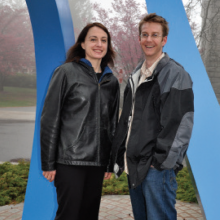
Eric Ostlund from Stockholm, Sweden, and Linda Carter Nguyen of Alameda, California, co-presidents of one of the largest student groups, the International Education Exchange Council.

Eric Ostlund, 24, a graduate student from Uppsala University, Sweden, studying law, economics, and criminal justice, said, “The IEEC is very different from anything you’re likely to find anywhere else, just in terms of sheer size and magnitude and all the different things we do. We’re one of the few environments where if you have an idea and you want to do it, you actually can.”

Ostlund was co-president with Linda Carter Nguyen of Alameda, California, whose Vietnamese immigrant parents named her after the actress who played Wonder Woman, from a television show they watched to learn English. Nguyen joined the IEEC to meet French students on campus before her semester in Paris. “I kind of corralled all the French people on campus and said, ‘Be my friend, take care of me.’ So when I went to Paris, that’s what they did. They picked me up in the airport. They introduced me to their friends,” she said. Flying back home, the liberal studies major resolved “to be more involved in the IEEC to keep this international dream alive.” 
IEEC students are a familiar sight on campus—staffing a study abroad table on the quad, distributing flyers, and organizing events and activities. They also raise funds for scholarships. Noah Kuchins, the IEEC adviser, works to connect all incoming students with buddies “before they set foot on campus.” He finds prospects when they inquire at the OIP about education abroad. His pitch: “You’re interested in studying in Japan and we’ve got 30 Japanese students coming next semester. Would you want to welcome one of them?”

Exchange Brings Opportunities

Students can choose among 115 study abroad programs in 28 countries. SF State has 55 bilateral exchanges of its own and offers 51 more through the California State University international programs office. Exchanges bring international opportunities to every department, including SF State’s undergraduate cinema major. Since 2010 Weimin Zhang, an associate professor and awardwinning documentary filmmaker, has led the International Documentary Workshop in Shanghai, China, each summer in partnership with Xiejin Film and Television College at Shanghai Normal University. She brought the first dozen SF State students to Shanghai in June 2010 to collaborate with a dozen Shanghai Normal students over three weeks to conceive, write, and film four 10-minute documentaries on unusual aspects of life in China, including the local hip hop scene, housing shortages, and migrant workers’ struggles. The students overcome language barriers. Zhang, a graduate of the Beijing Film Academy, said, “Even I was surprised they can make a film in a language they don’t even know.” President Corrigan, who visited the first workshop, marveled that students shared “a common language of film.” The Shanghai film school also sends several students to San Francisco for a semester each term. 

General Education Includes Global Perspectives

All undergraduates must fulfill a cultural, ethnic, or social diversity requirement. Some 300 courses already contain significant international content. Paul Sherwin, dean of the College of Liberal and Creative Arts and formerly dean of humanities, believes a forthcoming general education change will quadruple student enrollment to 4,000 in courses offering comparative study of global issues and regions. “The curriculum already has changed drastically in almost all majors,” even in his own field of English literature, said Sherwin, pointing to a recent hire who teaches a course on Shakespeare’s influence on India’s Bollywood.

“We’re creating global citizens,” said history professor Trevor Getz, an Africa specialist whose popular courses serve as a feeder to education abroad programs in Ghana and South Africa. “It’s not just important that we send our elite abroad. This country does a pretty good job of that. It’s equally important that the kinds of students that we have here are able to have that experience.” 

Read More

2012 Comprehensive Northern Arizona

The strides that Northern Arizona University (NAU) is making on all fronts in international education—doubling international enrollments, tripling participation in education abroad, marshaling enthusiastic faculty support for a Global Learning Initiative that will infuse more global content into the curriculum discipline by discipline—shows what a committed institution can do even under exacting budgetary circumstances. NAU has raised its international profile and activities even while dealing with the loss of a third of its state aid ($60 million) over four years. Part of its success stems from finding a novel way to finance the Global Learning Initiative, coupled with strong leadership and resolute support from the top.  

ITC 2012 Northern Arizona Vice Provost
Vice Provost for International Affairs Harvey Charles stresses the importance of allowing faculty to define global learning outcomes for their own disciplines.

Arizona’s third-largest university, perched beneath the scenic San Francisco Peaks in Flagstaff, already was deeply involved in study and research across the American Southwest—the 27,000-square mile Navajo Nation is next door. The global engagement push has it looking even farther. The university made global engagement a strategic priority and hired Harvey Charles as vice provost for international affairs and director of the Center for International Education. Charles earlier directed international education offices at Wheaton College in Massachusetts, Georgia Tech, and San Francisco State University. President John Haeger and Provost Liz Grobsmith convened the Task Force for Global Education in 2008 and charged it with crafting a blueprint for transforming NAU into a global campus and ensuring that graduates were ready to compete in a global economy. While 18 faculty and administrators formed the nucleus of the task force, 30 other faculty and the then-mayor of Flagstaff, Joe Donaldson, served on five subcommittees (the mayor was on the community engagement panel). They came up with numerous ways to embed global learning throughout academic majors, general education courses, and cocurricular activities. “It is our hope that students will have multiple and substantive encounters (as opposed to merely a one-course requirement) with these perspectives,” said the panel. The faculty Senate gave its blessings to the panel’s raft of recommendations in 2010.

Fast Forwarding Course Development

Anthropologist Miguel Vasquez recalled a meeting to winnow four dozen faculty proposals in the running for $4,000 seed grants to develop new courses. “Harvey walked in and said, ‘Let’s make this easy. I want to award every one of these grants because this is what we’re trying to do on this campus. We’ve got the money, so let’s do it,’” said Vasquez. “It pushed the whole thing fast forward.” The university-wide belt-tightening brought on by the reductions in state appropriations actually whetted faculty appetites for the global initiative, said Blase Scarnati, director of the Global Learning Initiative. “Things started moving around the table, and that kind of kinetic energy made a lot of innovative things possible.”

“Instead of generic global learning outcomes, we’re talking about global learning outcomes in the language of physics, dental hygiene, electronic media and film, engineering.”

Each department was charged with defining global learning outcomes for its own discipline. “Instead of having a university-wide committee telling everybody how to do global learning, we’ve given the responsibility to the faculty themselves,” explained Charles. “Instead of generic global learning outcomes, we’re talking about global learning outcomes in the language of physics, dental hygiene, electronic media and film, engineering.”

Looking at the World Through Sustainability, Diversity Lenses

ITC 2012 Northern Arizona Exchange Student
Feng (Bruce) Wang came as a business exchange student and stayed to work on its China Program Initiatives and earn a master’s degree.

The faculty also were pressed to realign the curriculum in ways that buttressed three bedrock NAU values: sustainability, diversity, and global engagement. Charles launched a twice-a-year, 20-page magazine, NAU Global, that explained the changes ahead and shone a beacon on the extensive study and research that faculty and students were undertaking overseas.

Scarnati, a musicologist, said even minor course adjustments “can have quite a dramatic impact” on internationalizing the curriculum. Assigning civil engineering students to design a bridge for Kenya instead of Arizona requires the same complex math calculations, but also forces students to weigh “all sorts of cultural issues in terms of materials and workforce management,” Scarnati said. When professors and students looked closely, global issues hit closer to home than some realized. In Scarnati’s own department, awareness grew about the threats that development poses to the African blackwood trees that provide the wood to make oboes and other woodwinds. 

It will take time to see some changes bear fruit. Starting in fall 2012, a five-year Global Science and Engineer Program (GSEP) offers science and engineering majors the opportunity to spend a full year studying and interning abroad and to earn a second bachelor’s degree in French, German, or Spanish (or a minor in Chinese and Japanese). It is modeled after the University of Rhode Island’s groundbreaking dual-degree program. Eck Doerry, an associate professor of computer science who used to take rising sophomores on “icebreaker” summer trips to Germany, said, “Engineers are going to have to change how they behave.”

Global Engagement Outside the Classroom

Paul Trotta, professor of civil and environmental engineering and adviser to the Engineers Without Borders (EWB) chapter, led students on service trips to a village in Ghana to build a solar-powered water station and perform other work, including building quarters for a village nurse. They undertook the latter after village leaders identified their most pressing need not as more solar power, but as lodging, to convince the government to send them a nurse. When an engineering student came down with malaria, an anthropology student stepped up to manage construction. It wasn’t applied anthropology, but “what a wonderful experience she had,” said Trotta. EWB also has undertaken wastewater projects on the island of Roatán, 30 miles off the coast of Honduras. “We need projects closer to home,” said Trotta, who noted it costs as much to fly one student to Ghana as it does to build a well.

Leslie Schulz, executive dean of the College of Health and Human Services, led a December 2011 service trip to a Tibetan refugee camp in Mainpat, India. Schulz, a nutritionist and diabetes researcher, brought a dozen faculty and students—dental hygienists, engineers, and sustainable community experts—on the journey that began with two days of flying and an arduous 17-hour bus ride. They dwelled for eight days in a Buddhist monastery and, with other Flagstaff volunteers, fanned out to seven refugee camps providing care, mapping needs, and trying to improve the spotty electricity supply. Schulz brought the leader of the Mainpat community to Flagstaff in May 2012 to help convince other NAU colleges to pitch in on future trips. Her only criterion for who goes is that each must be able “to contribute something to the community, not just study people.”

Surge in International Enrollment

NAU’s international enrollments have nearly doubled since 2008, paced by a surge in students from China and Saudi Arabia. Its  intensive English program “had a huge bump in enrollment,” from 90 students in spring 2009 to 220 in fall 2010, said William Crawford, director and associate professor of linguistics. The program recently expanded into a former elementary school building; the playground, still equipped with slides, is now a designated smoking area.

Image
ITC 2012 Northern Arizona Class
An intensive English instructor and students from Saudi Arabia.

Mandy Hansen, director of international admissions and associate director of the Center for International Education, said NAU’s size and locale is a draw. Sunny Flagstaff has a population of 60,000 and, at 6,900 feet elevation, stays cooler in summer than Phoenix. “In a smaller town like Flagstaff and a midsize school, they can find their place. Parents feel really comfortable sending their students here,” said Hansen. Catherine Ribic, director of international students and scholars, said some “are unhappy when they get here, but then they’re unhappy to leave.” 

NAU was an original participant in an American Association of State Colleges and Universities initiative to promote dual degrees with Chinese universities, and it now has agreements with four dozen universities for a variety of 2+2, 1+2+1, and 1+3 programs. Four of the 35 staff members of the Center for International Education work on the China initiatives. Among them is graduate student Bruce Feng Wang, who originally came to NAU on a 2+2 exchange from Beijing International Studies University. As a junior business major, Wang was part of a student delegation that met Warren Buffett in Omaha, Nebraska. He even got to question the legendary investor about his decision to invest in a Chinese electric car company—an investment that subsequently turned sour. “NAU has really valued international education,” said Wang. “I have friends who went to bigger universities, but they don’t provide the resources for international students that NAU does.”

Grabbing Every Opportunity

The Chinese government pays for faculty to attend what NAU calls its Scholar Academy where they learn about U.S. higher education and pedagogical approaches. Dozens of NAU faculty have lectured in China. Grobsmith allowed Charles to retain some revenues from the Scholar Academy to help fund other global activities, including the engineering dual degrees and a symposium highlighting student research. “We found a mechanism that enables him to invest in all these initiatives that have put us on the map,” said Grobsmith, who retired in June 2012 as provost and became special assistant to the president for strategic and international initiatives (The new provost is Laura Huenneke, biologist and former NAU vice president for research). NAU now is looking to create dual-degree programs with universities in Indonesia, India, and elsewhere. “Every opportunity that comes along, we try to grab it,” said Grobsmith. “There’s just unending opportunity. There’s a tremendous value placed on American-style education, and people are hungry to get their students here.”

Michelle Harris, associate professor of sociology, helped establish a dual master’s degree program with the University of Botswana. Two NAU graduate students spent 2011–12 in Botswana, while Thembelihle Ndebele spent the year earning a master’s degree in Flagstaff. Harris said the soft-spoken Ndebele helped give Arizona students “a taste of the world” in every class she took. Ndebele spent part of her year in Flagstaff interning with Catholic Charities. “I’ve learnt a lot from this experience. It will help me go back and try to boost our child safety systems,” she said.

Go Scholarships and Frequent Sales Pitches

Student participation in faculty-led education abroad courses tripled in three years. So-called GO Scholarships ranging from $250 to $1,000 are helping fuel growth. Half the $100,000 awarded comes from a small fee collected by the student government from all 17,000 undergraduates. There were 20 faculty-led study trips in 2012, mostly in summer. “We presented to 3,400 students in person in spring 2012 through class visits, information sessions, and fairs on campus,” said Eric Deschamps, director of education abroad. NAU focuses mainly on exchanges, which puts education abroad “within reach of a lot of our students,” he added. Still, even with growth in education abroad offerings, only 355 NAU students studied abroad in 2010–11.

NAU serves many first-generation college students and others with little familiarity with other countries and cultures, even though Mexico is just across the border. On a class for graduate students that Charles led to view student affairs operations at European universities in May 2010, more than half the participants were traditionally underrepresented students. Among them was Marvin Jim, a Navajo graduate student who works at NAU’s Native American Cultural Center. He called the trip “a defining moment in my life. We went to Europe with lots of questions and came back with even more. We got out of our comfort zones.” 

Senior Ruth Naegele gave up a career in supply management to start college in midlife and spent a semester at the University of South Australia on a Gilman Scholarship. It “could not have been a better experience,” said Naegele.

Early Stage of the Journey

NAU is still at an early stage of this journey but is well positioned to keep accelerating its progress. Vasquez, the anthropologist, noted the Southwest “is the only place in the world where the so-called first and third worlds share a border.” Both international and minority enrollments are growing. A decade ago 77 percent of students were white; now they comprise 66 percent. Latino enrollment jumped almost 8 percent from 2010 to 2011, while 5 percent more international students enrolled. “This place is a wonderful laboratory for diversity,” said Vasquez. The Global Learning Initiative gives NAU faculty and students new opportunities to learn about the world—and themselves.

Image
ITC 2012 Northern Arizona Surveying
Engineering students practice surveying on campus.
Read More

2012 Comprehensive Saint Benedict and Saint John’s

ITC 2012 Saint Benedict and Saint John’s Concert Pianist
Father Bob Koopmann, concert pianist and the last Benedictine monk to serve as president of Saint John’s, says the values won’t change.

Amid the woods, lakes, and prairies of Central Minnesota, the College of Saint Benedict (CSB) for women and Saint John’s University (SJU) for men provide a liberal arts education suffused with international experiences and coursework. Saint Benedict and Saint John’s ranked first among baccalaureate institutions in semester-long education abroad and 13th in international student enrollment in the 2011 Open Doors report. The biggest department—management—recently overhauled its curriculum and changed its name to the Department of Global Business Leadership. CSB and SJU have one of the most unusual coeducational arrangements in U.S. higher education: two campuses, four miles apart with two presidents but a single faculty and school buses that ferry students back and forth during half-hour breaks between 70-minute classes.

The separate campuses are bound by shared Benedictine values—monks founded Saint John’s in 1856 and nuns opened Saint Benedict in 1913. Saint John’s recently named its first lay president,  Michael Hemesath, an alumnus and Carlton College professor of economics, and shifted to lay control, as the sisters did half a century ago. Father Bob Koopmann, the last Benedictine president of Saint John’s, said the values won’t change. He expressed pride that the two schools have been able to partner since 1965 without one engulfing the other. “It hasn’t been easy over the years because Saint Ben’s was smaller—now they’re bigger—and within the Catholic Church men dominated and still do. But the fact that we could work it out is just wonderful,” said Koopmann, a concert pianist, music professor, and alumnus.

A More Seamless Approach to Internationalization

Sixty percent of the 2,000 “Bennies,” as the female students are known, and 45 percent of the 1,900 “Johnnies” study abroad, most on one of the colleges’ 17 semester-long programs on a half-dozen continents. Sixteen of these programs are led by faculty. In addition, the schools offer up to a dozen summer courses overseas and arrange service and internship opportunities from Belize to Bosnia to Hong Kong. 

It’s expensive to dispatch so many faculty around the world. “It has some challenging attributes,” said College of Saint Benedict President MaryAnn Baenninger, but this approach makes it easy for students to study abroad “with little detrimental challenge to their curriculum.” It is also “the only model that lets you change the international experience of your faculty in a wholesale way after they arrive.”

Nonetheless, the Saint Benedict president sees “a very big danger in equating internationalization with study abroad.” Especially since making internationalization one of three cornerstones of a 2010 strategic plan, the colleges have shifted emphasis from student mobility to a more comprehensive approach. “We’re developing more of a seamlessness on what it means to be global, but we’re not there yet,” said Baenninger, a psychologist. “We have to constantly poke ourselves and remind ourselves that just counting study abroad numbers isn’t what it’s all about. It’s what other activities students voluntarily choose to engage in and how they interpret difference and the ‘other.’” It is tempting for the 80 percent of students from Minnesota “to think that they and their culture are the norm,” she said. “You have to come at that in every which way.”

A Part for Everyone

Joseph Rogers, director of the Center for Global Education, echoed those sentiments. Internationalization “has to be embedded in all aspects of the college. It can’t reside just in study abroad or international student programming. Everyone has to feel they have a part to play in internationalization, from faculty who teach mathematics and the natural sciences to student development professionals in the residence halls,” he said. 

Rogers, an attorney and East Asia expert, led a semester program in China in 2006 for his alma mater, stayed on as director of education abroad, and was tapped to run the new Center for Global Education in 2010. Peggy Retka, his successor as director of education abroad, said, “We stick with our own programs because that allows us to build the academic offerings around our common curriculum, and so, almost every student can fit a semester abroad into their four-year plan. That’s good for our faculty and good for our students’ participation rate.” Each student on the faculty-led semester programs takes a four-credit study abroad seminar to fulfill an intercultural and experiential learning study requirement.

Image
ITC 2012 Saint Benedict and Saint John’s Buses
Queuing at Saint John’s for the buses to Saint Benedict.

In the years leading up to creation of the Center for Global Education, top administrators already were pushing to professionalize study abroad operations and make them less dependent on the proclivities of individual faculty. “Some faculty thought they were losing ownership of the programs,” said Vice Provost Joseph DesJardins. “There were some tough times but those conversations really matured the community.” DesJardins credited Rogers and Retka with allaying those concerns “by making decisions in a real collaborative way.” A 12-person advisory council composed of faculty and administrators now provides the vehicle for that collaboration. 

Growing Interest in China, Japan, and India

Rogers has moved to expand partnerships with institutions around the world and cement ties that began with those individual faculty contacts. One of the oldest and deepest partnerships is with Southwest University in Beibei, China, which stretches back to 1986. A faculty development trip to East Asia a decade later whetted chemistry professor Henry Jakubowski’s interest in Chinese medicine. He went on to lead the China semester program twice and teach an honors senior seminar, “Medicine: East Meets West.” He also had a hand in creating a summer exchange that allows 16 students from both countries to conduct research for six weeks in China and then six weeks in Minnesota. “It’s a fantastic way to build relationships,” said Jakubowski, who listens to Mandarin tapes through a speaker mounted on his bicycle as he pedals to work.

The colleges launched an Asian studies major in 2009 and expanded Chinese and Japanese language instruction with the help of a $140,000 U.S. Department of Education Title VI grant. A semester study program in Kolkata, India, was launched in 2011, thanks to the efforts of English department chair Madhu Mitra and other faculty with roots in that area. Mitra led the first group of students to Kolkata and even landed novelist Amitav Ghosh as a guest lecturer. It took three years and three faculty development trips to India to make that new program happen. “We did our homework,” said Provost Rita Knuesel. “I wanted to make sure I could look at two presidents and say, ‘We are ready to go.’” An economics professor, Sucharita Sinha Mukherjee, led the program in 2012, and Mitra will take the class to Kolkata again next spring. But Mitra said, “We’re really hoping that the next time (2014), a non-Indian faculty member will lead this course. It will be completely unsustainable if it’s just people from India.”

Junior Kia Marie Lor, 20, of St. Paul, the daughter of Hmong immigrants and recipient of a Gates Millennium Scholarship, jumped at the opportunity to study in Kolkata, but first had some convincing to do at home. “My mom was really upset. She was like, ‘Are you dropping out of college?’” the communication major related. “I told her, ‘No, I am just studying abroad.’ To a Hmong mother that is completely bizarre. In the Hmong language there is no word for study abroad.” But she won her mother over and later spent a second semester in China.

Since 1989 more than 1,200 Japanese high school students have attended a summer ESL program at CSB and SJU, which grew out of an enrichment program for U.S. high schoolers that history professor David Bennetts had organized. “That was the start of my venture into things international,” said Bennetts, who taught January courses in Japan seven times, started a semester exchange with Bunkyo Gakuin University in Tokyo, and created a U.S. history course for international students.

A Semester-Long Orientation Course

The colleges enrolled 252 international students in 2010–11, or six percent of enrollment. They are drawn by the availability of financial aid and scholarships that range from $4,000 to $19,000 a year. Vice Provost DesJardins said, “They are not visitors. It’s not ‘them.’ They’re us. If a kid is coming from Japan, they are going to be treated the same way for financial aid purposes as the kids coming from Chicago.” 

International students take a 12-week cultural academic orientation course in their first semester in addition to the standard three-day orientation that all new students attend.  Lisa Scott, the academic adviser who co-teaches the classes, said, “One of my very first lectures is about explaining the liberal arts and understanding why you’re here and what the liberal arts means to you.” For students interested only in business, “that’s a hard one to swallow at first so we come back to it again and again,” Scott said. “That ongoing orientation class is a real gift,” said Alex Schleper, director of the International Student Program Office and a onetime Saint John’s quarterback who shares the instructional duties.

“They are not visitors. It’s not ‘them.’ They’re us. If a kid is coming from Japan, they are going to be treated the same way for financial aid purposes as the kids coming from Chicago.”

ITC 2012 Saint Benedict and Saint John’s Student Workers
Student workers at the international student program office.

The colleges tapped the brakes on recruitment in China after an outsized entering class—50 instead of the usual 25—encountered difficulties in 2009–10. “They weren’t as successful in their first year as we had hoped they would be,” said Baenninger. The number reverted to normal for 2010. The lesson, said Roger Young, the international admission director, was that “we need to diversify. We can’t rely on China and the Bahamas and Trinidad and not on other areas of the world.” The colleges traditionally have had a pipeline to Caribbean countries where the Benedictines have monasteries.

There are far more success stories than disappointments. Huaweilang (Clement) Dai, 23, of Shanghai, China, graduated with a Phi Beta Kappa key and landed an internship with the Woodrow Wilson International Center for Scholars and its Kissinger Institute on China and the United States. Dai, who interned previously with the American Council on Renewable Energy, dreams of helping his homeland make greater use of clean energy even while it builds more coal plants. “We can’t abandon fossil fuel energy overnight,” said Dai, three of whose roommates studied or traveled in China.

Documenting Humanitarian Issues

The colleges offer students opportunities to volunteer in Tanzania, Dominican Republic, Ecuador, Guatemala, and Bosnia-Herzegovina. (Forty young people from Bosnia-Herzegovina attended the colleges on scholarships paid for by a trustee). Senior Trang Pham, 23, went to Bosnia for 20 days as part of a student group called Extending the Link that each year travels the world to produce a documentary on humanitarian issues. Hers was on recovery from the Balkan war. Earlier documentaries addressed the plight of orphans in Uganda and human trafficking in Nepal.

It was the fifth time the Vietnam-born Pham used her passport for college-sponsored study and service, after earlier stops in Japan (May 2009), Egypt and Israel (May 2010), Vietnam (summer 2010), and China and Hong Kong (winter 2010). She was one of the E-Scholars—“E” for entrepreneur—who are groomed to create socially conscious business ventures. 

Students can earn credit following El Camino de Santiago de Compostela (or Way of Saint James), the pilgrims’ route in Spain. The late Jose Antonio Fabres, a professor of Hispanic Studies, said that class provides “a very humbling” experience for college students: being on the receiving end of help. “In a lot of programs students do things for others. In this program others do things for them. They get help from strangers when their blisters become unbearable,” explained the Chilean-born Fabres in an interview weeks before his death from cancer.

Baenninger has launched a program that has taken dozens of Saint Benedict students to the Women as Global Leaders Conference in the United Arab Emirates, where the president serves on the board of trustees of American University of Sharjah.

Read More

2013 Comprehensive Lone Star College System

Amid dizzying growth in communities ringed around north Houston, the newest expansion of the 78,000-student Lone Star College System will add just 300 to 350 students—in Jakarta, Indonesia. It is a modest enterprise by Texas standards but is in keeping with other Lone Star efforts to internationalize the education it delivers at its six colleges to all students—2,000 of whom are international. 

ITC 2013 Lone Star Chancellor
Lone Star Chancellor Richard Carpenter

The architect of this expansion is Chancellor Richard Carpenter, who as a foster child in Louisiana foresaw a future painting houses before a music scholarship to a community college altered his personal trajectory. He became at 29 the country’s youngest college president in a Kentucky community college and ran systems in Nevada and Wisconsin before becoming Lone Star’s chancellor in 2007. He is a veteran of several economic development missions abroad led by governors and has seen how much interest there is among foreign leaders in building U.S.-style community colleges of their own to expand opportunity. “They look at it like they discovered gold,” said Carpenter, who sits on the board of Community Colleges for International Development, Inc. “We are American ambassadors. We take the American dream and plant it around the world.”

Magnet for International Students

Lone Star, founded in 1972, was North Harris Montgomery Community College District before adopting its current name in 2007. Lone Star’s enrollment stood at 49,000 in 2007. Its growth surge was fueled by the recession that sent unemployed workers to community colleges to improve their job prospects. Local voters approved a $420 million bond issue for expansion in 2008, and in 2012 Lone Star opened a sixth campus, University Park, in office space that once was the headquarters of Compaq computers. But a half-billion dollar bond issue was rejected in May 2013, which may apply the brakes to future growth.

Houston, a global center for the oil and gas industry, remains a powerful magnet for international students. Houston Community College enrolls 5,800, more than any other two-year college. Lone Star was fourth in 2011–12 with 2,000 and has had as many as 2,500. They pay $5,000 a year in tuition, a quarter of what University of Houston charges. “What a gift to get a solid education here and transfer that to a four-year university,” said Nithyanantha J. Sevanthinathan, Lone Star’s chief international officer who heads strategic global partnerships, and “Nithy” to everyone. 

Internationalizing the Faculty

Lone Star committed itself to an international course when it established an International Programs and Services (IPS) office in 2004. Nithy, the first director, formulated the framework and implementation. In 2008 IPS began awarding $4,000 Faculty International Exploration (FIE) awards to encourage faculty to internationalize the content of their courses and create education abroad programs. Fifty-five faculty have shared $270,000 in awards. The first went to then-band director James Stubbs, who visited jazz festivals in Europe and returned the next summer with students who performed at the famed Montreux Jazz Festival in Switzerland and in Italy. “We felt like celebrities,” said Stubbs, now dean of arts and humanities at Lone Star-Kingwood.

Only 41 students studied abroad in 2011–2012, even with the college offering 15 scholarships up to $2,000. “Program cancellations due to low enrollments have been the biggest challenge,” said Malaysian-born Nithy. Six of ten courses offered for summer 2013 were cancelled. Lone Star-North Harris Art Professor Eric Sims has tried unsuccessfully to run an art appreciation program to Spain, but said, “I haven’t given up. Many of these students have never been out of Houston. This is a life-changing experience.”

Stirring Imaginations

Still, Lone Star faculty have taken students to Italy, China, the Philippines, Sri Lanka, and Tanzania, and the FIE awards are a powerful stimulant for faculty imaginations. Lone Star-CyFair Psychology Professor Lori Richter and Adjunct Professor Davida Rogers took 16 students in June 2013 to Tanzania, where they studied orphans and children at risk, performed service, and took a safari in the Serengeti. Richter, a former Peace Corps volunteer in The Gambia who also lived in Kenya, said, “I just want our students to experience my experience. I want them to feel like the whole world is open to them.”

ITC 2013 Lone Star Study Service
Lori Richter, psychology professor and former Peace Corps volunteer, led Christopher Garcia and 15 other students on a study/service program in Tanzania.

Christopher Garcia, 19, a business student and the sole male in the Tanzania group, saved money from several jobs to go. “I’ve been looking at study abroad since I got to Lone Star,” said Garcia, who helped organize a community service project last spring in Houston that drew more than 300 volunteers. Garcia aspires to become an international businessman and when he does, “I want to be culturally sensitive.

Like Richter, Lone Star-Montgomery Spanish Professor Norseman Hernandez, who grew up in poverty in Honduras, embodies a passion for education abroad. “I was one of the kids selling food to people on buses. It’s been a long way for me to be here,” said Hernandez, who’s led students to Mexico twice and Chile once.

“My classes aren’t just about uno, dos, tres, and Ola! Como está? They’re about the world,” said Norseman, who as a boy dreamed of being a pilot. He uses Google Earth in his classes and assigns students to make presentations on different parts of the world. “I also learn. It’s like I’m traveling and I’m there, too,” he said. “I’m not in a cockpit, but I get to go wherever I want now.” 

“I’ve been looking at study abroad since I got to Lone Star,” says Garcia, an aspiring businessman. “I want to be culturally sensitive.”

International Education Conferences

The pride of Lone Star’s international programming is the International Education Conference it has held each spring since 2004 where prominent speakers address global issues and Lone Star’s own professors give workshops on their international  explorations. The conference sprang from a Title VI international studies grant that the North Harris campus won in 2002. “Everything international comes from that grant,” said Anne Albarelli, dean of academic affairs at North Harris. She and Theresa McGinley, dean of instruction in the Social and Behavioral Sciences, Business and Economics Division, spearheaded that effort and today serve on the conference planning committee and the IPS Council. 

Lone Star has spent $60,000 on the conferences over the years. The keynote speaker at the 10th conference in April 2013 was Middle East expert Mark Kimmitt, a retired brigadier general and U.S. State Department official. Lone Star has also piggybacked with the World Affairs Council of Houston to host such figures as Lech Walesa, the former Polish president and Nobel Peace Prize laureate. McGinley, whose parents survived World War II in Poland, said she always brought international perspectives to her U.S. history courses. Today more than 70 Lone Star courses carry an international studies designation.

Nithy is the impresario of the conferences. He was an international student once who came to Minnesota to pursue opportunities largely unavailable to Malaysia’s Hindu minority. With Fulbright support, he earned a peace studies degree and two MAs while organizing bicycle treks across the United States, South America, and Africa that schoolchildren followed online. “My dream was to journey the whole world on a bicycle,” said Nithy, whose father was a shipyard laborer.

Saving Vietnamese Parents Money and Visiting Wall Street

The largest number of international students come from Mexico, Columbia, Venezuela, Vietnam, and Nepal. Some live with relatives in Houston and commute to Lone Star. The six campuses are more suburban than urban. “They look like (international students’) image of what an American college looks like,” said Melvin Anthony of Lone Star-CyFair, one of 14 international student advisers.

ITC 2013 Lone Star Student Scholarship
Chi Cao of Vietnam won a Jack Kent Cooke Foundation scholarship as one of the nation’s top community college transfer students.

That is the route second year student Chi Cao, 20, followed, journeying from Danang, Vietnam, four years ago to live with an uncle in Houston while she completed high school and enrolled at Lone Star. “I decided to go to Lone Star to save my parents money,” she said. They are going to be saving a lot more. In April 2013 she won a $30,000-a-year scholarship that the Jack Kent Cooke Foundation awards to top community college students. Cao is headed to Texas A&M University and looking forward to buying textbooks for the first time instead of reading reference desk copies in Lone Star’s library.

Cao, a finance major who hopes to help Vietnam develop its financial system, revived a moribund international club at Lone Star, won class office, and was on a Model United Nations team that convened in New York. “As an international student, if you only have grades, it’s not going to help you get into a good school. You have to be involved in school and get this on your resume,” she said. Cao got to visit Wall Street on the New York trip. “It inspired me,” she said.

Naziat Khan, 24, was also on that Model UN team, which represented Bhutan, a Hindu country in the Himalayas. Born in Bangladesh and raised in Texas, Khan, who is Muslim and wears a hijab, said it was hard at first “to think like a Bhutanese.” Now she’s convinced that the best way to resolve problems is to “step into somebody else’s shoes.”

Expanding Overseas Without Taxpayer Dollars

Lone Star will offer dual degrees in Jakarta in a partnership with the Putera Sampoerna Foundation. Classes will be taught in English by Lone Star and local faculty. The venture came about after Nithy met a representative of the Foundation at a State Department-sponsored conference. Putera Sampoerna is an Indonesian industrialist whose foundation was looking for a four-year U.S. college to partner with its new Universitas Siswa Bangsa Internasional. Nithy convinced the foundation executive that Lone Star was worth a look. Sampoerna himself visited and liked what he saw.

Carpenter traveled to Jakarta three times and Nithy four times in advance of the opening. “We sat with the people in Jakarta and said, “We have a lot of expertise. We have the curriculum you need, we have instructional designers, we have technology and IT infrastructure, but we don’t take taxpayer money outside of our neighborhood,” said Carpenter. The foundation agreed to cover Lone Star’s costs up front, including salaries and expenses for two faculty and an administrator, with the expectation that Lone Star will repay that after the college starts generating profits.

Getting Used to Accents

Shah Ardalan is president of Lone Star’s sixth and newest campus, University Park. An electrical engineer who was born in Kurdistan, Ardalan was formerly the system vice chancellor and chief information officer. He has a patent pending on a digital career planning system that has won plaudits from the U.S. Department of Education. Ardalan wants to make University Park, which offers upper division classes in partnership with five Texas universities, “a model as the innovative college for the twentyfirst century.” 

Ardalan believes Lone Star should cast an even wider net for international students. “I want to be a reflection of what the real world is. It’s good for (international students) and good for my American students, too,” he said. When a Texas student complained about a professor’s accent, Ardalan told him to get used to it “because you’re going to hear more and more accents. When you pick up the phone, you cannot expect everybody to talk with the ‘nice’ accent you were raised with.” No one else had trouble understanding the professor, Ardalan noted. 

Dreaming in English

Ita Jervis spoke almost no English when she moved to Houston from Ecuador in 2001. She enrolled immediately in ESL classes, graduated summa cum laude from Lone Star and the University of Houston, and today advises international and ESL students at Lone Star-Kingwood. “What I love about Lone Star,” Jervis said, “is that we act. It’s not just words, it’s actions. We’re not waiting for tomorrow. Everyone works together as a team to do the best for our students.”

She often tells students what she told a classmate who addressed her in Spanish when both were ESL beginners: “Right now our mission is to speak English, so let’s practice speaking English within ourselves, because the faster we learn the language, the better we can achieve our goals.”

Her husband, who worked for an oil company and spoke English, told her that she’d know she was speaking the language, not just translating words, when she dreamed in English. The night that happened, she woke up and “just started jumping, I was so happy,” recalled Jervis.

“What I love about Lone Star,” Jervis said, “is that we act. It’s not just words, it’s actions. We’re not waiting for tomorrow. Everyone works together as a team to do the best for our students.”

She also counsels students to believe in themselves. “The first thing that happens when you come to a different country is that you lose your self-confidence, whether you are educated or not, poor, middle class, or rich. You feel stupid,” she said. One day, she assures them, they’ll be dreaming in English. 

Read More

2013 Comprehensive Colorado State

Soon after veterinary pathologist Tony Frank became vice president for research at Colorado State University in 2000, he was asked by the then-president to accompany him to South  Korea. “I wasn’t horribly enthused,” recalled Frank. “I’d been very focused on my own lab and had almost no connections to international activity. I really didn’t see what value I was going to add or how it was going to have a big impact.” But Frank returned from Seoul “an absolute convert,” won over to the idea that forging strategic partnerships with universities overseas could expand Colorado State’s reach and pay large dividends for its scholars, researchers, and students. “To be honest, I spent a lot of time kicking myself after that for having missed as many opportunities as I had over the years,” said Frank, who went on to become provost and, in 2008, president. He now has logged 12 international trips. 

ITC 2013 Colorado President
President Tony Frank came late to international work but now pursues it with a convert’s passion.

The land-grant institution, established in 1870 when Colorado was still a territory, is working hard not to miss opportunities these days. It has close partnerships with 17 universities in 11 countries including a new Joint Research Institute with East China Normal University (ECNU) in Shanghai and a robust dual-degree program with the Foreign Trade University in Hanoi, Vietnam. It has stepped up recruitment of international students to the picturesque Fort Collins campus in the foothills of the Rockies. In 2008–2009 there were fewer than 900 international students. Today there are more than 1,650, including a recent influx of more than 400 in its new intensive English and academic preparatory program called INTO Colorado State University. 

CSU is following a script laid out in a 2007 internationalization strategy. Leaders speak of “building the brand” and improving lives “throughout Colorado and the world.” Tom Milligan, vice president for external relations, who spearheads the branding push, said, “Being a global institution is part of how we want to think and talk about ourselves and position ourselves. We’re different from other medium-to-large-size public institutions. The things that we’re good at, like water, biomedicine, and veterinary medicine, we’re as good as anybody in the world.”

Links Around the World

Vice Provost for International Affairs James Cooney said, “The heart of our internationalization strategy from the beginning has been to link specifically to institutions around the world, get our faculty involved with those institutions, and develop joint research.” The hiring of Cooney in 2007 to a new position with elevated stature was also part of that strategy. The political scientist was lured to Fort Collins from Harvard University’s Weatherhead Center for International Affairs.

One aspect of Colorado State’s story is familiar to public universities almost everywhere: steep state budget cuts, amounting to $36 million or 28 percent over three years before a $6 million bump up this year. Only federal stimulus funds spared Colorado’s universities steeper cuts. The National Science Foundation ranked Colorado last among research universities in state funding per student. Colorado State relies on state money for less than 10 percent of its $911 million budget. It conducted $376 million in research in 2012. 

"President Tony Frank came late to international work but now pursues it with a convert’s passion."

The $220,000 that Cooney’s office had been given to expand education abroad, strategic partnerships, and other activities was shaved by $40,000. But its budget and staff kept growing thanks to $330,000 in added revenues from the spurt in international enrollments and new partnerships in China and elsewhere. “We feel we have one of the best models for working with China,” said the vice provost. China pays for up to 30 faculty to travel to China for research collaborations and steers talented students from a dozen high schools to CSU. Colorado State, for its part, gives each an $8,000 scholarship. It opened a five-person recruiting office at East China Normal University and recently cut the ribbon on a Confucius Institute specializing in water issues. 

A New Pathway “Into” the University

Colorado State is one of four U.S. universities partnering with INTO, a for-profit British company that forms partnerships with universities in the United States, United Kingdom, and China to recruit students and place them in intensive English and “academic pathways” classes with extensive support that lead to regular undergraduate and graduate studies. Provost Rick Miranda said, “We’d like to have more students come from South America, from Europe, from Malaysia and Indonesia. We don’t want to skew things too much toward China.” INTO has moved into renovated Spruce Hall, CSU’s oldest building. Many students live with domestic students interested in world affairs on a floor of a dorm designated the Global Village.

Haotian “Stewart” Wu, a senior business administration major from Hefei, China, is a live-in mentor there. He transferred to CSU as a junior from Anhui Agricultural University on a 2+2 program. He spent summer 2012 as a paid INTO “ambassador” traveling around China marketing CSU at education abroad fairs. The outgoing Wu has friends on the football team and attends games. Football “is pretty boring, but actually I learn a lot” about U.S. culture, said Wu.

The Office of International Programs teams with the athletics and alumni offices to offer a “Football 101” class where international students learn the rules, try on helmets and shoulder pads, tailgate, and attend a game. “They get a real kick out of it,” said Mark Hallett, senior director of International Student and Scholar Services. As many as 200 turn out and “scream with excitement” at kickoff. 

Grooming Gilman and Fulbright Scholars

Colorado State has also stepped up its education abroad offerings and, by raising funds from colleges, departments, donors, and providers, tripled scholarships to $150,000. Director of Education Abroad Laura Thornes said more than 800 students took classes for credit, and 500 took part in noncredit experiences in 2012–2013. Most went to Western Europe, but 115 studied or worked in China and Japan, 25 went to Kenya, and 17 to South Africa. One in six students has studied abroad by graduation. “If we could get to 25 percent, that would be our ideal,” said Thornes.

A push to encourage Colorado State students to apply for Benjamin Gilman International Scholarships paid immediate dividends. Two dozen won Gilmans in 2012 and 2013, more than the previous four years combined. The awards of up to $5,000 go to students who receive need-based Pell Grants. “We worked with all the diversity offices on campus to make them more aware of the Gilman,” said Thornes. Faculty and staff volunteers read and critiqued students’ essays. Accounting major Sabiha Dubose said her Gilman to study in Antibes, France, was “truly a blessing.”

“We worked with all the diversity offices on campus to make them more aware of the Gilman.”

ITC 2013 Colorado International Volunteers
Brooke Lake and Meggie Schwartz volunteer as cultural mentors for international students.

A similar push is underway for Fulbrights. Karen Gardenier, the Office of International Programs’ assistant director for academic programs, works with representatives from each of CSU’s eight colleges. Fewer than a dozen students applied in past years and only a handful won. “We’re hoping to get those numbers up and create more of a culture on campus for Fulbright,” said Gardenier. That effort includes small stipends for faculty to handpick and groom prospects. CSU also increased incoming Fulbrighters in the past five years from five to 35 annually.

International and Arabic studies major Brooke Lake is spending six months in Morocco and Jordan improving her Arabic before graduation. Lake, who volunteers as a cultural mentor to international students, did charity work in Egypt over an earlier summer, which “kick started my passion for the Middle East.” This all took her family by surprise. “They had no idea who their daughter was. My mom was like, ‘Who are you?’” recalled Lake, but now “she loves it.”

Making Music Together

There is a musical quality to CSU’s partnership with East China Normal University. After President Frank heard a concert in Shanghai, he set in motion a collaboration between the two universities’ musicians. East China’s opera director Cao Jin and Todd Queen, chair of music, theater, and dance, quickly “hit it off,” said Queen, a tenor who sang and taught master classes at the Shanghai institution. Twenty-five ECNU students and faculty came to Fort Collins in 2010 and with CSU’s orchestra and choir they performed Beethoven’s Symphony No. 9, with its “Ode to Joy,” a universal anthem for freedom. “It was a once-in-a-lifetime experience,” said Queen.

Mezzo-soprano Carol Perry sang in Shanghai in 2011. The experience was invaluable, she told a college publication. “In the performance world, we have to adapt to other cultures quickly. Not every production or rehearsal will be in your language. You need to be present in the culture you’re in,” she said. Most recently, Chinese and Colorado State students performed The Yellow River Cantata in CSU’s concert hall.

It is not the arts alone bringing CSU and ECNU together. They created a Joint Research Institute for New Energy and the Environment in 2011, with each committing to spend $300,000 annually for three years on the search for clean alternatives to fossil fuels. Wei Gao, a professor of ecosystem science and sustainability who directs the CSU China Programs office and Confucius Institute, also leads this research institute, which works on land, water, air quality, and climate issues.

Playing Pachelbel and Parsing P&G Financials

Since 2008, 32 economics and business faculty have taught compressed, four-week courses at Foreign Trade University (FTU) in Hanoi, Vietnam, which is “trying to reform its curriculum to mimic ours,” said economics professor Robert Kling. “It has really contributed to the internationalization of our faculty and had the unanticipated effect of giving our department more of a sense of community.” Vietnam’s education ministry pays CSU $23,000 for each course taught.

Thirty Vietnamese students spend their senior year at CSU and earn dual degrees. One is Phong Nguyen, who could be found one afternoon in a theater lobby of Lory Student Center playing Pachelbel’s Canon in D on a grand piano. The dual-degree program “is considered the best in our university,” Nguyen said. Classes at CSU were “more practical and down to earth,” added Nguyen, who liked working in teams to analyze a Dell bond issue and a Procter & Gamble financial report. “We’re learning from each other and from doing the projects.”

FTU is a CSU strategic partner. Many of those partnerships have been forged in rapid succession since 2008. Chad Hoseth, director of international initiatives, said CSU is now assessing all 17 and considering changes. “This is a list that evolves to meet the needs of our faculty and students,” he said.

Protecting Tigers and People

ITC 2013 Colorado Enviornmental Research
Research scientist Paul Evangelista and Professors Kathy Galvin and Robin Reid have all done extensive environmental research work in Africa.

Protecting natural resources is a passion at Colorado State and much of that work is conducted on an international scale. Nearly 90 Indian Forestry Service officers have trained at CSU. Social psychologist Michael Manfredo heads the Department of Human Dimensions of Natural Resources, which deals with finding ways for people to enjoy nature without trampling on it. Managing wildlife and natural resources “is 10 percent biology and 90 percent managing people,” said Manfredo, just back from working on an effort to reduce tiger-human conflicts in Dehadrun, India.

The department also offers a Conservation Leadership Through Learning master’s degree that involves a year of classes in Fort Collins and a second year of field work in Mexico. Seven of the first 21 students were international, and the program is expanding to Peru, New Zealand, and Kenya. In the field, Manfredo said, “everybody is a learner. The professors are learning new ways of thinking (just) as the students are.”

Manfredo said the elevated stature of the Office of International Programs helped get that program off the ground. “It sure makes it easier when you’ve got someone appreciative and supportive of what you’re doing,” he said.

Prairie Populism Writ Large

Robin Reid, director of the Center for Collaborative Conservation in the Warner College of Natural Resources, spent 20 years in East Africa conducting livestock research. Support from the top at CSU, she said, “is sparking connections all over the place. It’s causing this cross-campus set of energy and activities that is good for (everybody).” Research ecologist Paul Evangelista, who has worked in Ethiopia for 14 years, said CSU has long fostered his interdisciplinary work. 

Hoseth, the international initiatives director, said, “Our genetics are collaborative.” Case in point: when the College of Business hired its own study abroad coordinator, they placed her in Laurel Hall with the rest of the international program staff.

Hallett, the ISSS director, said, “There’s a bit of the prairie populist about this campus. It’s a land grant, outward-focused (institution) with a lot of idealism,” and now it’s doing extension work writ large on the international stage. 

Read More