
The Southward Shift

For those of us working in international education, 2025 was a year that required creativity and adaptability. It was marked not only by challenges in higher education, but also by a broader global context shaped by geopolitics, shifting priorities, and changing patterns of student mobility.
And for me personally, as someone who has dedicated more than 20 years to building partnerships and developing intercultural opportunities for students and scholars, it was also a year that offered unexpected moments of encouragement.
Meaningful International Engagement
In my role as director of international relations at Universidad de los Andes (UANDES) in Santiago, Chile, I work at the intersection of global partnerships, intercultural communication, and academic collaboration. It is a position that allows me to witness every day how meaningful international engagement can be.
For more than a decade, universities in the United States have been among our closest and most consistent partners, particularly in the development of tailor-made short-term programs. Since 2014, we have worked closely with a wide range of U.S. institutions to codesign experiential programs that bring their students to Chile and integrate them into our campus and local communities.
At the same time, we have been sending a growing number of Chilean exchange students who are eager to experience college life in the United States and learn from its rich academic traditions. These collaborations have become essential to our international strategy, not only for their academic value, but also for the trust and long-lasting professional relationships we have built together.
Shifting Winds
This year, however, the landscape changed. Due to uncertainties related to travel, our outgoing students opted for alternative destinations other than the United States for their exchange semester. At the same time, my team and I feared that U.S. institutions might also pause their programs with us—that mobility would quiet on both sides, even if temporarily.
And yet, something remarkable happened. It felt as if the winds had shifted, carrying the movement of mobility southward rather than north.
We hosted more than 100 students from U.S. universities here in Chile, a number that increased compared to 2024. Our established programs continued, and we even introduced new ones. Universities from Massachusetts, Georgia, and California, among other states, kept sending their students, even in a year marked by unpredictability. Many of our partners have already scheduled programs for 2026, and others are already planning for 2027.
What made this especially meaningful was the distinctive nature of our programs. These are not traditional academic trips. They are immersive, interdisciplinary experiences that combine academic content with cultural learning, community engagement, and above all, direct interaction with Chilean students. Our programs blend classes and seminars with elements of Chile’s cultural life—history, literature, poetry, music—along with discussions that link global issues to local realities. Students explore historical neighborhoods, local markets, coastal towns, the Andes, dunes, and museums. They share asados (barbecue) with local families and experience daily life in Santiago.
The Choice to Commit
The most transformative element, however, was the presence of UANDES students who joined every program as peers and cultural guides. Over thirty Chilean students participated this year, joining classes, excursions, group discussions, and in some cases even sharing hotel accommodations during the program, despite living in Santiago. They walked around the city with visiting students, answered their questions, and built genuine friendships. I am firmly convinced that peer-to-peer interaction continues to be the most effective, memorable, and enjoyable dimension of learning.
“I absolutely loved this experience, I could not have imagined a better five weeks abroad,” one student wrote. “The team was excellent, always showing great warmth and support. They really made us feel welcomed and supported throughout the entire program.” The feedback we received from students reminded us why these programs matter.
As I look back on the year, I realize that although mobility is often influenced by external factors, its impact is shaped by educators, administrators, and students who choose to create meaningful connections even in uncertain contexts. Our partnerships with U.S. universities endured and even strengthened, not because circumstances were easy, but because both sides chose to remain committed to mutual understanding and long-term cooperation. In a year shaped by mobility uncertainties, the continuity and expansion of our programs reaffirmed the impact of global engagement.
As we often say in Chile, “hoy por ti, mañana por mí,” which in English, might be expressed as “what we give today, we may receive tomorrow” or more simply, “support goes both ways.” This year, it was our turn to receive students here in the south, rather than sending them north. In the future, it will once again be our turn to visit, collaborate, and continue building together. And that, ultimately, is the encouragement that keeps me moving forward. •
Rosario Díaz Domínguez is director of international relations at Universidad de los Andes (Chile), past president of the international commission of CRUCH, and board member of LearnChile.




About International Educator
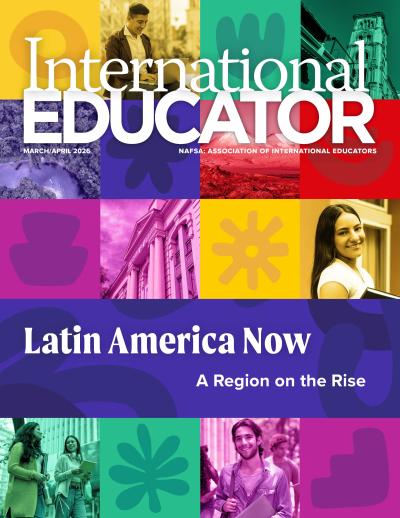
International Educator is NAFSA’s flagship publication and has been published continually since 1990. As a record of the association and the field of international education, IE includes articles on a variety of topics, trends, and issues facing NAFSA members and their work.
From in-depth features to interviews with thought leaders and columns tailored to NAFSA’s knowledge communities, IE provides must-read context and analysis to those working around the globe to advance international education and exchange.
About NAFSA
NAFSA: Association of International Educators is the world's largest nonprofit association dedicated to international education and exchange. NAFSA serves the needs of more than 10,000 members and international educators worldwide at more than 3,500 institutions, in over 150 countries.
NAFSA membership provides you with unmatched access to best-in-class programs, critical updates, and resources to professionalize your practice. Members gain unrivaled opportunities to partner with experienced international education leaders.