
How International Education Shaped a Generation of Changemakers
For many international students, studying abroad is more than an academic credential—it is a reorientation. Navigating unfamiliar systems, confronting structural barriers, and building lives far from home has a way of both expanding their worldview and clarifying purpose.
The seven former international students featured in this article illustrate that dynamic. After concluding their time abroad, they went on to found companies, lead institutions, and shape policy—often to address the very problems they encountered as students. Their work spans financial technology, career development, university access, and higher education leadership, creating impacts for communities in Argentina, France, Georgia, Nepal, Nigeria, Senegal, and Thailand.
These interviews have been edited lightly for flow and clarity.
Ketevan Darakhvelidze
Country of origin: Georgia
Current organization and job title: Chancellor, Ilia State University
Ketevan Darakhvelidze grew up in post-Soviet Georgia and was the first student from her hometown of Gori to receive a U.S. government undergraduate exchange scholarship. Darakhvelidze—a current member of the NAFSA Board of Directors—went on to study at Columbia University and three European universities. She’s now the chancellor of Ilia State University in Tbilisi, where she has helped secure funding for large-scale collaboration projects spanning more than 20 Georgian universities and established the country’s first international doctoral school through a five-year grant with German partners.
Tell us about your experience as an international student.

The first time I stepped onto an airplane was in 2003. I was a teenager leaving a post-Soviet Georgia that was still reeling from civil war, crippled by corruption, and struggling with a shadow economy. Winning a one-year U.S. Global Undergraduate Exchange Program scholarship to study American studies was beyond a dream; it was an absolute turning point, not only for me personally, but for my entire family.
My sister and I represented the first generation in our family to attend university. Landing at American University in Washington, D.C., and later transferring to St. Catherine University in Minnesota opened the door to a dreamlike world that changed everything.
It was my first experience living independently and sharing a dormitory room with an American roommate. I was required to take an academic writing course, which became one of the most challenging classes I had ever faced. Back home, students were rarely expected to write analytical essays or express their own arguments in writing. I even managed to save part of my stipend and purchase a laptop to take back to Georgia. Upon my return, that single laptop became a vital university resource. I used it to help my professors develop syllabi and to teach my peers how to build PowerPoint presentations.
How did studying abroad shape your approach to your work?
My worldview is perfectly captured by a phrase that resonated deeply with me at a recent NAFSA conference: “Talent is universal. Opportunity is not, and that is a design flaw.” I am living proof of this truth. If I am considered a “talent” today, it is only because intentional pathways were built for me at the right time through the deliberate, purposeful collaboration of the U.S. government, the European Commission, and host universities. At Ilia State University, I view it as my life’s work to correct this design flaw by building accessible learning opportunities and ensuring that students from every background have pathways into international education.
What advice would you give to current international students?
After completing your studies, return home. You are the architects of the pathways the next generation desperately needs. Bring back your skills, bring your networks, and use them to dismantle the design flaws holding your country back.
Manu Smadja
Country of origin: France
Current organization and job title: Cofounder and CEO, MPOWER Financing
Manu Smadja grew up in France and came to the United States at 17 to study computer science and cognitive science at the University of Virginia. He is cofounder and CEO of MPOWER Financing, which provides loans to international students from more than 150 countries and territories so they can study in Canada and the United States.
Tell us about your experience as an international student.

I had a ton of fun. I joined a Latino service fraternity and played an insane amount of soccer. My biggest challenge was financial: I could only work on campus, so I stacked up every job I could: tutoring and grading work in math, physics, and computer science and even refereeing indoor soccer. I eventually graduated with my family’s help, but concerns about money were always in the background.
As an international student, I was excluded from much of the U.S. financial system. Without credit, I couldn’t get a student loan, credit card, or cell phone. Even renting an apartment was a challenge—and this was as a student from Western Europe, which has a mature banking sector and a strong currency. I truly felt for my peers from emerging markets, for whom these hurdles were even higher.
How did that experience lead to the work you do now, and what structural barriers are you still focused on?
The core problem I’m obsessed with is simple: The most talented students in the world are routinely denied financing because of where they were born. We’ve proven you can lend to them profitably and responsibly. Last year alone, we helped finance more than 10,000 graduate international students in Canada and the United States. That’s 10,000 lives transformed, with ripple effects for their communities back home.
But financing is only part of the picture. Getting admission into top graduate degree programs and securing financing can only be transformative if students can actually get a study visa. Today, talented students from several countries can’t get visas at all, and there are many more who can theoretically come but whose odds of securing visas are very low.
What advice would you give to current international students?
You don’t have to be at an organization that works on social impact issues or at a nongovernmental organization (NGO) to make a difference. Everything we do has an impact—what we control is its intent and form. If I hadn’t worked in health-care financing at Capital One, in analytics at VistaPrint, and then at McKinsey, I don’t think I could have built a mission-driven organization like MPOWER. Don’t close the door to good organizations or opportunities because of perceived lack of direct impact. What you learn in those early years may be just as important as the direct impact you have.
Pat Chaisang
Country of origin: Thailand
Current organization and job title: Cofounder and CEO, Wayble
Pat Chaisang moved from Thailand to Canada to study at Simon Fraser University in British Columbia, where she struggled with limited English language skills, cultural adjustment, and how to build a career in a new country. She is cofounder and CEO of Wayble, a platform that helps international students navigate their education journeys from enrollment through the beginning of their careers.
Tell us about your experience as an international student.

Unlike many international students, I didn’t come from an international school background, so the transition was challenging. My English was quite limited when I first arrived, and I struggled to keep up with lectures, participate in class discussions, and build friendships. I was adapting to a new culture, learning how to build a life in a new country, figuring out how to gain work experience, and trying to understand what success after graduation would look like. I spent just as much time learning how to live in Canada as I did studying in the classroom.
How did that experience lead to Wayble?
Something as basic as a résumé was completely foreign to me. I didn’t know what a Canadian résumé looked like, how networking worked, or how to approach employers. What surprised me most was that many other international students were experiencing the same challenges.
After going through that journey myself, I started helping other students informally. I created a meetup group and began hosting résumé workshops and career sessions in my apartment. Students would come over, and we’d spend evenings reviewing résumés, discussing interviews, and sharing job-search strategies.
I never thought of it as a business—I simply saw students struggling with the same questions I had struggled with. That realization eventually led to the founding of Wayble. Because the company was born from lived experience rather than a business opportunity, every feature we build is rooted in questions I either asked myself or heard repeatedly from other students: How do I make friends? How do I build a professional network? How can I understand immigration pathways?
What advice would you give to current international students?
Don’t underestimate the value of your international experience. Living and studying abroad develops resilience, adaptability, and cultural intelligence in ways that are difficult to replicate. And don’t wait until graduation to start building your future—the experiences you gain outside the classroom often become the foundation for your career.
Nitin Agrawal
Country of origin: Nepal
Current organization and job title: Cofounder and CEO, Interstride
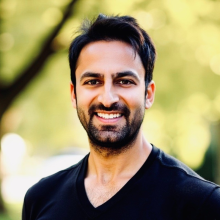
Nitin Agrawal grew up in Nepal and came to the United States to study at the University of Miami. He also studied abroad in the Netherlands and Slovenia before earning an MBA at the University of California-Berkeley. He is cofounder and CEO of Interstride, a platform that helps international students navigate the transition from education to employment.
Tell us about your experience as an international student.
Those years were formative, exposing me to both the opportunities and the structural uncertainties that international students so often face when moving from their education into the workforce.
The year I applied for my H-1B visa happened to coincide with the introduction of the lottery system. I was finishing my final semester abroad in Slovenia, and there was genuine uncertainty about whether I would be able to return to the United States to start my career. A few years later, I graduated from Berkeley in the aftermath of the global financial crisis. The job market was brutal, particularly for international students requiring H-1B sponsorship. That uncertainty pushed me to look beyond the United States, leading to a role with a Norwegian energy investment fund. I worked in Norway and Brazil before eventually returning to the States.
How did that experience lead to Interstride?
Years later, while consulting for MBA candidates who were applying to top programs, I kept seeing the same pattern: highly capable international students making life-changing decisions with limited information, fragmented resources, and minimal institutional support. Interstride was built to close that gap.
Employers need clearer guidance on hiring international talent. Students should not have to spend years navigating uncertainty just to understand their basic options. There also needs to be greater honesty from admissions offices about employment-related realities so students have expectations that are grounded in practical outcomes.
What advice would you give to current international students?
Push back on the assumption that success has to happen in the country where you studied. The world is deeply interconnected, and a career that spans multiple countries often brings a far richer perspective than one that does not.
Bimpe Femi-Oyewo

Country of origin: Nigeria
Current organization and job title: Founder and CEO, Edward Consulting; cofounder, Kinnect
Bimpe Femi-Oyewo came to the United States from Nigeria at the age of 16 on a partial scholarship and earned a bachelor’s degree in political science and sociology at the University of Maryland-Baltimore County and later a master’s degree in international development policy from Duke University. Femi-Oyewo is the founder and CEO of Edward Consulting—which helps African students access international education opportunities—and cofounder of Kinnect, a nonprofit focused on social impact.
Tell us about your experience as an international student.
I arrived with big dreams, a strong sense of responsibility, and an awareness of the sacrifices my family—particularly my single mother—was making to support my education. Transferring schools meant losing my scholarship, and there were moments when completing my education felt uncertain. But those experiences taught me resilience, adaptability, and perseverance. It was also the first time I saw how mentorship, access to opportunity, and support systems could change a young person’s trajectory. That planted the seed for the work I do today.
How did that experience shape the work you do now?
It was only after arriving in the United States that I began to realize how limited the information available to many students had been. Looking back, I discovered that there were universities that would have been a better academic, personal, and financial fit for me. At that time, many of the African students studying abroad were highly capable but underprepared for the academic, cultural, financial, and emotional realities of studying in a completely different system because of gaps in their preparation, support, and guidance.
I was determined to build the kind of organization I wish had existed when I was applying to schools—one where the student’s interests always come first and guidance is honest, transparent, and tailored to the individual. Over the past seven years, we have helped students from more than 10 African countries secure more than $30 million in scholarships and gain admission to leading global universities.
What accomplishment are you most proud of?
One story that stands out is that of Bright Uwakwe, a recipient of the scholarship we established in honor of my late father. Bright was exceptionally talented but came from a background with limited access to global opportunities and struggled with confidence due to a speech impediment. Through our program, we covered his testing, application, visa, and mentorship costs over two years. Together, we secured more than $2.1 million in scholarship offers and admissions to more than a dozen universities. Despite multiple visa refusals, he persevered and eventually secured a fully funded Chancellor’s Scholarship at Appalachian State University, becoming the first international student in that institution’s history to receive the award.
Graciela Guzmán
Country of origin: Argentina
Current organization and job title: Director of Institutional Relations, Instituto Tecnológico de Buenos Aires
Graciela Guzmán was the first person in her family to attend high school, which was made possible by a Rotary Club scholarship she received at the age of 11. She later completed the Hubert H. Humphrey Fellowship Program at the University of Minnesota and is now director of institutional relations at the Instituto Tecnológico de Buenos Aires, where she oversees alumni engagement, fundraising, and events.

Tell us about your experience as an international student.
I had the honor of being selected for the Hubert H. Humphrey Fellowship Program, a Fulbright and U.S. Department of State initiative, at the Hubert H. Humphrey School of Public Affairs at the University of Minnesota. My 2011–12 cohort focused on public policy management, economics, and institutional development. I tailored my plan to focus on fostering the inclusion of vulnerable youth in education and expanding their access to first-time employment. This topic is my life’s passion and mission.
The most enriching part lay in the diverse networking activities, professional development, and close collaboration with Minnesota state agencies and third-sector organizations. During those 10 months, we immersed ourselves in the community, connecting with professional peers, students, university professors, business leaders, government officials, NGO leaders, and members of multilateral organizations.
How did that experience shape your career?
It deeply shaped me and opened doors for me to give back everything I learned to my country and the world. In 2018, I was called upon to serve as secretary of state in the Ministry of Labor and Employment of Argentina, and I had the honor of representing Argentina as vice-chair at the 2019 G20 summit in Osaka, Japan, where youth employment was a primary agenda item. Sitting at the discussion table with the ministers of labor from the other G20 member countries was a massive honor, one that was made possible by everything I learned during my exchange. It enabled me to understand different perspectives, find opportunities for dialogue, and see that these issues transcend our borders.
What advice would you give to current international students?
Return to your home countries to share your experiences, insights, and connections. It is impossible to undergo an international exchange and remain unchanged. Strive for a broader purpose beyond personal or individual interests—an international experience nurtures the way we see the world, enabling us to improve it.
Yasmine Aboubacar Sedikhe SY
Country of origin: Senegal
Current organization and job title: Deputy CEO and Dean, Supdeco
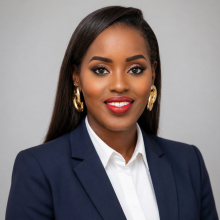
Yasmine Aboubacar Sedikhe SY studied at the Rennes School of Business in France and completed an exchange semester at London South Bank University and a six-month internship in London. She is now deputy CEO and dean of Supdeco, a higher education institution in Senegal founded by her late father.
Tell us about your experience as an international student.
I left for Rennes School of Business at the age of 20, a resolutely international institution where, almost from the very first weeks, my circle of friends spanned Benin, England, France, Ghana, Guadeloupe, Morocco, Nigeria, and the United States.
As a Senegalese Djiboutian woman, Francophone, and someone who instinctively turned toward the world, I had always longed for an international trajectory, and those years gave that longing its form. It was a period of intense formation, during which I learned as much from the geographies of my classmates as from any syllabus.
How did that experience shape your approach to your work?
Studying abroad gave me a comparative eye, yet, paradoxically, it returned me to myself. I came home persuaded of a principle that now governs everything I do: One cannot train African leaders through borrowed lenses. My international years did not dilute my identity; they refined it. Today, at the helm of the institution my late father founded, I work to build a higher education landscape that is globally fluent and unapologetically African—open to the world, yet firmly anchored in its own soil.
What accomplishment are you most proud of?
The accomplishment closest to my heart is not a single project, but a continuity: helping to carry forward, alongside my brother, the institution our father founded and ensuring that it does not merely survive his passing, but flourishes beyond it. To inherit a vision is one thing; to honor it while transforming it for a new era is another entirely. Transmission, for me, is the highest form of leadership.
What advice would you give to current international students?
Leave your country in order to grow and return in order to build. Studying abroad is a privilege, but not an end in itself—it is a preparation. The world does not need more brilliant minds who forget where they came from; it needs builders who carry their education home. •




About International Educator
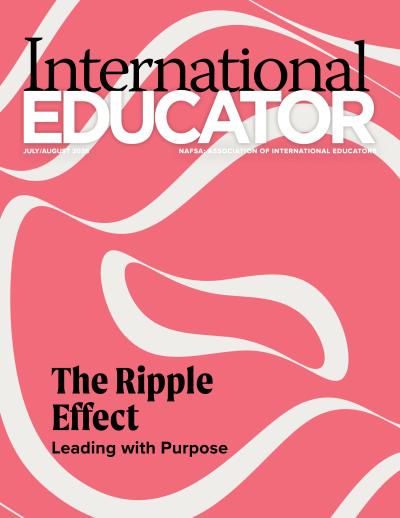
International Educator is NAFSA’s flagship publication and has been published continually since 1990. As a record of the association and the field of international education, IE includes articles on a variety of topics, trends, and issues facing NAFSA members and their work.
From in-depth features to interviews with thought leaders and columns tailored to NAFSA’s knowledge communities, IE provides must-read context and analysis to those working around the globe to advance international education and exchange.
About NAFSA
NAFSA: Association of International Educators is the world's largest nonprofit association dedicated to international education and exchange. NAFSA serves the needs of more than 10,000 members and international educators worldwide at more than 3,500 institutions, in over 150 countries.
NAFSA membership provides you with unmatched access to best-in-class programs, critical updates, and resources to professionalize your practice. Members gain unrivaled opportunities to partner with experienced international education leaders.