
Take 5: Voices from Latin America

In our bimonthly Take 5 column, International Educator poses a thought-provoking prompt to five members of the NAFSA community. These international educators, who represent a diverse range of voices and perspectives, respond with their insights, recommendations, and personal reflections on the myriad themes and questions that are facing the field.
What's one thing international educators should know about the Latin American region?
Juan Manuel Godoy Arias, Fundación Barceló
Latin America is not a homogeneous region, yet across its diversity there is a strong shared commitment to collaboration, adaptability, and innovation.
Students from the region are widely recognized for their talent, resilience, and ability to thrive in new environments. In my experience, this is also true of faculty, researchers, and international educators in the region, who have developed creative and impactful approaches to internationalization while often working with limited resources. This approach is reflected through a strong emphasis on internationalization at home and internationalization of the curriculum, with initiatives such as Collaborative Online International Learning representing one example among many.
At the same time, the region is not always fully recognized for what it has to offer. Latin American institutions bring strong academic and research capacities, which often become more visible once meaningful and sustained collaboration begins.
In Latin America, meaningful international engagement is not driven by short-term objectives, but by relationships built on trust that, over time, create lasting impact.
Marcelo Calle, Universidad del Azuay
One thing international educators should know about Latin America is that the region's internationalization is often driven by creativity and commitment rather than abundant resources. Universities frequently operate in complex economic environments, yet they have developed the capacity to build meaningful global partnerships, collaborative research initiatives, and student mobility opportunities.
In my experience working with universities across the region, I have seen that students who pursue education abroad are often motivated not only by personal advancement but also by the desire to bring knowledge, connections, and new perspectives back to their communities. International education is widely seen as a way to strengthen institutions, foster entrepreneurship, and support regional development.
These collaborations can also help shape institutional strategies as well as inform education and innovation policies that are aligned with regional realities. For international partners, this means engagement with Latin America should go beyond recruitment—it is an opportunity to build long-term, mutually beneficial academic partnerships.
Maria Fusca, NAFSA: Association of International Educators
Latin America as a region is so vast and diverse that the true potential of the area's contributions to the field of international education are yet to be fully realized. As institutions in the region build their capacity, create new international partnerships, and navigate longstanding structural obstacles to expansion, student mobility will grow. As it does, the true spirit of Latin America—one characterized by endurance and innovation—can be celebrated in the manner it deserves, to the benefit of the world at large.
Ezequiel Mateo Martinich, Universidad Abierta Interamericana
International educators must consider structural, cultural, and institutional dimensions that shape academic mobility, recruitment, and interuniversity cooperation in Latin America. Structural constraints include economic limitations and disparities across countries; uneven institutional development and quality, which reflect inequalities both between and within national systems; language barriers (particularly for English-speaking destinations); and complex or confusing regulatory frameworks.
However Latin American higher education institutions also demonstrate notable strengths. These include strong academic traditions in fields such as medicine, social sciences, agronomy, engineering, and education, supported by relevant scientific output, as well as a high degree of institutional adaptability to develop joint and collaborative programs, reflecting a contextualized approach to internationalization. For student recruitment, it is essential to recognize that students place high value on in-person experiences, are strongly influenced by family decision-making, and rely significantly on scholarships, financial support, institutional agreements, and opportunities for part-time work to enable international mobility.
Alejandra González Penagos, Universidad de La Sabana
International educators should know there is a historic, ongoing tension between higher education coverage and quality in the region. Policies promoting access have led to a wide proliferation of private institutions, making Latin America the region with the highest share of students enrolled in private institutions at approximately 54 percent, according to UNESCO. Strong national quality assurance systems exist but are not universal, so local partners are essential in navigating these nuances.
Another key aspect is the shift in partnerships. As the region improves its performance and develops institutional capacity, effective international partnerships don't solely provide access and benefits for students and faculty but instead, become long-term, comprehensive, equitable collaborations. In practice, this means moving beyond an extractive approach to engage with Latin American institutions in endeavors that are mutually beneficial. Key areas of focus are strengthening academic networks and promoting science diplomacy to connect global action with local needs. •





About International Educator
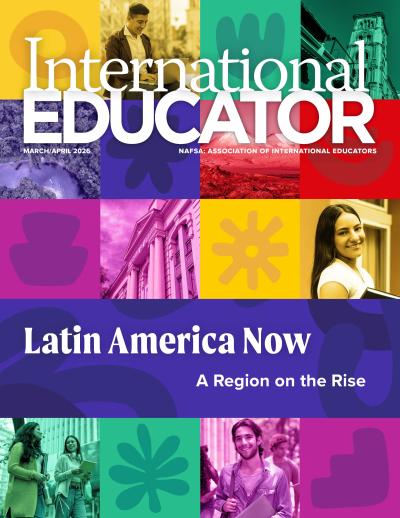
International Educator is NAFSA’s flagship publication and has been published continually since 1990. As a record of the association and the field of international education, IE includes articles on a variety of topics, trends, and issues facing NAFSA members and their work.
From in-depth features to interviews with thought leaders and columns tailored to NAFSA’s knowledge communities, IE provides must-read context and analysis to those working around the globe to advance international education and exchange.
About NAFSA
NAFSA: Association of International Educators is the world's largest nonprofit association dedicated to international education and exchange. NAFSA serves the needs of more than 10,000 members and international educators worldwide at more than 3,500 institutions, in over 150 countries.
NAFSA membership provides you with unmatched access to best-in-class programs, critical updates, and resources to professionalize your practice. Members gain unrivaled opportunities to partner with experienced international education leaders.