

Designing for People: A Conversation with Barbara Bouza
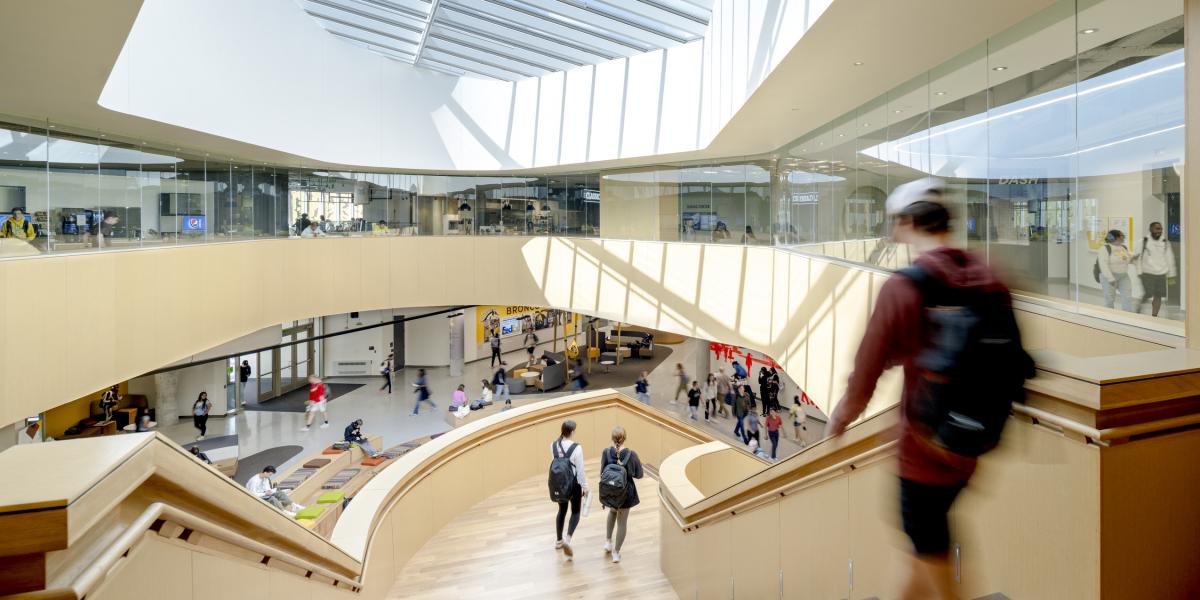
What does a Disney theme park have in common with a university classroom or a corporate office? According to Barbara Bouza, FAIA, NOMA, IIDA, quite a lot—and understanding that connection is key to designing spaces that truly transform how people learn, work, live, and play.
Bouza’s career path through architecture, entertainment, and global design has sharpened a distinctive lens on how people connect with place. A licensed architect with decades in the field, her career spanned some of the most influential names and companies in architecture and design before she became president of Walt Disney Imagineering (Imagineering).

There, she led the global, multidisciplinary team behind Disney’s theme parks, resorts, cruise ships, and immersive experience destinations. She now serves as executive director of Market Strategies & Growth – Live, Work, Play at CannonDesign, focusing on people-centered environments at the intersection of entertainment, sports, workplace, and community.
A fellow of The American Institute of Architects (AIA) and former AIA Los Angeles president, Bouza was also the founding president of Architecture for Communities Los Angeles and is a member of Fast Company’s Impact Council. She also serves on the SCI-Arc (Southern California Institute of Architecture) Board of Trustees.
This month, Bouza will be a spotlight speaker at the NAFSA 2026 Annual Conference & Expo, where she will discuss her global journey of discovery and what it has taught her about designing for human connection. In the conversation that follows, she reflects on those lessons—and what international educators can take from them.
Editor’s note: This interview has been edited for length and clarity.
Your career has taken you a lot of places, from architecture firms to Walt Disney Imagineering and then your current role at CannonDesign. What has been the through line in your work? Is there something across all of those experiences that has driven you?
One area I think about a lot is the convergence of art and science; ideation and technology. They’re not mutually exclusive, but sometimes, especially in architecture and design fields, they tend to get separated.
This idea of deploying both art and science together is important. When I think back early on, I have always loved sketching; I always had access to pencils and pens and paints and paper, whatever I could get my hands on. Then when I was in high school, one of the electives offered was architecture.
Now, I appreciate how that’s not very common at the high school level. When I took that class, it opened my eyes because all of a sudden, I was exposed to design tools. Those tools evolved over time in terms of computer technology, but even back then—there was a tool to draw a straight line. It was very different than fine art and the more technical aspects of it.
One area I think about a lot is the convergence of art and science; ideation and technology. They’re not mutually exclusive, but sometimes, especially in architecture and design fields, they tend to get separated.
It was at that point I thought, how do you take that and how does it become more of the physical environment? I probably didn’t use the term “built environment” when I was young, but I was beginning to understand how ideas resonate with people in shapes and forms.
And then you layer in storytelling and the possibility of bringing it to life. How was that done? That has always resonated with me. I think that’s how I ended up ultimately going to architecture school. And now when I look at my work at Walt Disney Imagineering, one of the ethos of our founder, Walt Disney, was the blending of creative ideation and technical know-how. You can have all the ideas in the world, but you also need to have the technology and expertise to build them.
I would say that’s one of my clear through lines, and it even resonates today with CannonDesign—when I look at the importance of human connectivity in live, work, play communities and talk about the need to balance the physical, digital and live experiences. What’s bringing people out to the physical place?
When Walt envisioned EPCOT (Experimental Prototype Community of Tomorrow) in the ‘60s, his idea was to address challenges facing cities through an ecosystem of residential, commercial, and recreational spaces that interconnect through multi-mobility, transportation, and walkability. He said, “Everything at EPCOT would be dedicated to the happiness of how people work, live, and play.” And so, I thought, ‘Wow, what a full circle moment for me.’
That’s amazing that your high school had a class in architecture. How did your experience with that as a young person inform how you view education?
Another thing that is fascinating is that architecture isn’t necessarily a profession where people say, ‘Hey, I want to be an architect,’ in the same way you hear people talk about being a doctor or a lawyer. I think that’s because most people don’t really interact with architects.
Companies hire architects, or an individual might hire an architect for their home. A great example is the organization Architecture for Communities Los Angeles, which engages people who don’t study or work in architecture by helping kids and families understand they can have an impact on the built environment around them. I didn’t appreciate the impact of my high school architecture class at the time, but when I look back now, I do.
You mentioned this idea of bringing a story to life in different ways. At your upcoming talk at the NAFSA conference you’re going to talk about your own global journey of discovery. Was there a specific moment or a takeaway from your international work that has informed or changed how you think about designing experiences?
Yes, even just going back to when I studied in the graduate design program at the Architectural Association in London. I had already done my bachelor’s degree in architecture in the United States at California State Polytechnic University-Pomona, but after a few years, my husband, who’s also an architect, said, “Hey, let’s go to London!” Having that experience of living in another country early on and picking up the differences, the cultural nuances were really transformative for me.
And specifically, my main professor was Ron Herron, who co-founded the architecture collective Archigram; their philosophy was ‘architecture of the imagination.’ So, it opened my eyes to this very different world. They always reimagined cities and communities through technology and mobility with a global perspective.
I thought that architecture was going to be about designing buildings, but what I realized, especially from a city like London which is very global, is that it’s actually about putting people in the middle of spaces and experiences. You’re designing for people, not for buildings. That doesn’t always resonate right away. For my education, it was good to push me out of the practical, the day to day; I’m not solving for this one corner. It’s about: what are the bigger societal ideas? That was the first time I was really exposed to that.
I thought that architecture was going to be about designing buildings, but what I realized, especially from a city like London which is very global, is that it’s actually about putting people in the middle of spaces and experiences. You’re designing for people, not for buildings.
Fast forwarding, at Imagineering we designed lands and attractions based on the animation hit Frozen. During the COVID-19 pandemic while we were all working from home, I’d be on my computer watching Frozen and my daughter would ask, “Aren’t you working?” I’d say, “Yeah, I’m actually working, I have to watch this over and over.” Imagineers were designing a “World of Frozen” in Hong Kong, Tokyo, and Paris, all at the same time. How do you take a beloved story and bring it to life, but also go deeper with the characters? Because now you can express it in a physical environment, in the attraction, in the food—how does that all come together?
In the Hong Kong Disneyland park, the gorgeous, natural Lantau mountains are already there so we were able to leverage that. The idea is to be unique to the location. But I think what I really learned was it was important to have designers on the team who were local and not just based in the United States There was a rich culture, history and expertise at each park: the Hong Kong park that’s been around for 20 years, Paris for 30 years, Tokyo for 40 years. Talk about depth of story and understanding of how guests engage.
You can do all the research, but make sure you allow room and voice for those who have the lived experience. I think that’s super valuable.
So, there was a shift to thinking we should lead more locally and work together. Even the nuances of the music and animatronics were critical. When we had characters singing, we did everything bilingual; it wasn’t just about translating. We had to truly understand the nuances. I think that’s why those experiences have been incredibly successful. So that’s what I’ve learned: You can do all the research, but make sure you allow room and voice for those who have the lived experience. I think that’s super valuable.
You said you’re not just designing buildings, but you’re designing for people, really. It seems like a lot of your work is really about designing spaces and experiences that bring people together. Why is that hard to do well, and what are some of the successful examples you’ve seen?
I believe what drives people to experience a physical place has fundamentally changed, whether you’re talking about an office, a classroom, a stage, a movie theater, retail, even a sports venue. It’s about how we talk about accessibility and choice. I speak a lot about reducing friction because it’s just human nature. If you make it too complicated or difficult, I’m going to choose not to do it. Going to the office or working from home can be very productive if you don’t have to sit in an hour of traffic. But there’s the part that’s super important about connecting people in person. The unscripted storytelling in the moment, the learning, that emotional connection—that’s when I go back to designing for people. That’s what’s important.
The unscripted storytelling in the moment, the learning, that emotional connection—that’s when I go back to designing for people. That’s what’s important.
One of my favorite projects at CannonDesign is the Hayward Field at the University of Oregon. We actually call it a “theater for track and field.” It’s basically a stage for athletes, whether it’s university athletes or global competitors, because it’s often the venue for Olympic trials and the USA Track & Field championships.
At the end of the day, it’s about how do you elevate performance or understand the stage people will be on? It’s also important that the experience takes the spectator into account, the fan. There is so much interaction between athletes or those “on stage,” so to speak, and those in the audience, because you feed off that energy. So that takes into account the acoustics, the views, the viewing angles, all those dimensions. The other piece I think is incredibly important with Hayward Field, is the storytelling.
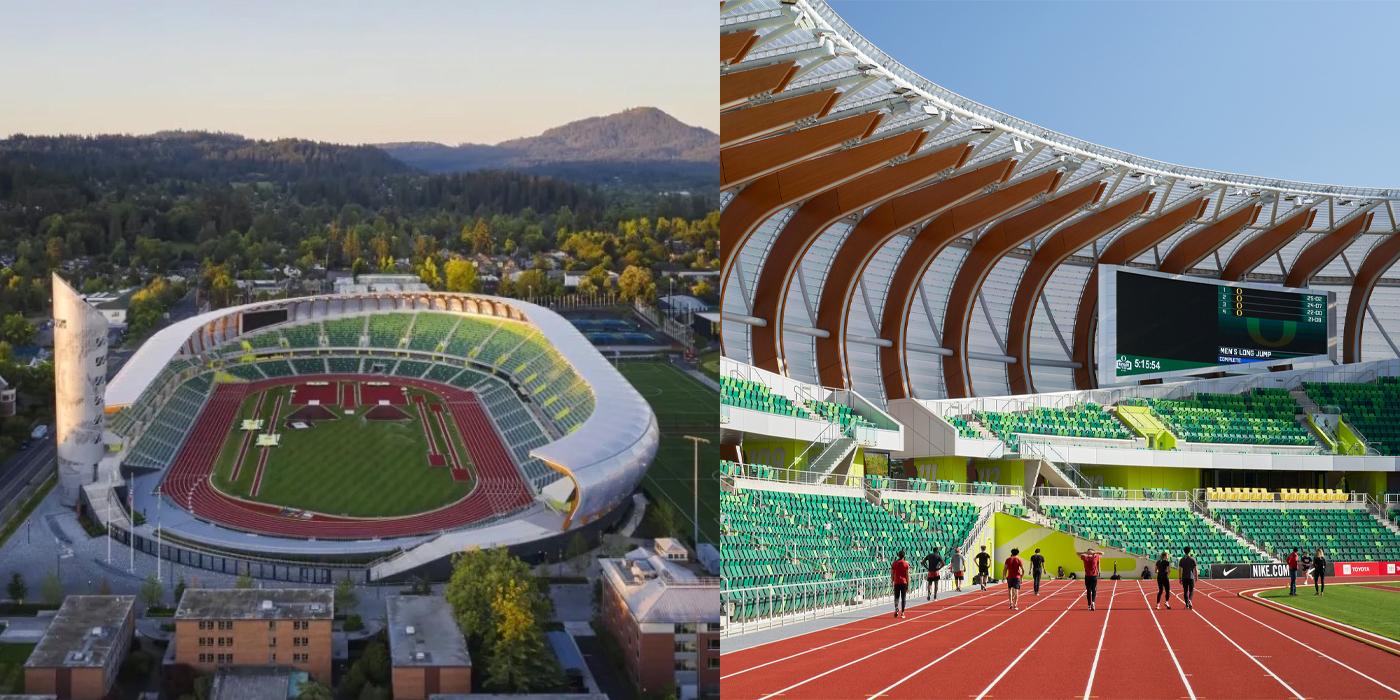
Because it’s so immersive, it doesn’t always have to be so literal. There was a history that took place there, and people somehow resonate with the emotional side, right? There were dreams that came true and goals that weren’t quite achieved. There were great successes. That’s where it’s hard, because every detail has to be intentional and thought through. It doesn’t have to be overly complicated, but it must be authentic. Sometimes, we need to create the canvas and a basic framework. The magic is, obviously, if athletes are successful there—it’s like building a football stadium and the team wins and you get lifelong fans.
I really started to appreciate the impact of the built environment on behavior and performance. That’s where it all starts to come together. It’s hard because not everybody thinks like that. And it’s hard to sometimes even articulate it and sometimes, you don’t need to. You just go there and embrace that it is this amazing experience.
You mentioned that what draws people to a physical place has really changed. What has changed since you started your career? What’s the difference that you’ve seen?
This is probably not even a change but I think everybody can resonate with these notions: “you have to do this” to “you have a choice.” And the value of the choice only exists if there’s actually a legitimate choice. For example, if the norm was school is these set hours, and this is where you learn, and then you go home and do your homework. During the pandemic, working from home wasn’t actually a new concept. Many companies had a little bit of the hybrid model before, but it wasn’t always culturally acceptable. Or, people just didn’t know better; they thought, well, this is how we do it. This is what works.
And then suddenly, that paradigm broke. We started to have choice. It challenged what people were used to, and we would say, “When people come back to work after the pandemic . . .” Well, people didn’t stop working during the pandemic. So this idea of, if I’m in the office, I’m working, and I’m not working if I’m not—it got disrupted and gave people an opportunity. It’s not about just going back to the way it was, we fundamentally changed. Because the choice is elevated. I think it’s just kind of rewriting the fundamental narrative.
You led large, interdisciplinary, and culturally diverse teams during your time at Disney. With all the different areas of expertise, different countries, different perspectives, and points of view, what did you learn about working across cultures with those teams?
At Imagineering, we had more than 100 different disciplines. Everything from architects, engineers, rock work specialists, PhDs, robotics, musicians, story writers, project managers, and more. In my world of architecture, it’s already cross-discipline, but this was at a whole other level. And I loved that. But then expand that all the way across the world as well. What was important was how we make sure people lean into their respective expertise while having the opportunity to explore other areas of interest (a bit like having a college major and minor); for example, a ride engineer who also studied writing or art in college. In the work environment, we tend to want to put people in these categories and say, this is what you have to focus on. It’s eye-opening to let people tell the story from a different perspective. For instance, this engineer had the opportunity to write the storyline for an attraction, it was fascinating to see it through her eyes since she understood the physics, the engineering, and the aerodynamics. Versus, somebody else who could write an equally compelling story, but they’re coming more from a humanities or even a fine art background. It’s a similar story, but from two very different points of view in terms of what they emphasize.
What was important was how we make sure people lean into their respective expertise while having the opportunity to explore other areas of interest (a bit like having a college major and minor); for example, a ride engineer who also studied writing or art in college.
To me, that’s very similar when you look across disciplines or across people from different backgrounds or countries. We recognized that people want to see themselves in a story. Sometimes not every story resonates around the world, and we learned that. And that’s okay. But there are ideals or context such as family, relationships, or even food that transcend words or a specific language.
I can watch a movie in a different language, one I don’t understand, but I still see that connection. It’s going back to the design and the space. It’s recognizing that as a designer, I can’t control, and I’m not going to control, who enters. I really want everyone to be welcomed, but they’re going to experience it differently, and that’s okay. When I say that connected experience brings people together, you could be sitting at an event and you’re elbow to elbow with people from very different backgrounds, very different languages. But what is it that connects you? Is it the story, the history? When I say global mindset, it’s going from the United States with international touch points and locations to being truly global. And when you are truly global, you bring in space for all voices. It’s not just exported one way; it’s an exchange both ways.
For international educators on campuses, so much of their focus is designing programs and experiences that are meant to be transformative for students. How do these memorable experiences work? What are those fundamentals that build on each other to create a memorable experience?
I always recognize that everyone experiences a space or place very differently. I love that line about how we sometimes do not really value a moment until it becomes a memory. I remember finding a picture of myself when I was probably about seven or eight years old at Disneyland with my family, like everybody else’s picture in front of the castle. But what was interesting about this picture is that I’m looking back at the castle we had just walked through. I’m not looking at the camera. I saw that picture and thought, ‘Wow.’ I bet that was me trying to piece together, again, that physical environment of a story that had come to life. My point of bringing it up is, in today’s world, when you look at how easy it is to take pictures with your phone, we’re always striving for perfection. I’m sure when my dad took that picture, he had a camera with 24 pictures on it; you got what you got. But what I appreciate is, it wasn’t like he took 20 shots and said, ‘Oh, you weren’t looking at the camera, let me throw it away.’ The fact that I wasn’t looking told me so much. At times there is more to the story with imperfection.
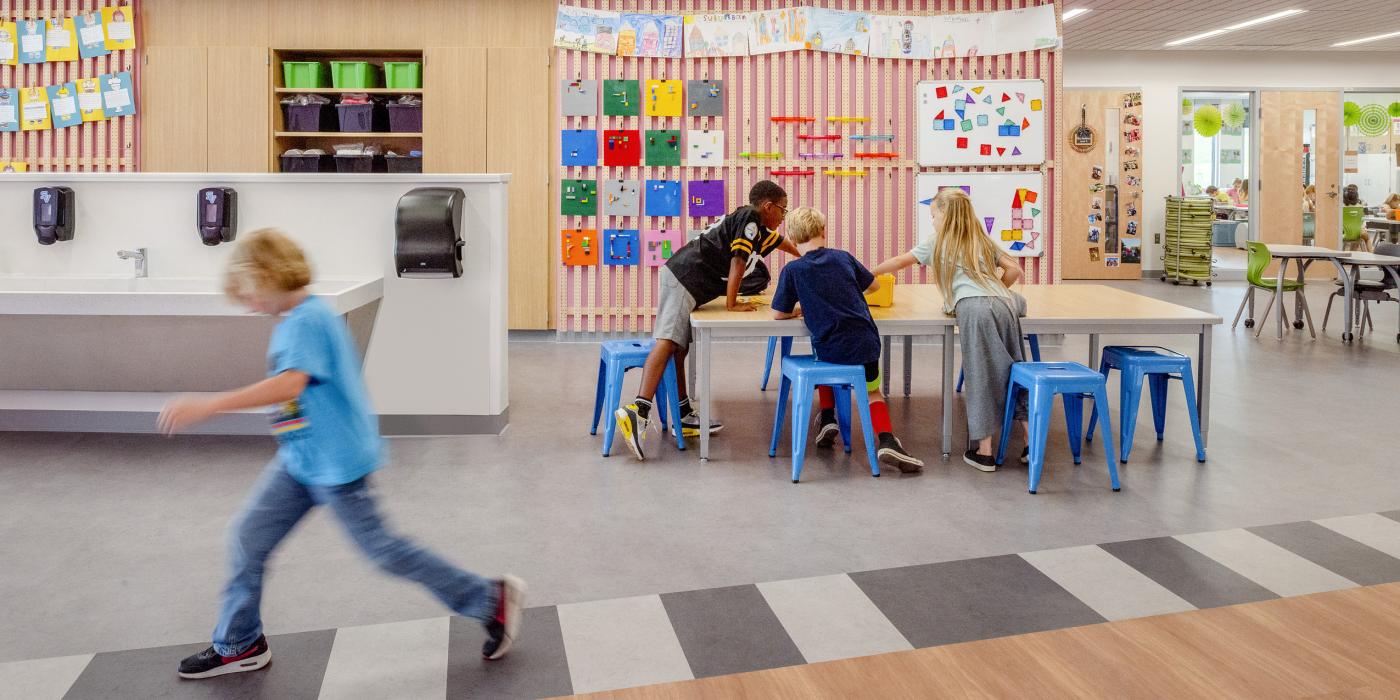
This reminds me of a project that the CannonDesign team did with Ehrman Crest Elementary and Middle School. They collaborated with the Children’s Museum of Pittsburgh and created this learning environment that encourages students to engage differently. Some students are visual learners; some will need a tactile environment. It was this whole idea about using a museum as a model for education. The museum was also saying they have the same problem with trying to get students engaged. It was a great collaboration. TIME recognized that project as one of the top inventions of the year a few years back.
A memorable experience is recognizing that you need the physical, digital or virtual, and the live, the human connection. Those three aren’t silos but become part of a connected ecosystem. A lot of the work I’m doing now is focused on making sure we look at all aspects of that. We did that at Disney, and we’re doing it at CannonDesign amongst the opportunities embedded across live, work, play communities and projects. •



About International Educator
International Educator is NAFSA’s flagship publication and has been published continually since 1990. As a record of the association and the field of international education, IE includes articles on a variety of topics, trends, and issues facing NAFSA members and their work.
From in-depth features to interviews with thought leaders and columns tailored to NAFSA’s knowledge communities, IE provides must-read context and analysis to those working around the globe to advance international education and exchange.
About NAFSA
NAFSA: Association of International Educators is the world's largest nonprofit association dedicated to international education and exchange. NAFSA serves the needs of more than 10,000 members and international educators worldwide at more than 3,500 institutions, in over 150 countries.
NAFSA membership provides you with unmatched access to best-in-class programs, critical updates, and resources to professionalize your practice. Members gain unrivaled opportunities to partner with experienced international education leaders.