
Links in a Mentorship Chain
While working at the University of Buffalo’s English Language Institute as a graduate student, Mariam Assefa recalls Stephen Dunnett, the institute’s director, walking by with a hammer.
“I saw him doing carpentry,” she says. “I learned that there was no job small enough or menial enough that he wouldn’t do it. Those lessons stuck with me,” says Assefa, who would go on to become the executive director and CEO of World Education Services and serve a term as NAFSA president in 2006.
That moment was one link in an unbroken chain of mentors and mentees that has spanned nearly six decades—a chain with countless pairings that have helped international educators develop much-needed skills, map out their careers, provide personal support, and ensure that institutional knowledge is passed along as the field continues to evolve.

“I don’t know if anyone can say in a few words how important mentoring is. It’s invaluable. It involves practical knowledge, subject matter expertise, professional development, and emotional intelligence—all in one package,” says Margarita Sianou, who became one of Assefa’s mentees at WES decades later after Assefa’s time at the University of Buffalo.
But this story begins much earlier, with some of NAFSA’s first leaders, and extends through multiple generations of international educators to the current day—a time when mentoring is needed more than ever, Dunnett says.
“People are looking for fields where they hope they can be professionally developed,” he says. “They need inspiration and hope, and those are the things mentors do.”
Homer Higbee
The first link in this particular mentor-mentee chain was one of NAFSA’s earliest leaders. As assistant dean of international studies and programs at Michigan State University, Higbee published the first comprehensive profile of international education as a professional field in 1961 and would go on to serve as NAFSA president from 1970 to 1971. Today, he is perhaps best known as one of the honorees who inspired NAFSA’s Award for Distinguished Service, and one legacy of his long career is the mentorship he provided to young professionals in the field.
One of those young professionals was Dunnett, who came to the University of Buffalo as a lecturer in 1971. Dunnett had a background in teaching English as a second language but little other practical knowledge about international education.
“[Higbee] had a wonderful professorial side to him, and I liked him as a human being, so a friendship began.”
“I understood the importance of language and culture and had studied overseas, but I didn’t link it together,” he recalls. The university’s foreign student adviser suggested he attend a NAFSA regional meeting, where Dunnett met counterparts from other institutions. “It brought me into a bigger world,” he says.
Soon afterward, Higbee visited Buffalo to assess the university’s international programs under the auspices of NAFSA, and that same adviser encouraged Dunnett to meet with him. “[Higbee] had a wonderful professorial side to him, and I liked him as a human being, so a friendship began,” Dunnett recalls.
Stephen Dunnett
Along with forming a friendship, Higbee became a mentor to Dunnett. He encouraged Dunnett to seek academic rank and “whispered in the ear” of the State University of New York’s (SUNY’s) incoming chancellor, Clifton R. Wharton Jr., about the value of starting a center to help international students master English in preparation for their studies. Wharton reached out to Dunnett, who came up with a design for what would become SUNY’s English Language Institute, which served thousands of students and emerged as a model for other institutions.
All along, “Homer was in the background giving me advice,” Dunnett says. “He was brilliant as an administrator and working with people. He had a vision and a strategic way of looking at things that I didn’t have.”
Other early NAFSA leaders also emerged as mentors, including Hugh Jenkins, who served as the organization’s president in 1965 and 1966 and became its first executive director. University of Minnesota professor Josef A. Mestenhauser, one of the field’s early scholars, helped Dunnett better understand research on campus internationalization, the integration of international students into the campus mainstream, and intercultural communications.
“I had no idea that I would meet seniors in the field who would take an interest in me and mentor me for many years,” Dunnett says. “I didn’t realize I was being mentored, but I knew they knew things I didn’t know, and they were willing to share it with me.”
“I didn’t realize I was being mentored, but I knew they knew things I didn’t know, and they were willing to share it with me.”
Over the next five decades, Dunnett would earn tenure at Buffalo and become the university’s vice provost for international education. He helped lead the SUNY system’s internationalization plans and took on leadership roles in both NAFSA and the Association of International Education Administrators (AIEA), for which he served as president. As he progressed in his career, “I realized I was becoming one of the old guys who once helped me,” he says.
Dunnett calls mentoring relationships “one of the great unanticipated benefits of membership in NAFSA,” and he led efforts to support returning members of the Peace Corps and the military and to formalize mentoring programs within his university. He also remained close with Higbee throughout his career and ultimately received the NAFSA award named after his mentor in 1996. But one of the most meaningful lessons Dunnett learned from his first mentor came much later.
“He said I could repay him by mentoring others, and I have tried to do that over the past 50 years.”
Dunnett visited an ailing Higbee shortly before his death. Dunnett recounts that after telling Higbee that there was “no way I could repay him for all the guidance and advice he had given me in those early years,” Higbee just smiled.
“He said I could repay him by mentoring others, and I have tried to do that over the past 50 years,” Dunnett recalls. Even so, he says, “only much later, looking back, did I realize the debt I owed.”
One of the debts that Dunnett would repay was to a young graduate student who would follow in Higbee’s footsteps by serving as NAFSA president nearly three decades later.
Mariam Assefa
Born in Ethiopia, Assefa arrived at the University of Buffalo as a graduate student. When she applied to work at the English Language Institute, she discovered that her path and Dunnett’s had nearly crossed years before in France, where both had studied at the University of Montpellier.
Assefa says she recognized that along with being an academic, Dunnett also had a “keen sense of how businesses were run.” He encouraged his employees at the institute to learn a wide range of skills.
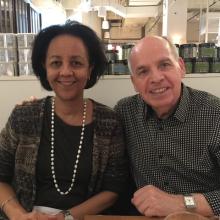
“There was a lot to learn, and I made it my business to learn as much as I could,” she says. “I’d observe how things were done, how he related to staff and treated people, and how things were organized. I asked a lot of questions, and he was open to that. He never said, ‘Stay in your lane,’ and if you were willing to take on added responsibilities, he’d let you.”
Dunnett encouraged Assefa to attend NAFSA regional conferences and wrote a letter of recommendation when she applied for a job as an international student adviser and admissions officer, launching her decades-long career in international education that culminated in leading World Education Services (WES).
As WES grew, Dunnett eventually joined its board, providing advice on adding a research division and expanding into Canada. “He was a very astute observer of situations, and I continued to rely on his advice,” Assefa says. “I knew he had my back.”
Assefa also drew from leadership lessons learned from her time working with Dunnett. “I saw my job as executive director as a person who enabled others to do their work, making sure they had the tools and clearing the way for them by solving problems,” she says. “Those were some of the lessons I learned from working with Stephen that helped me at the organization where I ended up spending the bulk of my career.”
“I’d observe how things were done, how he related to staff and treated people, and how things were organized. ... He never said, ‘Stay in your lane,’ and if you were willing to take on added responsibilities, he’d let you.”
Like Dunnett, Assefa had many mentors, including one who—like Higbee—dated back to NAFSA’s earliest years. Lily von Klemperer, an early pioneer in study abroad, challenged Assefa to publish work relevant to the field to hone her research and writing skills; Assefa would ultimately write a manual on the French education system as part of a U.S. State Department–funded program. “[von Klemperer] felt people didn’t think outside of the box, and she forced me to think along those lines—and do it. It gave me a fair amount of confidence, and it was because she dropped the hint,” Assefa says.
Assefa found herself pushing employees at WES in similar ways. “I pulled on the thread to encourage people to challenge themselves,” she says.
She encouraged colleagues to go back to school, attend training programs, and give presentations. Internal assignments were sometimes designed to help employees break out of their role or learn new skills. She focused on encouraging women moving into management roles to “break through the hesitancy.” And she would work side by side with colleagues as they developed new skills, including rehearsing presentations with her entire leadership team as timers ticked away.
“I always believed in the end that the mentoring that I received allowed me to explore my potential and [thought about] how I could pass that on to others.”
“I always believed in the end that the mentoring that I received allowed me to explore my potential and [thought about] how I could pass that on to others,” Assefa says. “Sometimes people needed a little bit of a push to go places where they never thought they’d be able to go.”
One of those people was a WES colleague who would end up leading the organization’s largest unit before retiring and serving as a mentor for a multilingual library halfway around the globe.
Margarita Sianou
After Sianou joined WES in 1988, Assefa admired her empathy and patience. But she also noticed that Sianou “did not like [making] presentations at all,” Assefa says.
“I had a profound fear of presentations,” Sianou agrees. “I still do.”
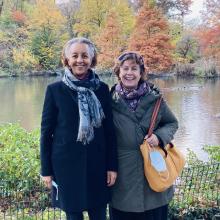
Assefa helped Sianou tackle her fear of public speaking by encouraging her to make presentations to other organizations on behalf of WES, drawing from personal experience to provide support. “She’d say, ‘Let’s do this together,’” Sianou recalls. “Then I would stumble, and she would say, ‘Let’s start again.’ She taught me how to behave professionally, how to talk, how to write my papers. That continued for 30 years.”
Assefa went on to build systems of support for Sianou and other staffers, including processes to evaluate external presentations and review newsletter articles. “If you survived that, you would be okay for the next step,” Sianou recalls.
“It started out as me being the mentee, but later we could gain insights from each other, and we are still excellent friends.”
Assefa recently told Sianou that their mentor-mentee relationship felt a little different because the two were about the same age. That allowed more give-and-take as Sianou moved into progressively senior leadership roles, ultimately becoming deputy executive director and director of the organization’s evaluation services, and their relationship evolved over the years.
“We had differences in opinion, and I know she respected my opinion as much as I did hers,” Sianou says. “It started out as me being the mentee, but later we could gain insights from each other, and we are still excellent friends.”
Sianou, in turn, would continue the thread after retiring and returning to her native Athens in 2017.
The Next Generation
As she readjusted to life in a city she hadn’t lived in since graduating high school, Sianou began volunteering for Greece’s first—and only—multilingual library. Founded by a Greek volunteer, Ioanna Nissiriou, and Nadir Noori from Afghanistan, who served as the coordinator of the Elliniko refugee camp, We Need Books provides multicultural resources, services, and community spaces. Sianou offered the team support and advice on outreach activities, advocacy, and fundraising as the organization continued to grow.
“We went from taking books in shopping bags to refugees in the camps to opening a beautiful library in Athens,” Sianou says. “It’s such a rewarding experience to be able to share and help wherever you can support. All I learned from my mentor is now shared with them.”
“It’s such a rewarding experience to be able to share and help wherever you can support. All I learned from my mentor is now shared with them.”
Providing support beyond the immediate confines of international education is a common thread in this chain. Assefa created a formal mentoring program at WES near the end of her career—but one with an external focus. Employees were given release time and training with a community-based organization to mentor recent immigrants and help them navigate job searches and interviews. The one criteria? Employees had to sign a contract promising to stick with the program. “We didn’t want to abandon our mentees,” Assefa says.
Continuing the Cycle
A commitment to supporting those entering the field has taken on new meaning lately. Dunnett recalls a panel discussion during recent conference when a student asked if they should pursue a career in international education. Some of the responses were lukewarm at best. “People are looking for reassurance that the work we do has never been as important as it is today, that the pendulum will swing back,” he says.
And so the cycle continues. Members of this mentorship chain point to the unique nature of international education and the value of support from more seasoned practitioners. “You can study international education and transnational education, and practitioners who work in the field have conferences to go to and learn, but mostly they have each other,” Sianou says. “It’s almost like storytelling—knowledge is transmitted, and people are committed.” •
Lessons Learned
Mentoring in the field has often been self-taught. “We had no professional training to be mentors,” Dunnett says. “We learned from others and did what we thought was best.” Even so, mentors and mentees shared some advice from their experiences.
- Mentoring often looks like something else. In the absence of formal mentoring programs, relationships are often informal and organic. “Mentoring to me is a light touch,” Assefa says.
- Trust is the crucial ingredient. But a willingness to listen and observe is close behind.
- Helping mentees identify blind spots is key. One reason trust is so critical is that strong mentors can help challenge weaknesses in their mentees. Dunnett, for example, encouraged Assefa to become more flexible in her relationships with colleagues. “There were areas where I could be totally blind,” she says.
- Create—and support mentees through—real challenges to build confidence. “What holds people back—both men and women—is lack of confidence. We are our worst censors,” Assefa says. “People need to achieve something to build their self-confidence. It can’t be something minor.”
- Mentees have responsibilities, too. Mentees should be open-minded, willing to open up about challenges and weaknesses, and able to hold back expectations that their mentor will solve problems for them. Also, mentees “have to come to [the mentor] more than you’re going to them,” Assefa says.
- Not every mentor-mentee relationship is a great fit. “Some people are not interested. They have to be comfortable,” Assefa says.
- There is rarely a single mentor in a mentee’s life. Professionals point back to multiple people who helped them at different stages of their career.
- Mentoring is uniquely rewarding. “It was one of the great experiences of my life,” Dunnett says.





About International Educator
International Educator is NAFSA’s flagship publication and has been published continually since 1990. As a record of the association and the field of international education, IE includes articles on a variety of topics, trends, and issues facing NAFSA members and their work.
From in-depth features to interviews with thought leaders and columns tailored to NAFSA’s knowledge communities, IE provides must-read context and analysis to those working around the globe to advance international education and exchange.
About NAFSA
NAFSA: Association of International Educators is the world's largest nonprofit association dedicated to international education and exchange. NAFSA serves the needs of more than 10,000 members and international educators worldwide at more than 3,500 institutions, in over 150 countries.
NAFSA membership provides you with unmatched access to best-in-class programs, critical updates, and resources to professionalize your practice. Members gain unrivaled opportunities to partner with experienced international education leaders.