

Take 5: Lessons in Leadership

In our bimonthly Take 5 column, International Educator poses a thought-provoking prompt to five members of the NAFSA community. These international educators, who represent a diverse range of voices and perspectives, respond with their insights, recommendations, and personal reflections on the myriad themes and questions that are facing the field.
What do you think is the most important quality for leaders to have? What does it look like in practice?
Jim Brosam II, Eastern Illinois University and Jameson Global
For me, the most important leadership quality is a commitment to team building. I believe in the power and efficacy of teamwork. I believe in the concept of “paced growth,” meaning aggressive but achievable progress that can be quantified in terms of measurable results for the unit and for each team member.
As a leader, I work hard to provide the training, support, and resources that each team member needs to succeed. I support worker flexibility and work-life balance with empathy. I support diversity and access in the workplace, including through an appreciation of different generational workforce needs and approaches. I understand that unit performance in enrollment, standards, financials, and other areas is ultimately my responsibility, and sometimes getting the best performance requires making difficult decisions. Nevertheless, my career experience has been that creating a supportive team environment—and a written, measurable strategy or operations plan—can lead to an organization achieving amazing results.
Franny Henkel, University of Kentucky
The quality I value the most in the leaders that I admire is empathy—the emotional intelligence to develop a vision that prioritizes goals from multiple perspectives. The leaders who lean into this quality are able to provide what’s needed to do the work and to really recognize how that work can best serve the community. Leading with empathy can strengthen an organization because it aligns goals in a way that sets up the most natural environment for collaboration.
Roopa Rawjee, Illinois State University
In my experience, the most important leadership quality is humility: an open mind, a willingness to accept feedback, and the ability to reflect on one’s communications and decisions to support a cycle of continuous improvement. In practice, humility keeps me accountable by challenging my assumptions and encouraging me to seek diverse perspectives. It reminds me that the strength of a team lies in its collective insight. Humility helps me value intercultural and intergenerational viewpoints so that I can better serve my students and stakeholders. When employees tell me they appreciate the warm, supportive work environment I’ve created, their feedback affirms that I’ve fostered psychological safety and an environment where people feel respected and empowered to contribute. Empathy shouldn’t be confused with likeability: A leader who is humble is inclusive, communicates openly, builds trust, and consistently takes ownership of deliverables as well as people development.
Tina Rousselot de Saint Ceran, Georgia Institute of Technology
International education work is shaped by forces that no single leader controls: shifting policies, geopolitical tension, funding swings, global health crises. In this volatile environment, the most important quality a leader can have is curiosity: a genuine willingness to keep learning and to stay open to how people, systems, and events are interconnected.
In practice, this quality means asking good questions and staying open to what a situation requires of you. When a partner announces a sudden policy change, a curious leader treats it as a puzzle to work through with the team rather than a crisis to manage alone. When told that a program isn’t being received as intended, the leader receives this constructive feedback as useful information and adjusts the approach. When a semester brings a genuinely difficult experience—such as a natural disaster or funding cuts—a leader who is committed to learning looks for what the experience reveals about the system, rather than simply reacting to the challenge.
There are other leadership qualities that matter, including integrity and compassion, but they serve different purposes: They shape how a leader treats people, while curiosity shapes how a leader responds to conditions that keep shifting. An interest in learning is the quality most likely to carry leaders through the uncertainty that defines international education work.
Brian Seilstad, Al Akhawayn University, Ifrane, Morocco
I really try to say yes to as many things as possible—not as a rubber stamp, but rather out of openness to new ideas, the creative spark, and the search for new ways to collaborate, whether within our own institutions or beyond them. This approach also requires forward thinking, planning, and learning rather than relying on existing formulas. That said, sometimes a “no” is necessary but only on firm principles, such as to address basic misalignments of institutional objectives or inappropriate imbalances of power. These decisions then need to be communicated in a reasonable, respectful, and transparent manner.
Elena Selezneva, Northern Arizona University
I believe the most important quality for leaders in international education is the ability to inspire and motivate. A good leader sets proper expectations and includes team members in the pursuit of overall goals while also developing and building on staff´s individual expertise and interests and creating a space where team members feel empowered to contribute. This validates people and deepens their sense of belonging. It’s important to regularly remind people about the importance of what they do, how their impact is real (for students, families, and the community at large), and how their work helps students develop and changes their lives.
By paying special attention to each individual’s needs and interests for achievement and growth within the scope of an organization, leaders promote a culture of lifelong learning, establishing positive expectations and creating a path for the development of the next generation of leaders in international education. •












About International Educator
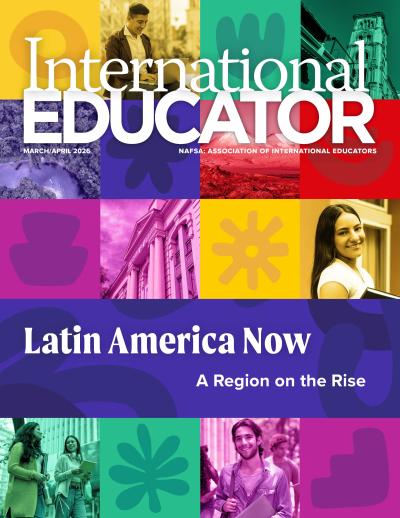
International Educator is NAFSA’s flagship publication and has been published continually since 1990. As a record of the association and the field of international education, IE includes articles on a variety of topics, trends, and issues facing NAFSA members and their work.
From in-depth features to interviews with thought leaders and columns tailored to NAFSA’s knowledge communities, IE provides must-read context and analysis to those working around the globe to advance international education and exchange.
About NAFSA
NAFSA: Association of International Educators is the world's largest nonprofit association dedicated to international education and exchange. NAFSA serves the needs of more than 10,000 members and international educators worldwide at more than 3,500 institutions, in over 150 countries.
NAFSA membership provides you with unmatched access to best-in-class programs, critical updates, and resources to professionalize your practice. Members gain unrivaled opportunities to partner with experienced international education leaders.