
Recruiting in a Diverse Region: Strategies to Tap into a Growing Market

In recent years, Latin America has emerged as an increasingly dynamic region for international student recruitment. Recruitment of students from this region reached an all-time high in 2024–25, according to the most recent Open Doors Report on International Educational Exchange.
Some countries have seen double-digit growth during the past five years in the number of students matriculating at U.S. institutions, including Peru (a 41 percent increase), Argentina (30 percent), Colombia (27 percent), and Chile (20 percent). Brazil, Colombia, Mexico, and Peru now rank among the top 25 sending countries for international students in the United States.
Most Latin American students choose to study at institutions in states that border Mexico or have large diaspora populations where students can tap into familial and cultural connections, according to a joint report by the Institute of International Education and the Center for Strategic and International Studies; the top receiving U.S. states for Latin American students are Florida, Texas, and New York. But geography and demographics are only part of the picture.
For U.S. institutions looking to expand their pool of Latin American students, recruitment in the region takes thoughtful preparation and strategy.
Recruitment professionals with experience in the region say strategies are and should be as diverse as the region and program goals, but some tactics can help move the needle no matter the country.
Clarify Your Value Proposition
According to experts, lack of familiarity with many U.S. states and institutions is one of the biggest obstacles to recruiting in the region.
California State University-Long Beach (CSULB) has invested in recruiting in the region for more than a decade. Nevertheless, "California is not always top of mind [for Latin American students]," says Sean Cochran, director of international enrollment management (IEM) at CSULB. "That means we have to be more intentional in positioning both the state and CSULB: emphasizing academic quality, career outcomes, industry connections, and the distinct advantages of studying in Southern California."
Familiarity with a specific institution or state is only part of the challenge—students may also need help understanding what a U.S. degree offers them. "Trying to make sure students understand the value proposition of a U.S. degree can be a challenge," acknowledges Jill Blondin, vice provost for global initiatives at Virginia Commonwealth University. The value proposition, Blondin notes, is rarely one-size-fits-all. "Perhaps [the] value proposition is for them to study something they could not study in their home country or at an institution that's higher ranked."
Some recruitment professionals may underestimate the level of academic rigor within the region, says Adria Baker, who spent 27 years as associate vice provost for international education at Rice University (Rice) in Houston, Texas, before founding GlobalEd Moments, a consultancy on international education exchange. "They may not have some of the same labs or facilities [that some U.S. institutions do] but you will find that their research work and understanding is really strong."
High competition for top universities in some countries, explains Blondin, means that there's a pool of highly qualified students looking for a similar match abroad. "Reputation and rankings are very important to students from Latin America," she emphasizes. Highlighting any notable rankings, institutional and faculty awards, and distinctions can go a long way in attracting these students.
Build from the Grassroots
While planning and strategy are important in any recruitment initiative, Baker cautions against adopting a hubristic mentality. "One thing that is really important with Latin America is that it's not just 'let's get a return on investment and we've got this plan.' It's [about] true relationship building," she says.
To begin developing authentic relationships within the region, Blondin suggests starting with a deep dive of institutional data—to ascertain which Latin American countries are already represented in your student body, faculty, and alumni—and then building interest from there. For IEM professionals who are new to the region, Baker and Blondin both recommend focusing on just one country.
Baker then suggests developing country-specific "special interest groups," like the one she convened on Rice's campus to build momentum for recruiting in Costa Rica. The group was composed of students, faculty, and staff from that country as well as representatives from the Costa Rican consular office in Houston and others with a special interest in the country. They would meet for brown-bag lunches to brainstorm ideas.
"It was very grassroots, but it really helped us [to] connect," says Baker. "Even at a large institution, that personal touch is possible and can make all the difference."
Focus on Program Alignment
Institutions should make sure the programs they offer align with the curriculum, knowledge, and academic interests of students in their target countries. For CSULB and other institutions, program preference plays a significant role in recruitment in the region.
"Many high-achieving students in the region are strongly oriented toward professional tracks such as medicine or law," says Cochran. "Since the CSU system does not offer medical or law degrees, that naturally narrows our appeal unless we proactively guide students toward related pathways—such as health sciences, biology, public health, business, or preprofessional advising routes that still lead to competitive graduate outcomes," he shares.
Cochran shares that at the undergraduate level, Brazil has emerged as a strong transfer market, with many students starting at their local community colleges and seeking to complete their degrees at a four-year institution. "For that reason, clearly explaining California's '2+2' transfer model to students and high school counselors across Latin America has proven to be an effective strategy for expanding access and strengthening our recruitment pipeline," he says.
Professional master's programs, which are interdisciplinary and focused on workforce readiness, are growing in popularity, adds Baker. Attract students in this market, she suggests, by offering professional development opportunities such as online seminars or joint research projects.
Consider Cultural Dynamics
As is true across many cultures and regions, families are involved in higher education decisions in Latin America. However, what this dynamic looks like can vary by country or within each country.
"In Mexico and Central America, parents seem to be highly influential [in education-related decision-making], and so we try to lead with what is important to them: safety, return on investment, [and] career outcomes," says Cochran.
"In Brazil, families are certainly involved but students often show more individual agency, especially among private school populations who frequent our events. [So,] we highlight campus life and the 'perks' of living in Southern California. In Colombia and Peru, extended family is also included [in decision-making], and we've seen that there are questions about reputation and prestige that we want to [emphasize] more in our messaging."
During in-country recruitment fairs, experts say recruiters should expect to communicate with students' family members who are not fluent in English. EducationUSA, a global network of advising centers supported by the U.S. State Department offering in-person and virtual recruitment fairs around the world, recommends recruitment professionals include a fluent Spanish or Portuguese speaker on their team. Native-language materials are also expected, says Cochran.
Government-Proof Recruiting
Given the current global economic and political uncertainty, IEM professionals shouldn't rely on in-country government funding programs to bolster recruiting, says Blondin. Instead, they need to government-proof their strategy, she advises, by developing alternative funding models and partnerships.
The Leo S. Rowe Pan American Fund (Rowe Fund), a program within the Organization of American States (OAS), is one such financial aid tool. It supports students from Latin America and the Caribbean in the last two years of their undergraduate or graduate studies. "It's not meant to replace institutional aid at the start, but to serve as a reliable interest-free safety net if challenges arise later," says Lina Sevilano, who manages the Rowe Fund at OAS.
"For many talented students, the real question isn't 'Can I get in?' It's 'Can I afford to finish?'" she says. "When students are carefully weighing return on investment, employability, and long-term outcomes, knowing there is credible support to help them cross the finish line can make all the difference."
Foster Connection
Financial support plays an important role, but students also need to feel a sense of belonging. A good place to start this work is with a look within, to the institution's alumni network. Blondin suggests tapping alumni from your focus countries and those living and working in Latin America to create connections within the region.
Unlike formal recruiting fairs, alumni events can provide a relaxed atmosphere where connection can flourish, says Baker. During her tenure at Rice, the school held ice cream socials with alumni and prospective students in the region. "While strategies should align with institutional missions, passion and personal connections can be powerful tools in building relationships," she shares.
Blondin also emphasizes the need for a continuous on-the-ground presence. "It could be through in-country representatives, agents, or partnership coordinators."
For example, Cochran shares that CSULB's recruitment officers have consistently visited Brazil, one of the school's priority countries, one or two times per year for the past five years to maintain visibility there. CSULB recruiters maintain a presence in the country by attending fairs—such as those hosted by EducationUSA and BMI GlobalEd—making individual school visits and working with recruitment partners.
While CSULB does work with regional agents, most of their Latin American students are not agent-referred, says Cochran. "They have [found CSULB through] word-of-mouth—often from extended family living in the Southern California area or alumni family members—and educational fairs and school visits."
Commit for the Long Term
Regardless of tailored recruitment strategies, relationship building requires a long-term commitment, says Baker. "It can't just be, 'I'm going to parachute in and then I want to recruit your students and I'm going to leave.' You need to get to know the people who are in charge . . . and work to develop a sincere, [trusting] relationship with them."
Recruiting in Latin America rewards institutions that approach the region with curiosity, humility, and a long-term commitment to genuine relationship building. Whether the focus is Colombia or Costa Rica, transfer students or master's candidates, the through line is consistent: know your value proposition, invest in relationships, and show up—year after year. •
NAFSA Resources
- Celebrating Student and Alumni Success Stories: A Collegial Conversation on Model Practices
- Latin America and Caribbean Special Interest Group
- "Partnerships 101"
- The New Global Student: Insights from International School Counselors on Choice, Motivation, and Mobility
- "Recruiting Amid Resource Constraints: Seven Tips"
- "Reflections on the NAFSA IE Competencies: Relationship Cultivation"





About International Educator
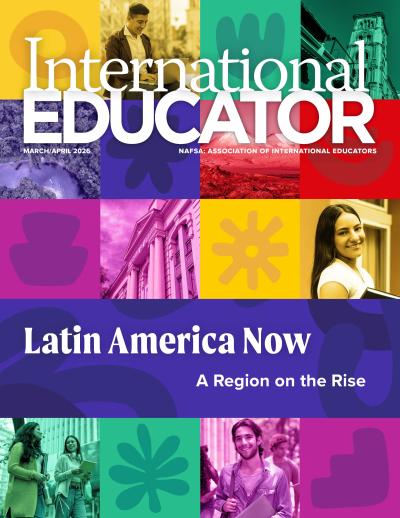
International Educator is NAFSA’s flagship publication and has been published continually since 1990. As a record of the association and the field of international education, IE includes articles on a variety of topics, trends, and issues facing NAFSA members and their work.
From in-depth features to interviews with thought leaders and columns tailored to NAFSA’s knowledge communities, IE provides must-read context and analysis to those working around the globe to advance international education and exchange.
About NAFSA
NAFSA: Association of International Educators is the world's largest nonprofit association dedicated to international education and exchange. NAFSA serves the needs of more than 10,000 members and international educators worldwide at more than 3,500 institutions, in over 150 countries.
NAFSA membership provides you with unmatched access to best-in-class programs, critical updates, and resources to professionalize your practice. Members gain unrivaled opportunities to partner with experienced international education leaders.