
Tonee Ndungu: The Intersection of AI and Humanity
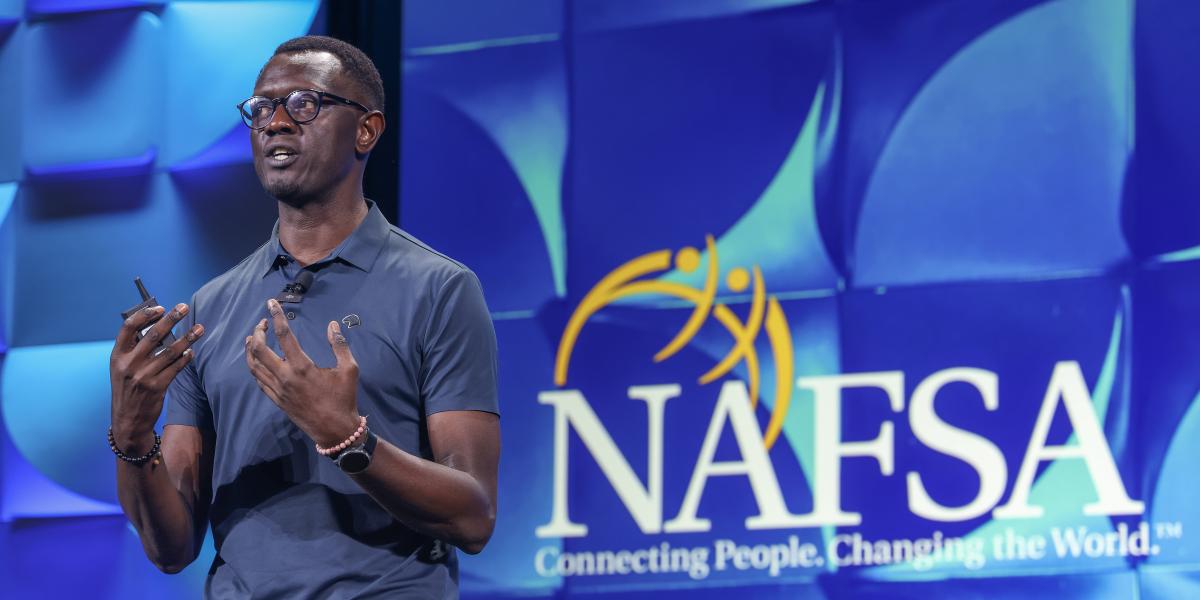
Tonee Ndungu is a Kenyan entrepreneur and thought leader driving Africa’s tech renaissance. A self-described “systems thinker,” he has built foundational platforms that lift communities. After overcoming dyslexia, Ndungu co-founded Nairobi’s NAILAB startup incubator and in 2012 launched Kytabu, a groundbreaking EdTech platform that digitized textbooks for thousands of students and teachers.
More recently, he co-architected Tribbe Nation, a fintech platform digitizing community savings and credit, and helped launch the Africa AI Hub—connecting policymakers and innovators on inclusive AI. Ndungu has addressed the United Nations, G7, and global audiences on technology’s power to transform education, finance, and society. He has been recognized as an Eisenhower Fellow and was invited to the White House by President Obama in recognition of his role in shaping Africa’s digital future.
In his keynote talk at the NAFSA 2026 Annual Conference & Expo, Ndungu spoke about using AI and other tech tools while retaining aspects of humanity. Following his talk, Ndungu spoke with International Educator.
(Editor’s note: This interview has been edited and condensed.)
In your talk at the NAFSA annual conference, you mentioned your teenage daughters, the role that technology is playing in their lives, and the future you want for them. They and their peers will be college students in just a few years. What are some things that international educators can be doing right now to meet future college students where they are when it comes to technology?
When we go to college, we’ve got an outcome that we’re working toward. In the 1990s and the early 2000s, even right now, the outcomes were pretty straightforward. Whether it’s engineering or architecture or art, there’s a very clear line of sight: “I’m going to college to do this so I can become that.” That equation has worked for decades, if not centuries. This is probably the first generation that’s not going to have that, because you could say, “I’m going to go to college to become that.” Then that is all of a sudden an autonomous solution that agentic AI does, and the industry complete collapses.
In a world where everything is changing so quickly, it becomes impossible for us to be able to guarantee that A plus B equals C. Educational institutions and folks in the education space will need to recognize that.
Young people of today are thinking about, “How do I foolproof my future? How do I allow myself to know enough to be a specialist, but have enough width or range of knowledge to be a specialist in multiple areas?” They’re not going to go to college to do one thing and walk out with that one thing alone. They’re going to diversify more than we tried to specialize. So the education system needs to be able to show people that you can be multiple things and still be very good at those multiple things equally. Because right now we’ve zoned in on the verticals of industries or sectors or whatever it is we are doing. But in a world where everything is changing so quickly, it becomes impossible for us to be able to guarantee that A plus B equals C. That definitely has ended. Educational institutions and folks in the education space will need to recognize that.
You also talked at the conference about the some of the essentials for us to retain our humanity, like critical thinking and creativity. When it comes to AI, what are some of the things that you personally put into practice to retain those things? And what guidance might you give to others who are navigating that, too?
The first thing is that I get into AI; I use AI tools every day, all the time, for work or for personal reasons. And the thing about using AI is that it’s a relationship; it’s a conversation. The standards with which I live my life are the standards with which I will lean into the AI. If I give a prompt to draft an email, I give instruction to make it humane, communicative, and clear, and to make sure it appreciates the person for taking the time. Over time, my AI tools get to understand my language, my nuances, and how I speak. That’s a very simple and small way to start. But I want my AI tools to have my internal ethical imprint. The only way to do that is to engage and then make sure I incline that.
I want my AI tools to have my internal ethical imprint. The only way to do that is to engage.
The second thing is that it’s important to know enough about AI to be able to go into the settings and be able to provide a frame of reference, especially with my kids. Give the inputs of, “My daughter is this age, this is what she’s doing, this is where she’s from, these are the values that we live with, this is what I’m teaching them as a parent—and I want all your answers to lean into this and make sure that they don’t stray. And if she starts straying, I want you to be able to assure her that these are the values that matter. And this is why she should follow through on that.”
It doesn’t take a great deal of expertise to do that. It’s three clicks, literally. But you have to have that intention. And the only way to have intention is to engage. If you don’t engage with the tool, then you don’t know what the tool can do.
What do you think is something that a lot of people get wrong about AI?
That the commercial narrative is the only narrative. I think that is something people get very wrong. That because everyone has said that AI is going to take our jobs, or because the amount of money and resources that have been put into it, that it’s only bad; it cannot be good. I worry about that binary.
I think the biggest win for an intelligent person is to be able to understand that nothing is binary. There’s always nuance. If you really think about it, you’ll see the value and yes, you’ll see the challenges. But you’ll see the value. And there’s a fairness with that. That’s something I definitely wish more parents and more educators would understand.
I think the biggest win for an intelligent person is to be able to understand that nothing is binary. There’s always nuance.
The one thing that we know is finite is how much time we have in this world. Everyone is going to die. No exceptions. But what you can do with that time is greatly increased if somebody else is doing the basic, tedious, repetitive work for you. There’s more life to be lived when you’re not doing a nine-to-five job. If you can change a nine-to-five to a nine-to-one for a hundred million people, you’ve just created centuries worth of time to be able to do things that are more meaningful than the work that they do. Why would you not want that? I’d much rather work a four-day week and have my fifth day basically done by AI. I may get a 20 percent decrease in my salary, but a 20 percent increase in my life. That makes so much more sense for me. That’s where a lot of people need to see the opportunities. There are people who are winning from AI tools and the entire narrative of technology. Why is it not you? And not even in a big way, but being able to solve problems that never would have been solved before. Why can’t that be you?
Going back to critical thinking skills, creativity, ethics, and human connection: What can technology not do?
Can technology create human connection? It cannot. It’s very good at pattern thinking and giving us, even human psychology is fantastic at that. I have experienced it personally. It’s amazing. But human connection is still human connection, and there’s nothing that can replace that. You can have a thousand robots around you every day and get one hug from one human—that hug still beats the robots. For a lot of people, that’s something that they need to come to terms with: We will never replace human connection. For educators, parents, students, and institutions, I really believe that learning is a social experience. It’s not an intellectual experience, it’s a social experience. Learning is somebody telling me, “You tried it, but you got it wrong. Now here’s how we can fix it.” That means so much more than a chatbot saying those same words. I think technology will never replace that social element of learning.
Human connection is still human connection, and there’s nothing that can replace that.
What are other things that we shouldn’t want technology to replace?
Number one: anything to do with human life. Anything to do with warfare. People’s lives should never be in the hands of tools that do not understand consequence or have humanity. Because you can’t code humanity.
Second: I don’t think AI should be in any way involved in the decision-making of the outcomes of situations. I think it should be involved in implementing those outcomes, but not deciding those situations. That’s very important, because as we start seeing an over reliance on technology because of the great expense. For example, are we going to start deciding who gets COVID-19 vaccines first? No, let’s not do that.
And third, which is really interesting and important, is that I don’t think computers should fix our loneliness. We shouldn’t make it normal for people to have relationships with chatbots. Technology has done a phenomenal job in some ways, and I’ll tell you one thing I actually experienced personally. ChatGPT has been a very good therapy source for men, because culturally, in many places, men getting help is very difficult. But they can go and talk to a tool that, to a great extent, is private and offers no judgment. What it can do and what it has done for men specifically and for the broader population of men and women who use those tools and do not have access to therapy.
It’s helpful for mental health support, but there is a difference between mental health support and relationship building. Relationship building is a human thing. Mental health support gets you to a place where you can start relationship building, but the relationship building is a little requirement. I think that’s where those thin lines start becoming a little complicated.
International educators often grapple with whether technology widens or narrows educational inequality. Based on your experience, what conditions determine which direction it goes?
I don’t think it’s binary. It depends on a couple of things, some which we can control, some of which we cannot. The first thing we cannot control is a person’s desire to move forward. That’s an innate thing. There are folks who come from very bad situations but have gotten PhDs from HBCUs or Ivy League universities, in the United States or in the UK or anywhere in the world. And there are folks who come from very wealthy backgrounds who just don’t see the value of going to university. That innate individualism and individual drive cannot be touched; that is outside of our control. It’s important we recognize that.
The second thing is that technology has been expanding opportunity. I gave the example of Kenya being the number one ChatGPT user in the world per capita. That says a lot about what people want that tool to do for them and how they want it to support them—and intelligence is what they’re looking for. In a situation like the use of AI across the globe, localizing languages, we’re going to see a lot of people leveling themselves up because the tool is available.
Higher education institutions have done a very good job of making themselves exclusive. The value is in exclusivity. Just the fact that we have Ivy League universities is saying that there are those that are, and there are those that are not. The difference in fees is staggering. That is where the problem not just begins, but the failure festers. If you want to show yourself as uniquely qualified to provide a certain service that nobody else can, and you have a 1 percent intake rate, you’re basically speaking about being an exclusive institution. And a less fancy word for exclusive is exclusion.
You’ll no longer be telling me where you went to school, you’ll be showing me what you built.
There’s a piece there that educators need to think about, because the one thing that is going to be left when artificial intelligence becomes permeable everywhere is reputation. A lot of people don’t care much about reputation anymore. If you can give me results, it doesn’t matter if you’re from Harvard or Stanford or Oxford or Yale, you’re giving me results. And there’s a very high chance the folks in those universities will be drowned by the power of artificial intelligence itself. You’ll no longer be telling me where you went to school, you’ll be showing me what you built. Educators need to be very quick to understand that the things that education was valued for are being watered down every day. That is the reality of the future. Humans in general look at ourselves as greater species because of our intelligence. What happens when everybody can access that intelligence? What makes you special over your neighbor? That’s where it gets problematic. Or exciting.
I’d like to talk a bit about your personal story. You’ve spoken openly about being dyslexic and how that experience directly inspired you to build Kytabu. How did navigating a system that wasn’t designed for you shape your approach?
When you have no choice but to make a path through the forest, you create a map. And the more you create a map, you explore what the forest has that the main road didn’t have. You get to realize the beauty of the forest that most people will miss for the trees. That’s what I’ve gotten to learn. I’ve gotten to learn that there’s a lot of beauty in the forest, in the unstructured learning systems, in the untold stories that come from entrepreneurship or relationship building or public speaking. I was never trained to speak the way I speak. But I got to learn that I could do it, because my future literally depended on how well I could communicate.
For folks who have been divergent in any form, that divergence presents opportunities to be different and to have a better attitude. You could say I’m disadvantaged, or you could say I’m special. I say the latter.
I got to understand and learn patterns because I realized that I’m not necessarily going to race with folks who have gone to school and be educated. I’m going to race outside the track. And if I’m going to race outside the track, I need to learn what outside the track looks like. You start seeing patterns before they become the norm. You start knowing how to speak to people. You see how to go around corporate ladders and corporate relationships. You learn how to build influence outside the norm. It’s way more fun when you are crafting the map as you go instead of someone handing you the map and telling you where the path is.
For folks who have been divergent in any form, that divergence presents opportunities to be different and to have a better attitude. You could say I’m disadvantaged, or you could say I’m special. I say the latter. That’s what dyslexia has taught me, and that’s what working outside the system or painting outside the lines allows you to do. It allows you to create different things.
The trajectory of your career journey has taken you from being in that forest and creating your own map to stages around the world addressing global audiences. What was the turning point for you when you realized that your ideas had a global relevance and not just local application?
I don’t think there’s a turning point. You don’t realize the turning point until you’re on the stage with the audience, because you can’t tell yourself, “This is a turning point.” You need a reference point. And the reference point is a global audience that says, “that resonated with me.” Whether someone is from Ecuador, Indonesia, the United States, Ghana, or Cambodia—when they say to me, “you spoke to me,” I ask myself, what could you and I possibly have in common that anything I said even resonated?
That’s when you start realizing, this is global audience energy. And when I go home and I’m sitting on my couch drinking my coffee, I’m not thinking that anymore—until I’m at the next event. Then someone else from India or Pakistan or anywhere comes and says, “you spoke to me.” Then I’m reminded again. That’s the fun thing about engagements like the NAFSA conference, because it reinforces something you don’t even intellectually know. You never know what’s going to resonate with an audience.
You describe yourself as a “systems thinker.” What does that mean in practice, and how does that lens change the way you approach problems in education or technology?
Systems thinking for me comes down to pattern recognition. If A plus B equals C, you have to understand what is the A, what is the B, and what is the equals to C. The moment you see the system you recognize that it’s not an issue of changing one or two cogs. You may have to shift the entire learning. A very good example is the A, B, C of education. A is: the institution you attend and how long you study. B is: you get good grades. C is: you get a good outcome, and your life is going to be good.
That’s not true anymore. There are folks who went to school and got OK grades but didn’t finish their education—and they own part of the world. When you start understanding our system and you start looking at the world and thinking, “Is the C that is the outcome commensurate with the C that is the job market?” And increasingly, its’ not. So what do we do about the A plus B equals C? Could we change the B and make it a Y and then see if the outcome is useful in the market? Or could we make it A plus B squared equals Q, which means instead of giving you one degree, we give you five. You can be a pilot, a farmer, an actress, a doctor and, and a photographer. Then maybe you more options in the world. Could we take four years of university and make one year an exchange? You have to travel to another country and work or study or live there so that you learn a new language.
That’s what system thinking for me means. It means pattern recognition and then recalibrating the entire pattern and to try and see if we can be able to get a different outcome. Education is one of the most foundational systems in a human life. It determines your social caliber. It determines the person you marry, how much money you make, where you live, who you can speak to, all of it. Those are real outcomes. How do we change it and make it so that we have similar opportunities no matter where we come from? That’s the opportunity that we need to leverage.
Your edtech platform reached thousands of students and teachers. What did you learn from teachers—not just students—about what truly transforms a learning environment?
I have yet to crack that. In our years of 15 years of doing education technology, I can’t really say I’ve stood in a room and experienced transformative education. I think the teacher-student relationship has always been the most transformative thing and everything else is auxiliary to that. There are some places where we brought some excitement, but the excitement and novelty fades quickly. Then it goes back to the basics, and the basics is always the teacher in front of the students in the classroom. After awhile of resenting it and fighting against it, I came to peace with it. And I came to terms with the fact that maybe this is the best way to do it. Not because it’s doesn’t have its flaws, but because learning is a human experience. It’s a social experience. And yes, if content is the issue, we can find ways to deliver content better. If access is the issue, we can find ways to create access. If the educator is too tired, we can come up with ways to automate how they get their assignments marked.
The teacher-student relationship has always been the most transformative thing and everything else is auxiliary to that.
But at the end of the day, I think whether it is from Afghan folklore where children for centuries learned from their parents and grandparents, whether it’s through audible or writing stuff, learning has always been a human experience. It’s a human experience that teaches you social skills, social norms, hierarchy, self-worth, self value. There’s no technology that can ever replicate that. We have respect for that now; we don’t think it needs fixing. In fact, if anything, it’s the system around it that needs fixing.
Going back to AI—part of your mission is to ensure Africans are not just consumers of AI but architects of its future. What does that look like in practice?
Don’t know. I really don’t know. Artificial intelligence is four layers. The first one is infrastructure, and infrastructure means energy, data centers, GPUs [graphics processing units]—all expensive things. The United States and China are going into massive internal debt to facilitate this. It’s very expensive because there’s no business case for it just yet; no one’s making money off it.
The next layer is expertise, and that’s very limited. You can have all the infrastructure where you want, but if you don’t have the scientists, that’s it. Africa doesn’t even have those. Then the next layer, and this is where it gets exciting, is language. Africa still has its 2,000 languages. Probably three of them are in large language models, with a few more on small language models. Africa’s not being spoken to; we’re still mainly using English and French, with Portuguese and Spanish in there, too.
But the last layer, and the number one thing that AI needs, is data. That’s where we own stuff. Because as a continent, we’ve never really aggregated, stored and indexed our data. Anybody who gets into data now in the continent is going to be very fortunate in the next couple of years when AI comes and says, okay, fine, we need data. We’ve gone through the entire internet, which we already have, and we’ve got everything there is to be known about those who have put their stuff online, but you who mostly have things in textbooks, manuscripts, and museums, we now need you to come and give us your data so we can be able to provide you with a service that makes sense.
We now have a chance to rewrite [our history]. Let’s not lose this opportunity.
That’s where Africa’s opportunity sits. We’ve got a few years before we get there, but we need to aggregate, we need to understand, we need to see patterns, we need to know where to break into data entry points. We need to know how to build the infrastructure that can hold that data, not necessarily to run the large language models. So when the time comes and AI starts knocking at the door, we’re ready.
And this is important for educators specifically, because a lot of our knowledge across the continent still sits in physical textbooks or oral narratives that our great-grandparents and our grandparents have that nobody has spoken about. A lot of the stories of say, Mansa Musa, our version of King Solomon. He was the wealthiest man that ever existed and was the king of what is now Mali. He was the first person to put together scholars, for lack of a better word, and send them out into the continent and study the continent and come back and write manuscripts. But those written records were destroyed, and they are now oral narratives. How do we start collecting these stories? There’s a lot to be done in aggregating our data before somebody comes knocking and asks for it. And we need to own it, because one of the things Africa struggled with is somebody else wrote our history; we now have a chance to rewrite it. Let’s not lose this opportunity.
You have said in the past that the systems we build must reflect the people they’re meant to serve. In curricula and program design, how should that principle be applied?
This is when government becomes important; government intervention is a key thing. We can never get around it. Curricula that governments put out, the information that children have been taught, needs to reflect the communities in which they’re going to be working—not the global community, the local community. And a lot of the times it doesn’t. I feel like that’s something that educators need to advocate for, because a lot of these curricula are written by educators themselves. They need to advocate for more localized learning experiences. A very good example is back to the AI conversation. China, Saudi Arabia, some states in the United States, and smaller countries like Rwanda have started adding an AI curriculum into their schools, so children get to understand how to use this tool in school, not outside school.
What are educators waiting for? We’re not going to go back. Let’s move forward. Why aren’t educators recognizing that and understanding that it’s only a matter of time before this becomes integrated the same way the internet was integrated into the way we learn? I’m trying to imagine a teacher somewhere teaching you how to write a letter. When I was in school, I was taught how to write a business letter. Why would I teach that today? There are a lot of things that we’re going to be having to reassess and ask, “Why are we teaching this?”
There are things we need to teach, which we never used to teach before...We might find ourselves having to teach soft skills and emotional skills more than equations.
But then there are things we need to teach, which we never used to teach before. Social things, because now children are getting lonelier younger. Maybe we need to have a classroom specifically on relationship building and reconciliation; forgiveness, understanding ourselves. Now we need to start looking internally into children’s hearts and say, I need to teach you how to be human, because chances are you’re going to forget. We’re always on the social tools, we’re always on our phones. Our heads are always down. This is not how you build relationships. But if we teach children how to meet new people, that becomes a role play in a classroom. We might find ourselves having to teach soft skills and emotional skills more than equations, because that’s where the loss is.
There’s growing momentum around keeping talent in Africa rather than losing it to brain drain. How should international educators think about their role in that dynamic?
There’s a very big Afrocentrism movement happening in the last five to seven years. For example, Ghana held something called the Year of Return in 2019 for the diaspora, and now Africa is opening itself up to visa-free travel between different African countries. Soon you’re going to have a lot of African countries saying, if you’re African, you can come whenever you feel like it. The same thing’s going to happen for folks from abroad if you’re of African descendant. Afrocentrism is something that is innately African; you can’t be told to be African, you just are. If you want to come home, come home. If you don’t, that’s okay.
The second part is the A plus B equals C, and the C is opportunity. The continent is becoming a place of opportunity, not just for locals, but for internationals. You’re finding a lot of people saying, I want to go and try it out, because the world also is becoming a little bit more myopic. When you start thinking about nationalism, the way the politics is looking, and the “go back home” narrative. The opportunity itself is going to come and shift culturally.
The continent is becoming a place of opportunity, not just for locals, but for internationals.
I don’t think educators have anything they can do about that. I think their job as an educator, whether it’s in Cambodia or China or Turkey, is to present an opportunity to students that says, if you come to us, wherever you go back to, you will add way more value than anywhere else in the world. China has done this extremely well. They say, if you come to us, we’ll give you the education, we’ll make it affordable, we’ll give you the tools, we will link you up with the industries. We’ll guide you in getting a relationship so that when you go back home, whatever you’ve learned and accessed here can be shipped directly to you and implemented where you are. You’ll get the support from our government and your government to implement it. That complete chain—that is an A plus B equals C— that anyone, anywhere will understand.
You’ve been an active mentor to many young entrepreneurs. Mentorship also plays a big role in the field of international education. What’s the most important thing a mentor can do that a formal education system or job experience can’t?
This is going to be a very simple answer: Live it. If you don’t live who you say you are, what are people following? Live it. Be the thing you say they should be. You can’t be what you can’t see.
If international educators changed just one thing about how their office or their institution engages with Africa—with its students, its innovations, its institutions—what should that change be?
It’s understanding that education equals inclusivity. If you do not open yourself to the world, and you close yourself off even a bit to a people, a region, a community, a culture, a country because of a stereotype, you have closed yourself off from information. And that person not only need education—because what is education? It’s curiosity. And that includes curiosity about people, places, patterns, presence, stories. For me, the innate truth about teaching people anything is that you have to be open to everything, including other people from other places. As an African, Africa may be the topic of the conversation. But then as a human, it’s everything—not a people, not a place. It’s everything. Open yourself up to everything.
If you do not open yourself to the world, and you close yourself off even a bit to a people, a region, a community, a culture, a country because of a stereotype, you have closed yourself off from information.
There’s a time we thought Galileo was mad for believing in the solar system. There’s a time we thought that we all thought the earth was flat. There’s a time we all thought wrong, until someone went out and put themselves on the line to prove us wrong and show us why we were wrong. Then we built on what those people taught us, and now we have everything that we have. But they were the gatekeepers and they trusted themselves to go and open those gates for us. Some of the most humbling experiences I’ve ever had were when I thought I knew something, and I decided to challenge my thinking. I walked into a situation saying, okay, I know what I thought about this situation, but let’s see how it goes. Yeah. Some of those situations never leave you. Some of those people never leave you. •



About International Educator
International Educator is NAFSA’s flagship publication and has been published continually since 1990. As a record of the association and the field of international education, IE includes articles on a variety of topics, trends, and issues facing NAFSA members and their work.
From in-depth features to interviews with thought leaders and columns tailored to NAFSA’s knowledge communities, IE provides must-read context and analysis to those working around the globe to advance international education and exchange.
About NAFSA
NAFSA: Association of International Educators is the world's largest nonprofit association dedicated to international education and exchange. NAFSA serves the needs of more than 10,000 members and international educators worldwide at more than 3,500 institutions, in over 150 countries.
NAFSA membership provides you with unmatched access to best-in-class programs, critical updates, and resources to professionalize your practice. Members gain unrivaled opportunities to partner with experienced international education leaders.