
Lessons Learned in Crisis

Universities across the United States are confronting a campus climate affected by intensifying political polarization, civil unrest, and at times outright violence spilling into and around academic communities. Peer institutions in other democratic societies face similar pressures.
Political strife and volatility may represent a new challenge for universities in these areas, but for educators throughout Latin America, navigating uncertainty and even volatile social and political environments has long been a feature of university leadership.
"In Latin America, the social function of universities has always been shaped by territorial and historical realities," says Héctor Erlendi Godoy Hernández, vice rector of Universidad de Ibagué in Colombia. "[Latin American] universities operate in contexts marked by inequality, political instability, and social fragmentation. As a result, [universities] assumed roles as mediators, knowledge coproducers, and builders of civic identity."
Luis Kauachi, director of internationalization at Universidad Iberoamericana in Mexico, explains that this commitment to social responsibility was set into motion and codified during the 1918 Córdoba Reform—a student-led movement that began in Argentina and swept across Latin America, reshaping how universities understood their role in society. The reform enshrined the university's social mission, its duty to democratize knowledge and protect academic independence, and established universities throughout the region as platforms for cultural development and emancipation.
Kauachi also points to the Tlatelolco Massacre—the killing of hundreds of student protestors at the National Autonomous University of Mexico by Mexican armed forces on October 2, 1968—as a pivotal modern moment of youth standing against political oppression. The massacre and the subsequent series of demonstrations are observed every year, and the remembrance has become part of the national culture. "It's still very present. It's always in the background," Kauachi says.
Operating in an environment where social unrest and political violence can be part of everyday reality, Latin American educators have adapted by implementing principles they incorporate into their work. Below, Latin American education leaders share advice for their colleagues in other parts of the world who are pursuing educational mission while navigating upheaval and uncertainty.
Foster Trust
To begin with, establishing the university's legitimacy and fostering trust in the institution is crucial, says Rosario Díaz Domínguez, director of international relations at Universidad de los Andes in Chile.
"In many Latin American settings, universities cannot rely only on formal authority to manage a crisis; they need credibility built over time through consistent values, meaningful engagement with society, and visible contributions to the public good through scientific, cultural, and intellectual work," she stresses.
When trust is established, campuses can hold space for disagreement without it escalating into polarization.
In Chile, Domínguez notes, universities are consistently considered among the most trusted institutions in society. This level of public confidence gives universities a unique responsibility and opportunity to foster constructive dialogue and to contribute to the broader democratic culture.
Kauachi observes that the bond of trust within the institutional context is critical. "Don't call external forces in—don't break the bond of trust—unless there's a very visible and imminent threat. Issues should be worked out by the university community and [handled] internally."
Pointing again to the Tlatelolco Massacre, Kauachi notes how that breach of trust by the military has never been forgotten. "It's still alive 60 years later," he says.
Domínguez adds, "One important lesson is that universities can remain spaces for dialogue even in politically complex environments. In Latin America, institutions are often [called upon] to navigate moments of social tension while continuing their academic mission. This experience has reinforced the importance of fostering respectful debate, listening to different perspectives, and maintaining trust within the university community. These are valuable practices for institutions anywhere in the world."
Prioritize Student Voices
Domínguez observes that spaces for dialogue at universities should be meaningfully incorporated into the culture. They shouldn't feel like mere formality or protocol, but rather as real opportunities for conversation and reflection.
"Creating meaningful forums, such as open discussions, moderated conversations, or community dialogues, can help students feel that their perspectives matter. When universities demonstrate that they truly care about listening and engaging with their communities, students tend to value and participate in those spaces much more," Domínguez says.
Cynthia Eve Aird, provost of Galen University in Belize agrees. Aird acknowledges that students in Belize, which doesn't have the same history of social unrest and activism as other parts of Latin America, may think their voices don't matter. To mitigate this, Galen University intentionally helps students become more informed and provides opportunities to become active participants in their democracy.
Kauachi points out that students may be coming from a perspective that educators don't share. "Youth may [feel a mixture] of hope and despair. Students have bottled up frustration. We need to be careful not to aggravate or cause further damage, which may involve sitting down to listen [and] stepping down from the academic 'high horse.'"
Prepare, But Accept the Unknown
It's not enough, however, to foster meaningful dialogue when crises unfold, Domínguez cautions. Institutions should have clear policies and channels for dialogue before tensions arise, she says. This exercise isn't only about trying to predict potential conflicts, but about being attentive to the realities and concerns that are already present within the university community.
"When situations occur, leaders should communicate transparently, listen to students and staff, and focus on maintaining the university's core mission of teaching, learning, and the respectful exchange of ideas," Domínguez adds.
Kauachi echoes the importance of intentional engagement. "Don't go silent. Engage. Speak up when it's needed as an institution. Contribute to social discourse, but contribute in ways that are aligned with institutional values and concern for society."
Yet even with intentional preparation and dialogue, uncertainty still comes into play. Kauachi observes that educators in Latin America aren't daunted by the unknown, being well practiced in navigating instability.
"In Latin America, we fall back onto our roots. We are equipped to deal with uncertainty—it's [the] reality in our everyday context. My advice [to others] is to practice adaptability, resilience, and trust in your partners," Kauachi says. "Be nimble and accept that sometimes you just don't know."
Standing on strong foundations built on trust, open communication, and respect for colleagues and students, Latin American university leaders have thrived throughout a tumultuous history. Their experience should reassure colleagues dealing with daunting new challenges that they, too, can continue to fulfill their educational mission while navigating rising tension and uncertainty. •
NAFSA Resources
Resources:





About International Educator
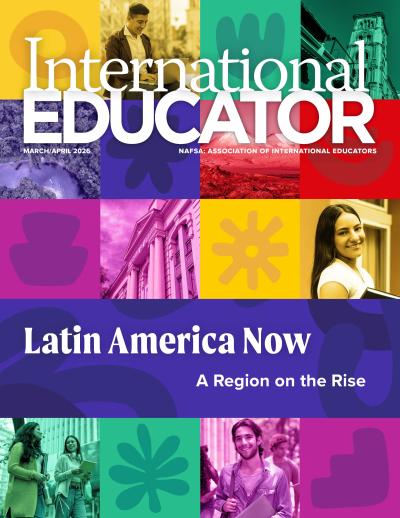
International Educator is NAFSA’s flagship publication and has been published continually since 1990. As a record of the association and the field of international education, IE includes articles on a variety of topics, trends, and issues facing NAFSA members and their work.
From in-depth features to interviews with thought leaders and columns tailored to NAFSA’s knowledge communities, IE provides must-read context and analysis to those working around the globe to advance international education and exchange.
About NAFSA
NAFSA: Association of International Educators is the world's largest nonprofit association dedicated to international education and exchange. NAFSA serves the needs of more than 10,000 members and international educators worldwide at more than 3,500 institutions, in over 150 countries.
NAFSA membership provides you with unmatched access to best-in-class programs, critical updates, and resources to professionalize your practice. Members gain unrivaled opportunities to partner with experienced international education leaders.