
Partnering Across Borders

Every year, San Diego State University (SDSU) and its Mexican university partners, led by Universidad Autónoma de Baja California (UABC), present at the RE:BORDER Conference. The event brings 800 attendees together to explore transborder issues related to migration, the environment, binational education, economic and workforce development, borderlands health, and public policy.
Now in its eighth year, RE:BORDER has been a catalyst for numerous binational research and academic collaborations. SDSU and UABC award seed grants to research teams during the conference’s Think Tank challenge, a pitch contest modeled on the “Shark Tank” television show. Previous grants have supported research toward developing a binational laboratory for infectious diseases, addressing peer mentoring for migrant children, and creating a STEM teaching manual for teaching transnational migrant students attending schools on both sides of the border.
The conference offers attendees the opportunity to understand what is happening in their own backyard. “We’re situated just 15 miles from the border,” says Cristina Alfaro, associate vice president of international affairs at SDSU. “Sometimes, we send students all over the world and we don’t know what’s happening in our own region.”
Shared Commonalities
With Latin America beginning just south of the United States border, and with so much influence from the region within the United States itself, many U.S. universities look to Latin America for partnerships. That’s especially true of institutions in areas that closely identify culturally and geographically with the region, including border states and Florida, for example.
“In a place like Miami, with such pride in Latin America, we enjoy some unique advantages that aren’t always present in other environments,” says Liesl Picard, associate director of the Kimberly Green Latin American and Caribbean Center (the Center) at Florida International University (FIU). The Center, which was founded in 1979 to promote the study of Latin America and the Caribbean in Florida and throughout the United States, sponsors or cosponsors an event every two days. (Both FIU and SDSU received NAFSA’s Senator Paul Simon Award for Comprehensive Internationalization—FIU in 2021 and SDSU in 2025.)
At SDSU, the RE:BORDER Conference is just one example of 42 partnership agreements the institution has in Latin America, including study abroad and research. The close relationship with institutions across the region has benefited both SDSU and its partners. “For us, it’s about developing a reciprocal, trusting relationship, and a lot of times it ends up being like a friendship,” shares Alfaro.
“For us, it’s about developing a reciprocal, trusting relationship, and a lot of times it ends up being like a friendship.” —Cristina Alfaro
Moreover, many universities in Latin America have the same areas of focus as their counterparts in the United States. “What we do have in common are high-quality universities. They all harbor islands of excellence in research and different fields, so there is a lot to offer,” says Marcelo Távora Mira. Until recently, Mira was director for the Office of International Relations at Pontifical Catholic University of Paraná (PUCPR) in Curitiba, Brazil, a position that he held for 12 years.
PUCPR found an ideal partner in Kent State University (Kent State). The two universities formed the American Academy, a dual-enrollment program that allows students to complete their first two years of undergraduate study in Brazil at the PUCPR campus, taking Kent State classes taught in English by Kent State faculty members, and earning academic credit from both universities simultaneously.
“We have a similar profile to Kent State,” relays Mira. “The partnership has generated amazing results over time.”
Characteristics of Successful Partnerships
Many of the core attributes of a fruitful partnership are the same with Latin American universities as with those in any other location. “Successful partnerships require shared academic interests, mutual trust, and consistent communication,” says Andrés Paredes, coordinator of international relations at Universidad de las Américas (UDLA) in Quito, Ecuador.
“It takes time, commitment, and investment to develop meaningful and sustainable research partnerships,” says Picard. “Research is not something you just develop and then parachute in to execute. The most important thing is that we trust one another and have mutual respect.”
A strategic vision for the partnership is also essential. “There has to be strategic thinking from the institution to promote building a relationship of trust between the scientists and the institutions,” says Mira.
“Successful partnerships require shared academic interests, mutual trust, and consistent communication.” —Andrés Paredes
Alfaro agrees. “My advice for anyone trying to start these types of partnerships is to be aligned to the strategic plan of the university,” she recommends.
What doesn’t work is only trying to respond to instability in the region and react to an immediate crisis. “We’re playing the long game,” says Picard. As an example, she cites the Center’s long-standing partnership with organizations in Haiti, which, among other projects, has led to the development of the Digital Library of the Caribbean (dLOC), a cooperative of partners that provides users with access to Caribbean cultural, historical, and research materials.
However, advancing collaboration during a crisis isn’t simple. For example, Alfaro points out that a professor at SDSU has been working on developing a partnership in Cuba for several years to have a research class on literacy development. Due to ongoing and current geopolitical turmoil between Cuba and the United States, Alfaro says that the university’s risk manager put a hold on the partnership. “We cannot take a risk until there is a little more stability,” she relays.
She emphasizes that cultural sensitivity and humility are especially important for a successful partnership. “It’s almost international competence on steroids. A lot has to do with understanding and knowing the culture you are working with.”
“We always value our partners inside and outside the United States as equal players.” —Liesl Picard
Alfaro is fully bilingual. If she’s not participating in a meeting, she finds someone else who is multilingual to attend in her place. “You want to do everything possible to honor your partners’ culture and language and to demonstrate your respect,” she says. “So many times, [partners in Latin America] say, ‘All you Americans talk about is what you can get from us, not what do you bring to the table.’”
Picard echoes that sentiment. “We always value our partners inside and outside the United States as equal players,” she says. “We never thought that we in the U.S. academy have something more to offer than we are receiving from our partners. They make our research projects more robust and make program and project design more complete. We also feel that the results come out in a way that really [address] the research question in a way that’s more comprehensive and informative.”
The Multiplier Effect
When Latin American partnerships succeed, they pave the way for even more partnerships. “Successful partnerships tend to evolve organically, expanding into additional publications, joint grant applications, academic exchanges, or interdisciplinary collaboration,” says Paredes.
“If you are savvy about how you work together, you can have a strong multiplier effect when you are doing outreach to and with other programs,” Picard notes. Moreover, small programs can expand to become major projects.
Twenty years ago, FIU established the Global Waters for Sustainability (GLOWS) initiative, a program that aimed to address the world’s growing water crisis. Today, the project has grown into the Tropical Rivers Lab, whose work includes a collaborative effort to document the importance of the river basins that flow from the Amazon River and the impact that they have on local communities in Brazil, Colombia, and Peru. The project is led by Elizabeth Anderson, an FIU associate professor of earth and environment.
“It’s a collaboration with a diverse set of stakeholders: [nongovernmental organizations], universities, Indigenous organizations, the religious and private sectors,” says Hilary Landorf, executive director of global learning initiatives at FIU. “It also relies on a lot of Indigenous knowledge, with interviews from residents and fishermen and women on how they are sustained by the river and what they are doing for conservation.”
Seeding the Future
GLOWS is just one example of how partnerships can expand and lead to additional engagement between institutions. The RE:BORDER Conference tells a similar story: eight years in, it continues to generate new research partnerships and seed grants that extend well beyond the conference itself, deepening the web of collaboration between SDSU and universities across Latin America.
Landorf says that among the major takeaways of the GLOWS project is that “there has to be time and space for reciprocity in research. Everyone is going to benefit.” The result, she says, is a prime example of how Latin American-U.S. partnerships can succeed.
“It’s the most inclusive project I’ve ever seen,” she asserts. “And I’ve seen a lot.” •
NAFSA Resources
- NAFSA's Guide to International Partnerships: Developing Sustainable Academic Collaborations
- Starting with the SDGs: A Practical Framework
- Engaging International Alumni as Strategic Partners
- “Global Learning for Global Citizenship at Florida International University,” Internationalizing the Campus 2021
- “San Diego State University Transcends Geographic Borders to Build Global Communities,” Internationalizing the Campus 2025





About International Educator
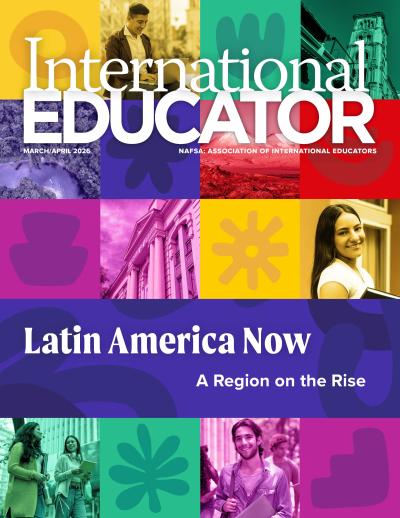
International Educator is NAFSA’s flagship publication and has been published continually since 1990. As a record of the association and the field of international education, IE includes articles on a variety of topics, trends, and issues facing NAFSA members and their work.
From in-depth features to interviews with thought leaders and columns tailored to NAFSA’s knowledge communities, IE provides must-read context and analysis to those working around the globe to advance international education and exchange.
About NAFSA
NAFSA: Association of International Educators is the world's largest nonprofit association dedicated to international education and exchange. NAFSA serves the needs of more than 10,000 members and international educators worldwide at more than 3,500 institutions, in over 150 countries.
NAFSA membership provides you with unmatched access to best-in-class programs, critical updates, and resources to professionalize your practice. Members gain unrivaled opportunities to partner with experienced international education leaders.