
Rooted in Purpose: Latin American Universities Put Social Responsibility at the Heart of Internationalization
When researchers at Universidad Nacional de San Martín (UNSAM) developed Argentina’s first COVID-19 vaccine in 2021—designed and produced entirely in the country—the Buenos Aires–area public university faced a decision on how to proceed. The partnerships it pursued through the vaccine development were guided not by visibility or prestige, but by a single objective: scaling a locally developed solution while ensuring it remained accessible through the public health system.
This story is striking, but it is not unusual in Latin America. Across the region, universities have long operated from a premise in which social responsibility is embedded at the core of institutional identity, rather than layered onto an academic mission. For many institutions, community engagement, social inclusion, and regional development are not additional priorities.
“Social responsibility is not considered a ‘third mission,’” says Héctor Erlendi Godoy Hernández, vice rector at Universidad de Ibagué in Colombia. “It serves as the foundational premise from which teaching, research, and internationalization arise.”
“Social responsibility is not considered a ‘third mission.’ It serves as the foundational premise from which teaching, research, and internationalization arise.” —Héctor Erlendi Godoy Hernández
That perspective traces back to the 1918 University Reform in Córdoba, Argentina, which established three pillars that still shape higher education across the region: teaching, research, and extensión—a concept encompassing community outreach and civic engagement. More than a century later, that tradition continues to influence how Latin American universities define their role at home and abroad.
A Reform That Redefined the University
The 1918 Córdoba Reform did more than reshape university governance in Argentina. It reframed the purpose of the university itself. The movement asserted that institutions of higher education should not function as isolated elite enclaves, but as civic actors accountable to society. It formalized extensión as a central pillar alongside teaching and research—embedding community engagement into the institutional structure.
The reform’s influence spread across Latin America, shaping how universities understood their obligations to society. In 1957, the First Latin American Conference on University Extension and Cultural Exchange (Primera Conferencia Latinoamericana de Extensión Universitaria y Difusión Cultural), organized by the Union of Latin American and Caribbean Universities and known in Spanish as UDUAL, reinforced that orientation. The union defined extension not as a supplementary activity but as an essential mission integrating teaching, research, and engagement with social problems.
“Unlike other contexts in which social responsibility was later added as an institutional function. In Latin America, it has been embedded from the beginning as a core purpose of the university.” —Luis Kauachi
The reform’s spread across the region also generated dense networks of academic solidarity and traditions of South–South cooperation—patterns that continue to shape how Latin American institutions approach international engagement, says Valeria Pattacini, secretary for internationalization and international cooperation at UNSAM.
That history, several educators note, remains central to how universities in the region define their purpose today. “Unlike other contexts in which social responsibility was later added as an institutional function,” says Luis Kauachi, director of internationalization at Universidad Iberoamericana Ciudad de México (IBERO) and chair of NAFSA’s Latin America and Caribbean Interest Group. “In Latin America, it has been embedded from the beginning as a core purpose of the university.”
Sandra Guarín, vice president of international affairs at Universidad del Rosario in Bogotá and chair of NAFSA’s Latin America and Caribbean Forum, points to that same historical through-line. Universities in the region, she notes, have long treated outreach—whether called extension, social projection, or university social responsibility—as central to their identity. “We are not markets,” she says. “We are institutions and communities with our own vision, capabilities, and experience.”
“We are not markets. We are institutions and communities with our own vision, capabilities, and experience.” —Sandra Guarín
That embedded orientation continues to shape how many institutions approach international engagement today—not primarily as competition or brand-building, but as cooperation aimed at strengthening their ability to address shared local and global challenges. In much of the region, a university’s legitimacy is measured not only by academic excellence, but by its contribution to democratic life, social cohesion, and equitable development.
Mission as Method
In practice, the integration of social mission and internationalization looks less like a policy framework and more like a series of deliberate choices on which partnerships to pursue, which research questions to prioritize, and which communities to focus on. Several Latin American educators stressed that this is not a recent strategic turn but a deeply ingrained culture.
Universidad Nacional de San Martín, Argentina
At Argentina’s Universidad Nacional de San Martín, those choices are shaped by the realities of the district the university calls home. San Martín sits in the Buenos Aires metropolitan area, a territory marked by significant inequality, productive complexity, and cultural diversity. “The social inequalities and cultural diversity . . . are not just external conditions but structural elements shaping the university’s agenda,” Pattacini says.
That agenda informed the university’s approach to its COVID-19 vaccine—developed entirely in Argentina—where international partnerships were pursued not for visibility but to scale a locally developed solution and ensure it remained accessible to the public health system.
“The social inequalities and cultural diversity . . . are not just external conditions but structural elements shaping the university’s agenda.” —Valeria Pattacini
The same logic applies to smaller initiatives. A project in the Reconquista River basin, a heavily polluted waterway on the outskirts of Buenos Aires and home to roughly 4 million people, connects UNSAM researchers, local communities, and Canada’s International Development Research Centre to foster intercultural dialogue and inclusion among migrant populations. A community library in the La Cárcova neighborhood, funded through a German Academic Exchange Service grant, uses international cooperation to reinforce local educational access and cultural infrastructure.
More recently, a tuition-free summer school on artificial intelligence (AI) and health—supported through cooperation between the Organization of Ibero-American States and the Andean Development Corporation—has brought cutting-edge global knowledge in AI to UNSAM students regardless of their economic background. “Internationalization is meaningful when it produces tangible institutional and social outcomes,” Pattacini says.
Universidad de Ibagué, Colombia
At Universidad de Ibagué, situated in Tolima, one of the Colombian regions most affected by decades of armed conflict, that tangible impact has taken the form of direct community immersion. The Peace and Region Semester, launched in 2011, sends students into municipalities across Tolima to facilitate dialogue, support cultural mediation, and coproduce local knowledge alongside communities long overlooked by universities in larger cities. Between 2019 and 2023, more than 600 students served as cultural mediators in 17 municipalities, conducting over 150 structured community sessions, according to Godoy Hernández.
The initiative is deliberately designed to position participants—both students and community members—as active peacebuilders rather than passive recipients of post-conflict interventions. One project focused specifically on identity reconstruction and agency, helping communities shift from being perceived as “recipients” of aid to becoming authors of their own recovery, Godoy Hernández shares.
International partnerships, including collaborations with Spanish universities and the Spanish Agency for International Development Cooperation, are built around the same territorial logic. Universidad de Ibagué pursues partnerships that support applied research, sustainable tourism training in rural communities, and projects that combine academic research, artistic production, and psychosocial recovery—such as an audiovisual memory archive developed in collaboration with national and European partners. “Internationalization serves as a multiplier of local impact, rather than an end in itself,” Godoy Hernández says.
Universidad del Rosario, Colombia
At Universidad del Rosario, the question of which partnerships to pursue is answered by the institution’s core values. Their internationalization model is structured around eight principles, including social justice and sustainability, and incoming partnership invitations are evaluated against them, Guarín shares. Recent Erasmus+ projects with European institutions have focused on reducing educational gaps, climate change, and environmental governance. Invitations where profit appears to be prioritized over genuine cooperation objectives are declined.
The university’s Intercultural School of Indigenous Diplomacy, known by its Spanish acronym EIDI, illustrates what that commitment looks like in practice. Launched in 2007, the initiative works directly with Indigenous communities in Colombia facing political marginalization and threats to their territorial rights, pairing students and faculty with Indigenous leaders, community organizations, and nongovernmental organization partners to develop diploma courses and participatory action research. Over 15 years, more than 5,000 Indigenous people have participated in training programs. Working in partnership with New York University, four collective missions have brought Indigenous women community leaders to the United Nations Permanent Forum on Indigenous Issues in New York. This is an example of how the international engagement described by Guarín can amplify local voices rather than replace them.
Alignment with the SDGs
The same logic that shapes which partnerships these institutions pursue also shapes how they approach the United Nations Sustainable Development Goals (UN SDGs)—enthusiastically, but not uncritically. The SDGs have resonated in Latin America in part because they articulate challenges the region has been grappling with for generations. At Ecuador’s Universidad Católica de Santiago de Guayaquil, the framework connects with Indigenous Andean concepts like Sumak Kawsay—a philosophy of “living well” rooted in reciprocity and stewardship—that align with the core logic of the SDGs, says María Verónica Peña Seminario, the university’s director of internationalization.
For her, ensuring that all students—not only those with the financial means to study abroad— develop global competencies is a central institutional priority. Virtual exchanges, joint courses with international partners, and globally oriented projects linked to local challenges have become core tools for what she calls “global learning for all.” “The SDGs are not perceived as an external mandate but as a bridge connecting global commitments with local knowledge systems,” she relays.
“The SDGs are not perceived as an external mandate but as a bridge connecting global commitments with local knowledge systems.” —María Verónica Peña Seminario
That bridge is visible in northern Peru, where Universidad Señor de Sipán (USS) in Lambayeque has organized its community engagement work explicitly around the SDGs, particularly SDG 3 on good health and well-being. The university’s Iron Allies program deploys health sciences faculty and students into vulnerable communities to conduct nutritional education and monitoring in response to high rates of childhood anemia in the region.
Developed in partnership with Peru’s Ministry of Women and Vulnerable Populations, the program has reached thousands of families and earned formal recognition from the ministry. “Engaging with the community is, in many ways, our most authentic form of internationalization,” says Alejandro Cruzata Martínez, rector of USS, “because it compels us to apply global standards to urgent local challenges.”
At IBERO in Mexico, Kauachi welcomes the SDGs as a practical communication tool—a perspective shaped by the university’s Jesuit commitment to social justice—while cautioning against their misuse.
“There is a risk that SDG alignment becomes a branding exercise—a way of packaging existing activities in fashionable terms without actually changing anything,” he says. “Latin American universities are at their best when they approach the SDGs not as a checklist but as a provocation: Are we really addressing the structural causes of inequality? Are our international partnerships genuinely contributing to sustainable development, or are they reproducing the same asymmetries they claim to address?”
“There is a risk that SDG alignment becomes a branding exercise—a way of packaging existing activities in fashionable terms without actually changing anything. Latin American universities are at their best when they approach the SDGs not as a checklist but as a provocation.” —Luis Kauachi
That provocation points to a broader tension the region is actively navigating. As Latin American universities expand their international engagement, the risk is that greater visibility comes at the cost of institutional autonomy—that the pressure to secure international funding, climb global rankings, and attract partners from wealthier systems gradually reshapes institutional agendas from the outside in. “Funding is never neutral,” Pattacini says. “It shapes agendas and institutional trajectories. The challenge is to secure resources without losing direction or autonomy.”
A Century Later
More than a century after students in Córdoba insisted that higher education belonged to society—not the other way around—that conviction continues to shape how Latin American universities engage with the world. The tradition of extensión, born from a student movement and formalized across a continent, remains the animating logic behind decisions about which partnerships to pursue, which communities to center, and what internationalization is ultimately for. “Being international is not about distancing ourselves from our realities,” Pattacini asserts. “It is about connecting them to broader conversations.” •
NAFSA Resources





About International Educator
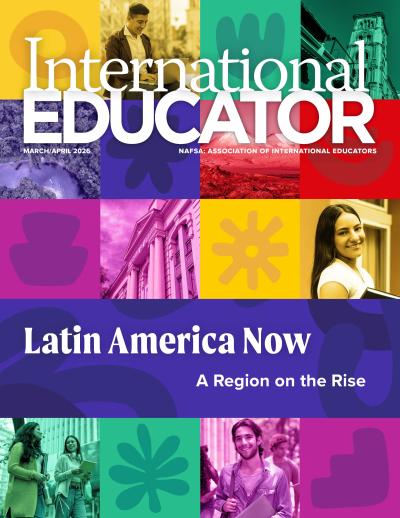
International Educator is NAFSA’s flagship publication and has been published continually since 1990. As a record of the association and the field of international education, IE includes articles on a variety of topics, trends, and issues facing NAFSA members and their work.
From in-depth features to interviews with thought leaders and columns tailored to NAFSA’s knowledge communities, IE provides must-read context and analysis to those working around the globe to advance international education and exchange.
About NAFSA
NAFSA: Association of International Educators is the world's largest nonprofit association dedicated to international education and exchange. NAFSA serves the needs of more than 10,000 members and international educators worldwide at more than 3,500 institutions, in over 150 countries.
NAFSA membership provides you with unmatched access to best-in-class programs, critical updates, and resources to professionalize your practice. Members gain unrivaled opportunities to partner with experienced international education leaders.